Showing posts with label 1950's. Show all posts

Friday, May 3, 2013

The Modern Side of J.C. Penney


“Picked at random, a single J.C. Penney Co. store can be a remarkably unimpressive establishment.” So went the opening line of a long and generally laudatory September 1950 Fortune magazine article about the then nearly 50-year old retailer. The statement was true enough of the majority of J.C. Penney stores of the day. While certainly not unpleasant, a “low-key handsomeness” was about the most one could credit to the typical Penney store design.

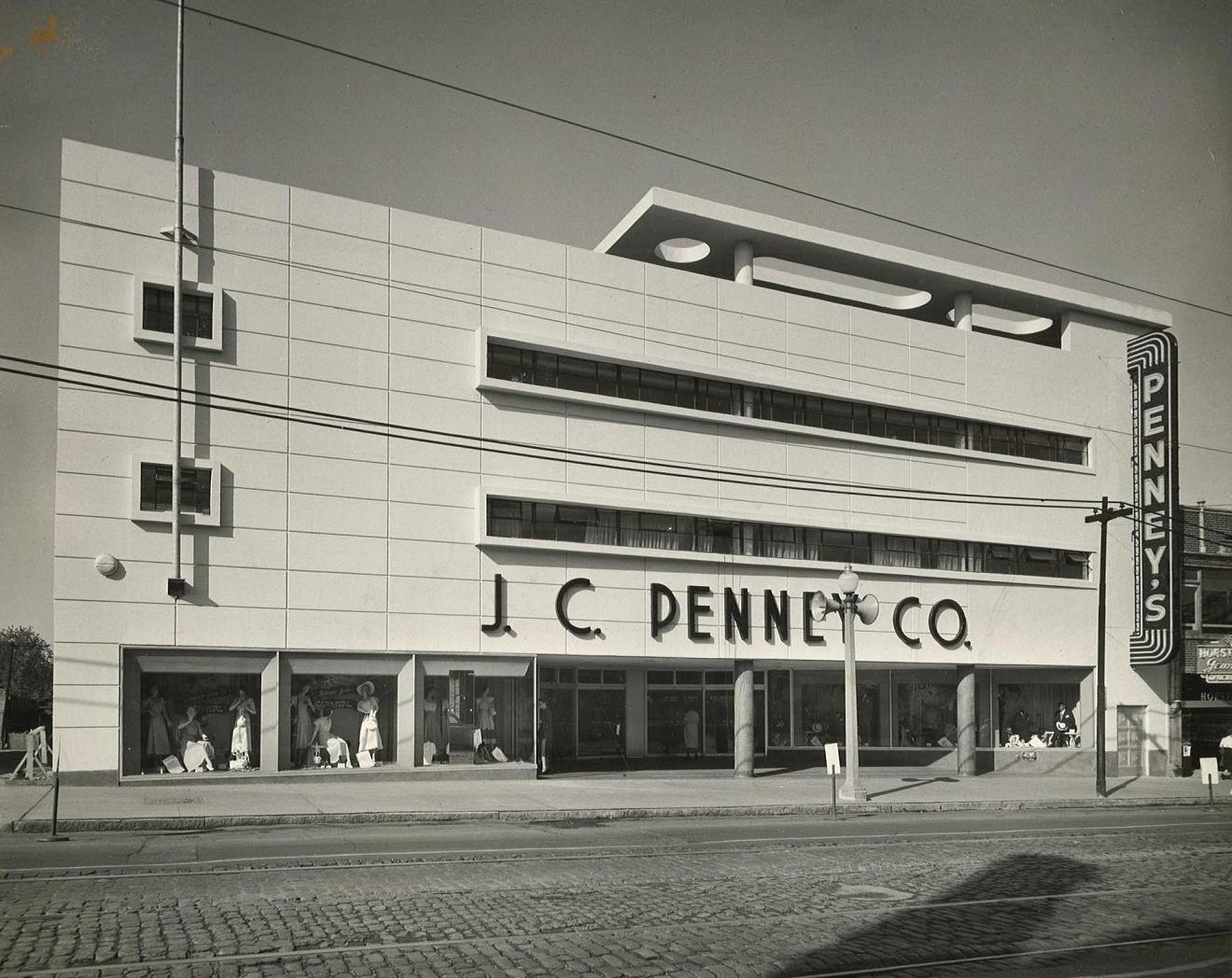
But scattered among their 1,600-plus stores at the time were a number of bonafide architectural gems –fine examples of deco and moderne styling that undoubtedly stood out from their respective city blocks at the time. A fortunate few of these buildings, including the two pictured above, survive today – though neither one has housed a J.C. Penney for years. One thrives as part of a major specialty retail chain, while the future of the other is less assured. In the first photo, the rented searchlight (note the name of the company, “Film Ad Co.” – with all the movie premieres in town, these were probably fairly easy to come by in the L.A. area) is on site and ready to go for the grand opening of the new Penney store at the corner of 3rd Street and Wilshire Boulevard in Santa Monica, California, which opened in 1949.

This store was designed by Milton L. Anderson, a little-known Los Angeles-based architect, who also designed fine-looking Penney stores in San Bernardino and Burbank around the same time. Like his more renowned counterpart, Stiles Clements (the store directly faced a Clements-designed Ralphs grocery store across the street), Anderson designed in the Spanish Colonial Revival style in the late 1920’s, a popular Southern California architectural motif in the era just prior to the advent of art deco/streamline moderne, which he later embraced.

The specific style of this building, according to a 2006 City of Santa Monica Landmark Assessment and Evaluation report, is classified as Late Moderne, a school that “borrowed the horizontality, curved canopies, and curved corners from the Streamline Moderne style, and the flat roof, window bands, and boxy form of the International Style… Broad cantilevered rectilinear or curved canopies were also a character-defining feature… (as were) soaring sign pylons that dominated (a) building’s facade.” The report underscores the store’s most notable design feature, the “cylindrical fluted tower on the building’s northeast corner that rises above the roofline to form a prominent anchor to the retail store building as seen from Wilshire Boulevard and 3rd Street.”

The store (which replaced J.C. Penney’s original 1930’s-vintage Santa Monica unit at 1328 3rd Street, just up the block) both predated and survived Penney’s “full-line era”, roughly the early 1960’s through the early 1980’s, when the company sold large appliances, sporting goods, automotive and other assorted hard goods in addition to the Penney staples of clothing, linens, towels and the like. In all likelihood, the Santa Monica store, due to its location and relatively small size, never ventured far beyond the company’s traditional soft goods offerings.

In 1965 a three-block area of 3rd Street, encompassing the Penney store and other retailers, was closed off for conversion to a pedestrian mall. Known since then as the “3rd Street Promenade”, it remains successful today, no doubt owing to its limited scope, successfully avoiding the pitfalls of overreach that have doomed conversions like it in other cities.

The store survived under the Penney flag into the mid-1990’s, a point when the vast majority of these had long since been supplanted by large, regional mall-based stores. (Amazingly, a similar store hung in there all the way until last summer.) Since 1998, the store has been a prominent location for Banana Republic, the upscale banner of Gap Inc. The famous façade has been preserved (sans the Penney signage, of course), and $7 million worth of interior renovations were carried out. As of this writing, it looks like The Gap is putting this one up for sublease. Perhaps another supplier of high-end khakis will show some interest in this beautiful building.

Even more striking, perhaps, is the second store pictured, which opened the same year at 5930 Easton Avenue (later renamed Dr. Martin Luther King Drive) in St. Louis, Missouri, in an area of town known as the Wellston Loop. Once again, Penney engaged the services of a local architect, William P. McMahon & Sons, and once again a stunningly-designed building resulted.

McMahon, a St. Louis native, had already enjoyed a long career at that point, having designed homes, churches and various commercial buildings around town beginning in 1907. By the 1930’s he was working in partnership with his son, Bernard, a recent architectural school graduate who favored Modernism and would spend time in California, where streamlined design reigned supreme. By the time the Penney project rolled around, Bernard had long since mastered the form. Not to be outdone, the elder McMahon brought his own Modernist sensibilities to the job, honed through aerodynamic design work he did for a military aircraft manufacturer during World War II, when building design commissions were slow in coming.

The Wellston J.C. Penney store is considered a prime example of the International Style of Modernism, according to a 2006 report submitted to the National Register of Historic Places. It “typifies (the International style) through its rejection of ornamentation, incorporation of horizontal ribbon windows with cantilevered surrounds and dependence on regularity to organize the primary façade rather than axial symmetry.” (The difference between ‘regularity’ and ‘symmetry’ being “lots of windows or other structural features placed at regular intervals” as opposed to “the strict symmetry of a Greek temple”, the historical precept upon which much architecture was, and is, based. This excellent series of articles explains the concept better than I could ever hope to.) The building’s crowning feature, literally and figuratively, is its floating partial canopy, with cutouts that “frame views of the sky.”

Penney had opened their first St. Louis store two decades earlier, in 1928, at 2604 North 14th Street, and two others quickly followed – at the corner of Morganford and Gravois in 1929, then at 5976 Easton Avenue (doors away from the featured store) in 1930. This gave the company locations “north, south and west of downtown” respectively, according to the NHRP report.

Interestingly, “Unlike St. Louis’s three largest department stores, Stix Baer & Fuller, Scruggs-Vandervoort Barney and Famous Barr, J.C. Penney chose not to build a central store downtown. Instead, Penney’s focused on a decentralized model of retailing along the lines of Woolworth’s and other national chains by locating multiple in neighborhoods where its customers lived”, the report says. (This wasn’t necessarily true of Woolworth’s or Penney’s in other large cities, though, as both chains had a number of major downtown flagship stores by this time. But St. Louis was an exception.)

The Wellston store’s location enabled it to capitalize on the migration of St. Louisans to the suburbs while continuing to draw a fair amount of business from city dwellers. (Penney opened a second very successful neighborhood location the following year, 1950, at the Hampton Village Shopping Center, with the polar opposite architectural theme – a “Colonial Williamsburg” motif. That store remains open today.)

As late as 1967, the Wellston store still qualified as a key link in the Penney chain, and as such it was approved for an extensive “New Image” makeover that year, putting it in league with their new mall-based showplaces at Northwest Plaza and South County Center. By 1976, however, things had changed. In the report’s words, “the trends that enabled the Wellston store to be successful through the 1950s and 60s propelled shoppers even further westward; changing neighborhood demographics hastened the company’s departure.” That year, the Wellston J.C. Penney store closed. For the last 37 years it has stood vacant.

The building has been the subject of controversy in recent years, and nearly met its demise a few years ago when the local alderman withdrew his previous support for its preservation. Fortunately, St. Louis is blessed with a preservation community that’s second to none, and with a disproportionate number of great mid-century architectural blogs that tend to put the word out about such things. The best of the bunch, in my opinion, is B.E.L.T. – “The Built Environment in Layman’s Terms”, written by Toby Weiss (who also sings in a band called The Remodels – how great is that?). She recently informed me that the building has indeed been added to the National Register of Historic Places, and that the referenced alderman “has backed off on wanting to tear it down.” Other than that, all is quiet.

Of course, the key to survival of any historic retail building is a viable tenant. Maybe someone offering mid-priced khakis will give it a go.

As always, my special thanks to the J.C. Penney Archives at Southern Methodist University’s DeGolyer Library for the use of these great photos.

Thursday, April 11, 2013

Remembering Korvette's Eugene Ferkauf


Last year saw the passing of one of the most influential figures in retailing history, one who deserves more recognition than he receives today, I’m afraid. Eugene Ferkauf, founder of the legendary E.J. Korvette chain of promotional department stores, passed away on June 5, 2012 in New York City at the age of 91.

In the early sixties, Ferkauf found himself the subject of a fair amount of media attention as his company ascended. By all appearances, E. J. Korvette looked to be on the verge of breaking out into a national chain. As the decade rolled on, however, things changed drastically – the company ran into trouble, the dreams were scaled back, and with Ferkauf’s departure in 1968, “Korvettes” (as it was then officially known) began to wane rapidly. His influence continued, but more on the discount industry as a whole rather than on the company he founded.

The origins of E.J. Korvette, which have been discussed to some extent here before, fall squarely within the realm of the bootstrapping American dreamers of the mid-20th Century:  Eugene Ferkauf, a young man from Brooklyn, seeks a career in retail upon his discharge from the Army. Offered a slot in R.H. Macy & Co.’s training program, he turns it down and instead follows in the footsteps of his father, opening in 1948 a luggage store in an East 46th Street  second floor walk-up (for you non-New Yorkers, that means “building with no elevator”).  Breaking away from his father’s approach, he sells at reduced markups and starts to move large volumes of product, selling everything from a simple “traveling case” for a college-bound son or daughter to 20-piece top-grade leather luggage outfits for U.N. diplomats.

Along the way, he decides to stock some small electric appliances - virtual red meat to ravenous postwar consumers eager to upgrade their lifestyles now that The War was over. (Not that the words “upgrade” and “lifestyle” were common to the American vocabulary in those days. They weren’t. Mostly, folks were just eager to toss Grandma’s old wind-up clock in favor of a nice, self-starting electric Telechron.) The appliances are marked well below “manufacturer’s suggested prices”, and sales go through the roof. Ferkauf begins to open to open more stores in the city – in first floor locations.

His employees are his friends – high school pals from Brooklyn, with a few Army buddies peppered in - the people Ferkauf feels most comfortable with, and whom he trusts above all others.  They start as sales clerks and shelf stockers in the early stores, and many move into executive positions as Korvette rapidly grows into a full-blown corporate entity. Even then, they continue to call each other by their adolescent nicknames – “Doodie” and “Schmultzie” being two examples cited in Time Magazine’s 1962 profile of Ferkauf.  Within a few years, many of these guys acquire another nickname - “millionaire”, as a result of their association with Korvette.

The roots of the company name itself extend to Ferkauf’s Brooklyn boyhood. “E.J.” stands for Eugene (Ferkauf) and Joe Zwillenberg, friend and Korvette employee from the very beginning, and “Korvette” is inspired by the Corvette, a class of World War II warships operated by the Royal Canadian Navy. A popular, and false, story behind the name’s origin soon arises - that E.J. Korvette stands for “Eight Jewish Korean War Veterans.”  (Where the myth started remains a mystery, but it endures to this day. Evidence of that turned up in NBC Nightly News’ report on Ferkauf’s passing, where Brian Williams made mention of it and briefly outlined the name’s true origin. Personally, I was just delighted to see the story covered on network news.)

By 1953, five years on, Ferkauf has four more stores – on Third Avenue and 42nd Street in NYC, in White Plains, at Rockefeller Center, and in Hempstead, Long Island.  These stores share common characteristics with the first (sans the “second floor walk-up” aspect) in that they’re “noisy, cluttered, and so pressed for space that they have lapped over into annexes next door or down the block”, as Fortune magazine would put it in November 1956. The next store, however, Korvette’s first suburban “shopping center” location near Westbury, Long Island, would be markedly different.

And that’s where the legend of E.J. Korvette and its founder, Eugene Ferkauf, really began.

The late author David Halberstam, in his masterwork The Fifties, an essential read for anyone interested in that decade’s massive effect on late 20th century American culture – consumer, popular and otherwise, devotes an entire chapter to the rise of E.J. Korvette.  Halberstam sets up a memorable scene: “As Ferkauf looked at the potato fields of Westbury, he experienced a vision of the new suburbia: a sparkling, huge new store with vast parking facilities.” (Surely you’ve heard of “Westbury potatoes”, just like Idaho or Maine potatoes, right? Well, no one else has either; that’s why they built a shopping center on top of the place.)
    
More of Halberstam’s vivid picture painting: “There would be no more taking whatever real estate agents gave him and adapting buildings that could never be made to fit his needs. In fact, he had always wanted a store that was not merely successful, but also beautiful – like Lord & Taylor, a showplace the customer would also admire. Westbury would be the site for that store; there was plenty of space, easy access to the highways that connected Long Island to New York City, and best of all, it was only ten minutes from Levittown.”

Korvette’s “Westbury store” (actually located in Carle Place, L.I., on the corner of Westbury Avenue and Glen Cove Road), constructed on an insanely short schedule and opened just in time for the Christmas 1954 selling season, soon validated Ferkauf’s line of thinking, grossing $2 million in the month of December alone, and $28 million the following year. Ferkauf was “one of the big boys now”, as Halberstam put it.

The Westbury store was the first of what would become known as “Korvette Cities”, integrated shopping complexes comprising a general merchandise discount store, a supermarket, and (eventually) carpet and furniture centers. The supermarkets were only marginally profitable, but they drew customers in. And Ferkauf had no desire to go into the carpet or furniture business himself – the turnover was “too slow”, and these items “require(d) too much after-sale service” according to the 1956 Fortune article, so he franchised the Korvette name to two outside firms.

A popular feature was the beloved pretzel vendor, stationed just outside the main entrance at Westbury at $800 a month rent. These would soon become a fixture at Korvette stores and other discounters throughout the region. (800 bucks a month in the 50’s. That was a bunch of pretzels.)

In the ensuing years large, beautiful Korvette stores popped up regularly in major suburban areas all over the Northeast: West Islip, Long Island in 1956, followed by Springfield, Pennsylvania and North Brunswick, New Jersey in 1957, Scarsdale, NY in 1958, Camp Hill and Philadelphia, Pennsylvania in 1959, Audubon and Trenton, New Jersey and Huntington, L.I. in 1961. As Ferkauf’s fame reached a new peak in 1962, new suburban Korvette stores were opened in Nanuet, New York, West Orange, New Jersey, the Baltimore suburbs Towson and Glen Burnie, Maryland and at the massive new King of Prussia Mall in suburban Philadelphia. And of course, the famous Fifth Avenue store, covered numerous times here, opened in June of that year.    

The timing for Ferkauf’s push into the suburbs couldn’t have been better, and it put his company in a rarefied position to capitalize on the sweeping changes taking place in American life.  One trend was fairly obvious, of course – the hordes of families actually relocating to the suburbs from the cities and naturally desiring convenient places to shop, but there were other factors at work.

A brilliant 1962 Fortune magazine article about the discounters, “The Revolutionists of Retailing” by Charles E. Silberman, touches on several of these reasons. For one thing, the suburbs were “changing character”, and not all of the new suburbanites were high or middle income families. Through the 1950’s, many of the country’s best known main line department stores began to open branch stores in the suburbs. As often as not, these branches were stunning from an architectural and design standpoint, but many were missing a key component of their downtown flagships’ success – the “basement store”, where bargains and discontinued items sold in volumes.  “During the flush years of the early postwar period, however, (department) store managers became infatuated with the explosive growth of the middle income group and the consequent possibilities for “trading up”…(but) they failed to see that their basement customers were moving to the suburbs, too. As a result, they left unsatisfied a substantial demand for low-priced staples and semi-staples – children’s clothing, sheets, towels, women’s lingerie, men’s sport shirts, etc.” said Silberman. In doing so, they created a huge opening for Ferkauf and his fellow discounters.

As far as “trading up” is concerned, the article goes on to note an interesting countertrend that also benefited the discounters. While many middle income consumers were indeed trading up, equally significant, maintained Silberman, were those consumers who were “trading down.”  The consumer culture was now running at full tilt, the article noted, and “Far from being sated with goods and services…Americans are finding it difficult to accommodate all their desires even with their rising incomes, so they stint where stinting is possible. Consumers who want a new car, a boat, a trip to Paris, and a college education for their children are likely to go out of their way to save 10 to 20 percent on the children’s underwear.”  So the discount store was finding its place even among the well-to-do, and those who felt they were.

But the discount stores’ appeal went beyond price: “strange as the notion may seem to devotees of Marshall Field’s or Neiman-Marcus, a good many Americans actually enjoy shopping in discount houses.” In a survey cited in the Silberman article, “Convenient location, good parking, self-service, and the opportunity to browse without being browbeaten by a clerk” all ranked above price concerns. (Funny how the notion of “being browbeaten by a clerk” seems almost quaint today, even in full-service department stores. “Spending less than 20 minutes searching for a clerk” might be more applicable now.)

And at the forefront of all this, according to Silberman, was Eugene Ferkauf, “due to the chain reaction he helped set off.” Undoubtedly the most prestigious endorsement, cited in this article and numerous others, came from Malcolm McNair, professor of retailing at the Harvard Business School, who in 1962 declared Ferkauf among the six greatest merchants in history, alongside Frank W. Woolworth, John Wanamaker, James Cash Penney, General Robert E. Wood of Sears and Michael Cullen, founder of King Kullen, widely credited as the first supermarket. Three of the group had long since passed on and two others, Penney and Wood, were in the “Chairman Emeritus” stage of life, leaving Ferkauf as the greatest contemporary retailer. And you know you’ve made it when you’re profiled in a children’s book, as Ferkauf was in “Famous Merchants for Young People”, a 1965 title by Sigmund Lavine.  (Rumors that the book is being re-released as “Famous Hedge Fund Managers for Young People” are unconfirmed at this point.)

Arguably it was the opening of Korvette’s Fifth Avenue store in New York City, on March 15, 1962, that prompted the brightest spotlight on Ferkauf and his company. Though untypical in many ways – a stately, seven-story Roman columned building in the heart of Manhattan’s toniest shopping district as compared to Korvette’s standard sleek, sprawling suburban shopping cities (need more “s” words, there, don’t you think?) – the sheer boldness of the move caught the media’s fancy.  

There was a Business Week cover story on February 10 - “Korvette’s Eugene Ferkauf pits his brand of discount selling against the carriage-trade tradition of Fifth Avenue”, featuring a cover photo of Ferkauf, looking natty in a trench coat on a dark, rainy New York day. In April, Ferkauf and Korvette figured prominently in “Rise of the Superstores”, a Dun’s Review piece about the tidal wave of discounting and its effect on manufacturers –“few indeed can match Ferkauf’s performance in retailing –a field where only a new concept, carefully nurtured, can bring in the millions.”  

But probably the most coveted media prize in those days, long before the decline of print sales and the rise of the “Google Doodle”, was the cover of Time Magazine. Each week the Time cover featured a top national or international personality from the area of government, science, sports, the arts or business, and on July 6, 1962, it was Ferkauf on center stage in a painted portrait, (as most Time covers were then) amid a downdraft of discounted-price tags and a lamppost bearing the address of his new flagship store.

The Time article itself is a fascinating account of Korvette’s history up to that point, and it offered considerable insight into Ferkauf’s thoughts on his company and its place in the retail world. On Korvette’s role in the marketplace:  “If Macy’s, Gimbels and Carson’s are selling at lower prices, it’s because we’ve inspired this competitive situation. We have done more to stretch that buck than anyone in American distribution. I don’t know by what percentage we’ve increased the purchasing power of the American dollar, but I know it’s significant.” On Korvette’s lack of stockholder dividends:  “As long as I have anything to do with this company…all the profits will go to expansion. The hell with the stockholders. (and, grinning) …don’t forget I’m the biggest one.” On the future: (and “not wholly kidding”, as Time put it) “All we hope for this company is that it should do all the merchandising business in the U.S.”

It also afforded an interesting glimpse into his unconventional working style: “He has no office, no secretary, no personal files. He has never dictated a business letter or made a speech…He shuns credit cards; he regards them as a temptation to spend company money. He never goes to cocktail parties or conventions; they cost time.” And into his family life as well: “No matter how far he must travel to inspect one of his stores, whether to Hartford or Harrisburg, he is always home before the children bed down. Only six nights during the past 14 years (since Korvette’s founding) has Ferkauf spent away from home, and four of them were on a recent business jaunt to Italy.” Not a lot of us can say that.

For the next several years, Korvette’s growth continued on the trajectory the magazines had raved about. New stores were opened in 1963 in Paramus, New Jersey next to Bergen Mall (and a stone’s throw from Garden State Plaza) and in Trumbull, Connecticut. Then came the company’s first stores to be built outside the “Northeast Megalopolis” (Boston to Washington, DC, or in Korvette’s case, Hartford to DC) – by the end of 1964, Korvette had four stores in the Chicago area – in Oak Lawn, Elmhurst, Morton Grove and Matteson (a fifth area unit would open in North Riverside in late 1965), three in suburban Detroit – Southgate, Roseville and Redford Township, and two in greater St. Louis – Sunset Hills and Cool Valley. Back in the megalopolis, two D.C. area stores - Rockville, Maryland and Baileys Crossroads, Virginia opened around this time as well.

But as the mid-60’s approached, problems began to surface. Some of these were rooted in the company’s increasingly upscale approach to the market (read: fancier stores), a progression that started with the first suburban Korvette locations in the mid-50’s and accelerated after the overwhelmingly positive reception to the opulent Fifth Avenue store. Business Week succinctly described the concerns of retail observers: “How, they ask, can you operate a palace on a discount base?” Despite the prettier (and more costly) stores, the additional services offered, and a newly expressed preference for the phrase “promotional department store” over “discount store”, Korvette president William Willensky took pains to reassure them: “…when it comes to pricing, we are a discount house, no ifs, and(s) or buts about it.” Eventually, however, these moves began to take a toll on Korvette’s profits. As long as volume grew it wasn’t a huge concern, but they stood vulnerable in the event of a sales downturn. Also, they were now closer than ever to direct competition with Macy’s and other full-line department stores at the same time these firms were finally grasping the new rules of the price game.

Another issue concerned the company’s “Western” stores in the expansion markets of Chicago, Detroit and St. Louis. On the whole these stores (all massive “Korvette Cities”) did reasonably well, but the results fell short of those Korvette enjoyed a few years earlier upon entering Philadelphia, where they virtually crushed the competition, or of their very strong showings in Baltimore and Washington, DC. Things were particularly contentious in Chicago, a land rife with discount stores as it was, but also the home turf of Sears, a name that rhymed with “unassailable retail powerhouse” in those years. They “met Korvette’s incursion head on”, as Fortune magazine put it in February 1966. But Ferkauf, quoted in the same article, had no regrets: “I’m glad we went in when we did. Today we’re enjoying the fruits of the move.”

A major hassle occurred when Korvette’s longtime furniture lessee, the H.L. Klion Company, imploded. Lacking the infrastructure to cope with Korvette’s continuous expansion and crippled by two labor disputes, Klion’s furniture deliveries became hit-and-miss, resulting in a whopping $2 million in customer order cancellations in 1964, many of those with custom-ordered upholstery. The crux of the matter, of course, was that the signs all over the department read “E.J. Korvette”, (the customers most likely never even heard of Klion), so Ferkauf and company were compelled to act in order to preserve Korvette’s good name and to attempt to ameliorate the damage.  In August 1965, Korvette took over the Klion operation, and around the same time bought out their carpet lessee, the Federal Carpet Company, as well.

But the most vexing problems stemmed from the Korvette supermarkets. For all of their mastery at selling appliances and other products for the home, and despite their growing experience in affordable fashion and other relatively new areas, when it came to running supermarkets Korvette was light on expertise. By the mid-60’s that part of the operation was raining red ink. For one thing, there was no central warehousing capability, “(so) close day-to-day control over the inflow of goods was impossible – a fatal flaw in the low-margined food business”, said Fortune in 1966. Especially affected were the supermarkets “in the unfamiliar land of Detroit and Chicago, to which Korvette could not profitably ship staples from the East, and where it had no experience in the local purchase of meat and produce.” They soon leased off the Detroit and Chicago supermarkets to other operators, with several in the latter market going to Dominick’s. The issue continued to plague their core Eastern markets, however, and food store competition there continued to intensify, complicating the matter.  Ultimately these problems led to a merger that, in sad hindsight, would mark the beginning of the end for Korvette.     

According to former Korvette vice president Eve Nelson, Ferkauf was prone to “crushes” on companies, an assertion well supported in his 1977 autobiography “Going Into Business : How To Do It, By The Man Who Did It”. (Half Korvette history, half tutorial for aspiring retailers, it’s a fun and informative read.) From the moment Korvette hit the big time in the early 50’s, it seems he was constantly involved in merger talks with one firm or another, often multiple companies at once.

For the most part, Ferkauf pursued the talks with a singular goal in mind: to bolster Korvette in areas where it was weak, creating a combination where both parties brought complementary strengths to the table. In the early years, when Korvette was strong in appliances and other hard goods but lacking in soft goods experience, he focused on department stores with an emphasis on fashion at discount prices.

Three of these were based in New York – J.W. Mays, Ohrbach’s and Alexander’s. Ferkauf had great respect for the merchandising acumen of Joe Weinstein, head of J.W. Mays, a Brooklyn-based retailer with a few suburban branches, despite obvious reservations about Weinstein’s personal manner. (He relates a story where during one meeting, Weinstein sneezed into Ferkauf’s lasagna, “…and I was hungry.” Thus ended the merger discussions for that day.) J.W. Mays’ arch rival, the Bronx-based Alexander’s, had some years back moved into suburban White Plains. When George Farkas, who controlled Alexander’s, opened the company’s huge, attractive Rego Park, Queens branch, it set off “an undeclared war” with Mays.  Nathan Ohrbach, who took a fatherly liking to Ferkauf, opened his flagship store in NYC’s Union Square in the early 20’s (later moving it to 34th Street) and in subsequent years opened several branches in area suburbs. Ohrbach’s eventually flew its flag in California as well, with a very elegant location on Wilshire Boulevard opening in 1948. For a while, Ferkauf held out hopes a four-way merger with the above named firms, and went to great effort to orchestrate negotiations (seating Weinstein and Farkas on opposite ends of the table, of course) towards that end, but a Mays-Korvette-Orhbach’s-Alexander’s combination never materialized. In 1955, Ferkauf did acquire a 43 percent stake in Alexander’s for just under $10 million, but was never was allowed to buy the additional shares needed to wrest majority control from the Farkas family. In 1968, the Alexander’s interest was sold for more than double what Korvette paid for it.

Others entered the picture, including City Stores, who owned the department stores Lit Brothers (Philadelphia) and Maison Blanche (New Orleans), the variety store chain McCrory, and New York specialty stores Oppenheim Collins and Franklin Simon. When City Stores’ financier, Albert M. Greenfield (“who reminded me of Sydney Greenstreet”, said Ferkauf), made the magnanimous offer to buy out Korvette for half of the going stock price, the prospects there came to a swift end.

Later, there was even a brief flirtation with Montgomery Ward, following Korvette’s move into Chicago in 1963-4. Wards were several years into a major expansion drive by then, opening large, modern stores in malls and shopping centers across the country, but they had alarmingly little presence in their home base of Chicago. There, they were saddled with The Fair, a staid department store operation and perennial fourth or fifth-fiddle to Marshall Field’s, Carson Pirie Scott, Wieboldt’s and erstwhile others. Eager to open mainline Montgomery Ward stores (direct competitors with Sears and Penneys) in Chicagoland, they saw the (then four) area Korvette stores – brand new, attractive, well-located and the right size, as an ideal way to accomplish that. But Ferkauf considered Montgomery Ward’s consistently sluggish profit performance, despite years of investment in exciting new stores, to be “far from satisfactory”, and while the possibilities discussed ranged from a merger to simply selling off the Chicago area Korvette units to Wards, nothing ever came of it. Wards ended up converting The Fair units to standard Montgomery Ward stores, and would go on to anchor a number of Chicago-area malls in the ensuing decades.

And finally (in many ways), Ferkauf’s quest to merge with a supermarket chain, an endeavor that also began early on. First up was Penn Fruit, a very successful Philadelphia-based company that Ferkauf considered “one of the finest food supermarket chains in the United States”. (And that I consider to have had “some of the best-looking stores in history”.) Ferkauf was keenly interested in them and some talks were held, but Penn Fruit’s banker ultimately nixed the idea. Then came years of exasperating, often humiliating talks with Food Fair, another Philly-based food titan, which mercifully came to an end with Food Fair’s 1961 purchase of the Boston-based J.M. Fields discount chain. Ironically, it was Ferkauf they would turn to for advice (much more humbly this time ‘round) when J.M. Fields started to incur serious losses, and he was glad to oblige. 

The “one that got away”, according to Ferkauf, was New Jersey-based Supermarkets General, a member of the Shop-Rite cooperative and later the operator of Pathmark supermarkets. In his book, he professes great admiration for SG and Pathmark (ironic in light of Pathmark’s reputation of recent years but completely valid at the time), and describes the missed opportunity in failing to pursue a merger with them in very emotional terms. The failure, it turns out, was all based on a misunderstanding. As it happened, SG executive Herb Brody had told Ferkauf in an early 60’s meeting that “Shop-Rite will never merge with anybody”. But he meant the cooperative, not Supermarkets General itself, Brody clarified - a good decade later.

As mentioned, by the mid-60’s Korvette’s “supermarket problem” had reached a critical point, but at the end of 1964 it seemed the solution lay right in Korvette’s backyard.   Hills Supermarkets, a Long Island-based operator of 40-plus stores (mostly located on the Island) was growing fast. Best of all, they had recently opened a state-of-the-art distribution center smack dab in the middle of Korvette’s core territory. The song of synergy, complete with harps and celesta, was in the air, and in February 1965 a merger between the two companies was consummated.  Nelson Riddle couldn’t have arranged things better, it seemed.

But it proved to be a disaster from the start, with zero personal compatibility between Ferkauf and Hilliard Coan, Hills’ former chairman, and their respective teams. With Coan installed as chairman and Ferkauf as president and CEO of the combined organization (still under the name E.J. Korvette, Inc.), things bumped along uncomfortably for just over a year. It all came to a head in May 1966, when Coan tried to force Ferkauf out of the company.

Ferkauf, still Korvette’s largest stockholder by a wide margin, hastily put together a meeting with his friend Charles Bassine, the chairman of Spartans Industries, Inc., with the goal of merging the two companies. The net effect, of course, would mean a shift in the balance of power at Korvette. Spartans operated two discount department store chains, Spartan and Atlantic Mills. They also owned a huge garment manufacturing operation in Tennessee (Bassine’s original business), which annually churned out zillions of men’s sport shirts (connoisseurs’ items for today’s thrift-shopping hipsters) and other clothing items for their own discount stores and just about everyone else’s.  In just about a month, the deal was done. Korvette was now a division of Spartans Industries, and Coan and his deputies were shown the door. The Hills/Korvette food stores would soon be sold off altogether, most to Pueblo Supermarkets.

Ferkauf, who sold his Korvette stock at the time of the transaction, stayed on briefly in a largely advisory role, but by 1968 he’d had enough and decided to retire. A historic chapter was now closed. Sadly, in the midst of the tumult of Korvette’s previous few years, Harvard’s Malcolm McNair had removed Ferkauf from his “greatest merchants” list. But I submit that he still belongs there, for several important reasons:

He played a large part in defeating the “Fair Trade” laws. These were basically a form of legal price fixing, in which retailers were obligated not to sell products below the manufacturer’s set price. The very idea of not being able to shop for a bargain price has been unthinkable for eons, but through the 1950’s, Korvette was sued by company after company for daring to breach their sacrosanct list prices . When this happened, Ferkauf either brought in another product line or just defied them. One by one, the manufacturers rescinded these policies, and when General Electric finally caved in 1958, it was over.  The laws were repealed. Public sentiment had won, and discounting was now legal.  

He was early to see the potential in the suburbs. I know. You can read this site and innumerable other sources dealing with retail history, and after a while you get the sense that everyone and their Aunt Martha led the charge into the suburbs. But Korvette’s Westbury store opened in 1954, and that was early.

His management style was ahead of its time in many ways. In 1982, the book In Search of Excellence, by Peters and Waterman, was published to wide acclaim, and it’s still regarded as one of the most important business books ever written. One of the core principles of the book was described as “management by walking around”, which meant exactly that  - spending time on the floor, listening, interacting with employees , seeking their opinions and inspiring the troops where needed, as opposed to  hiding out in a corner office waiting for status reports and issuing directives. This is de rigueur among well-run companies now, but Ferkauf excelled at it decades before it was standard practice.

Also, Korvette arguably had the most powerful female executive in retail in the 1950’s and 60’s, with Ferkauf’s hiring of Eve Amigone Nelson. She was the company’s director of advertising and promotion during the halcyon years, and was given free rein to shape their marketing program, with magnificent results. There was little discussion of a “glass ceiling” back then, in an era when women were rarely even allowed on the floor. Ferkauf played a part in helping to change that.

He keyed in on the entertainment culture like no one else.  It was reported that one of the eulogists at Ferkauf’s funeral related the story of buying his first Beatle record at E.J. Korvette.  No doubt this story rings true for legions of record-buying fans (of the Beatles and every other artist imaginable) in those years. He hired a record producer, David Rothfeld, to run the operation, and throughout the 1960’s and beyond, Korvette easily had the top-selling record departments of any mass-marketer in the country.  Rothfeld’s group also developed a hugely successful electronics line under the house brand “XAM”. (If you’re curious as to what that stood for, it was “Max” spelled backwards. Max was Korvette’s audio equipment buyer’s cat. Now you know.)

Well, Professor McNair passed away in 1985. Maybe someone will create a new list at some point.

In any event, the pioneers tend to move on. They spend more time looking forward than looking back, and with the exception of writing the “history” portion of his book, that’s exactly what Ferkauf did in the years following his departure from Korvette. There would be other retail ventures – Bazar (not to be confused with “Baza’r”, the West Coast-based discounter), a Pier 1-style import store, Clubmart, a New York-area membership discount operation, and Sunbelt Department Stores among them. In 1976 he set up his own retail consulting practice, Penfield Retail Services, where he worked with a number of high-profile clients including The Southland Corporation (7-Eleven), Playboy and Citibank. The legendary New York Times retail writer Isadore Barmash dubbed him a “doctor for companies” in a 1981 article.

Better known than any of his post-Korvette retail endeavors, however, was his philanthropy. In addition to their charitable organization, the Eugene and Estelle Ferkauf Foundation, in the mid-1960’s, Ferkauf and his wife became the founding benefactors of the highly acclaimed Ferkauf Graduate School of Psychology, part of New York’s Yeshiva University.

In the fall of 2008, I wrote a series of short posts on the history of E.J. Korvette. I’ve received many responses via site comments and emails from folks who worked at Korvette since the posts first appeared, and over the years they’ve continued to come in. For quite a few of them, it was one of their first jobs, where they worked in high school or college. Some worked there for just a year or two, yet looking back now from their late fifties or sixties, virtually all consider their tenure at Korvette to be among their happiest experiences. If their stories are any indication, it’s safe to say that Ferkauf was very well-liked and respected by his employees.

And the Ferkaufs’ generosity even extended to me, in an unexpected, personal way. About a year after I’d done the series of Korvette posts, I heard from Mr. Ferkauf’s wife, Estelle, saying how much she and her husband enjoyed them. Not long afterward, I received a warm email from their daughter, Bobby, as well. Even the most successful business stories fade with time, but people tend to remember how they were treated along the way, and these acts of kindness underscored everything I’d read and heard about them.

Now, a few words about the photos that appear a couple of miles above this paragraph. They’re vintage Korvette publicity shots of early suburban stores, all of them sporting red signage, whereas on later stores it was typically blue. (Note my steadfast avoidance of dropping any Prince song titles here. Sheer willpower.)  The first, circa 1961, shows the historic Westbury store, the original “Korvette City” prototype, packing ‘em in some seven years after its opening. The second, also from that year, is an unknown location to me. Third up, from 1958, is the Springfield, Pennsylvania store, the first in Korvette’s very successful launch into the Philly area. Last, also from ’58, is what Korvette officially called their “Westchester store”, which bore a Scarsdale address but was actually located in an unincorporated area of Greenburgh at the Midway Shopping Center. This store has the rarer block letter signage in lieu of the well-known script.  In a fun side note, one of these signs was uncovered in 2010 when the former Korvette building in nearby Pelham was redeveloped. 

Wednesday, December 12, 2012

A 1950's Christmas in Martinsburg


It’s always amazed me how Kodachrome film can make an over 50-year old scene look like it took place last night. That’s certainly the case here in this beautiful night shot of a Christmas shopping crowd at a Peoples Drug store in Martinsburg, West Virginia, from an original slide I bought some time back.

But this was well over fifty years ago, probably closer to sixty, an infinitely simpler time compared to today’s warp drive existence. This was prior to the “shopping center era” for most communities across America, and prior to the “mall era” for all but a handful. These were the early postwar years, just before the boom, a time when doing a big chunk of one’s Christmas shopping at the corner drugstore was still an entirely reasonable proposition. When the main Christmas gifts one received, oftentimes, were the ones that still matter most today –time spent and meals shared with loved ones.  Oh, and maybe a new Falcon Pipe for Dad and a bottle of Tussy Wind and Weather Lotion for Mom, of course.

Peoples Drug, the leading drugstore chain in the greater Washington, D.C. area, had a history that spanned the 20th century itself, save for a few years on either end.  Founded in 1904 with a single store at 824 7th Street in D.C., the company had grown to nearly 160 stores by the end of 1955, with locations in six states (Maryland, Virginia, West Virginia, Pennsylvania, Ohio and Tennessee) in addition to those in the District. The Peoples name lasted until the early 90’s, a few years after their acquisition by CVS.

I don’t know the address of this location, and being a night photo there aren’t enough visible details to date the building with any accuracy. As always, I’m hoping someone can help us here. The signage, however, sports the wonderful late 30’s/early 40’s deco lettering (“drugs”) that many drug chains (and variety chains like Kresge and Murphy) used from time to time on corner locations.

To the extreme right of the photo you’ll notice another retail icon – a tower sign for the Acme grocery store. Now there have been lots of Acmes out there – Acme of Akron, Acme of Virginia, Acme Co. (makers of rocket-powered roller skates, dehydrated boulders and the “Do-it-Yourself Tornado Kit”), but I think this store was part of the best known Acme of all, the Acme Markets division of the Philadelphia-based American Stores Company. For many years they operated a small number of stores in the West Virginia panhandle.   

All I know is I’d have loved to have done at least some of my Christmas shopping there.  A Stetson hat and a time machine, and I’m there!   
     
One quick note - I’m so sorry for the long gap between posts. I’d like to be able to say I was “waiting for the end of the world” as the Mayans would put it (or was that Elvis Costello – I never get these things straight), but I can’t. I’m working on some new things to put up here, some holiday related and some not, between now and Christmas.

In any event, I hope each one of you is off to a great holiday season, or will be soon! 

Wednesday, September 26, 2012

Bring Back the San Fernando Penney's!

You know, there must be some people who read this site regularly and wonder – “Dave, you’re a blogger. Why don’t you ever take a stand on anything? You never weigh in on the big issues of our time. You’re always on the fence. Asleep at the wheel. Out to lunch. AWOL!”

Well, friends, I want you to know that I hear you, and today I’m answering the call! And the issue I herewith weigh in on is one that is, or should be, near and dear to our classic retail-loving hearts. It can be summed up in one phrase:

Bring back the San Fernando J.C. Penney.

When a national retail chain closes shop in a long-standing location, it’s typically news – in the local area, that is, and not far outside it. But this summer, when J.C. Penney ended an 80-year tenure in San Fernando, California (the city of San Fernando, specifically, which lies within the San Fernando Valley, part of Greater L.A.), it set off a furor that popped in and out of national headlines for weeks.

On Saturday, July 28th, despite rallies in the local community, online petitions, celebrity pleas, tons of local news stories and national coverage from the likes of the Huffington Post, the public radio show Marketplace, Bloomberg Businessweek (Plain old “Business Week” was much more concise, right? But hey, it’s his magazine now!) among others, J.C. Penney shuttered the San Fernando store, which had existed in its current location since February 1953.

Official comment from JCP on the matter has been terse, putting it charitably. “We would not have moved forward with this difficult decision if we did not believe it was absolutely necessary for the future growth of our company”, the company’s press response read.

Speculations behind the closing have been raised (and shot down) from several angles, with some alleging the closing was part of an effort to trim costs in light of huge losses JCP has experienced this year as a consequence of its controversial rebranding/repositioning efforts.  Others contend the small store (60,000 square feet with just over half of that space devoted to selling, three floors, no escalators), long an anomaly for Penney, is a poor fit for the rebranding concept. Still others claim the San Fernando location itself has been unprofitable for years.

It’s easy to understand why San Fernando residents are upset about losing their Penney store, an obvious point of pride for the community. The store has been an anchor for their downtown at a time when most big-name retailers long ago abandoned downtown locations for the “wide open spaces” we refer to today as malls and shopping centers. Certainly it was handy – while Penney has no shortage of huge stores in The Valley, it’s hard to beat “down the block” for convenience, even though selections were limited compared to standard Penney stores. There’s the longevity factor – the San Fernando location far outlasted the hundreds of downtown Penney stores built through the decades up until the late 50’s. Indeed, had JCP opted to close it down in 1970 or 1980, the uproar might never have materialized.
Lastly, the store’s timeless deco-influenced facades, front and rear, remain a thing of beauty. Most late 1940’s/early 1950’s Penney stores across the country were very plain in appearance, while the San Fernando unit exemplifies the extra effort that many national retailers poured into their California locations. Just two years ago, the building’s owner, Ashkenazy Development, spent some $350,000, including the services of a historian, to restore the facades and the “Penney’s” blade sign, which reportedly hadn’t worked for nearly forty years. 

The story took a nasty turn on the second night after the store’s closing, when residents discovered sign crews (after dark, with the company name on their truck covered up) pulling the “J.C. Penney Co.” lettering off the back of the building and one worker preparing to go after the neon blade sign with a torch, all in violation of an order to leave them alone pending a historical preservation hearing. The removed letters were reinstalled the next day.

At this late date, it seems unlikely that J.C. Penney will reopen the store, but you have to admit it would be a great public relations gesture and would serve to counteract some of the negative publicity the company has received in recent months. The “Save San Fernando’s JCPenney” site features a couple of interesting concepts for expansion, should JCP reverse their decision. At any rate, the store’s designation as a historic site appears to be assured. Rightfully so.

Our goal here, of course, is to depict great stores like this in their heyday, and once again I thank the J.C. Penney Archives at the DeGolyer Library at Southern Methodist University for their invaluable cooperation in supplying these photos – festooned in Grand Opening glory, followed by an interior view, then front and rear facade views from after the festivities cooled down.

As a postscript, here’s a sidenote from the “Basic Data Sheet”, a centrally-maintained dossier of sorts, for this store, last updated in 1971 and now part of the JCP archives. It’s interesting to note who Penney’s regarded as competition in those days -within a four-mile radius, there were department stores: Ohrbach’s, The Broadway, Robinson’s, a small Sears “hard-lines” store, discounters White Front, Kmart, Gemco and Cal Stores (sister division of Baza’r stores). “Fantastic Fair” one of my ultra-faves, is also listed, but I’m pretty sure they were gone by that time. (I’ll have to do a 10-part series on that one someday.)There were also the variety stores Grants and Newberrys, and apparel stores Scotts, the Melody Shop and Sally Dresses. The Penney’s unit outlasted them all.


Monday, July 2, 2012

J.C. Penney, King of the Soft Goods


Reaching its silver anniversary in 1927, the J.C. Penney Company found many reasons to celebrate. The amount of Penney stores had more than doubled since 1920 to more than 750 locations “in practically every State in the Union” according to the New York Times (close to it - 45 of the then 48 states), and annual sales of nearly $116 million.  

By this time the founder himself, James Cash Penney, had largely turned over leadership of the company to others while he vigorously pursued various philanthropic interests, most importantly a program to enhance America’s agricultural production. A farm boy at heart, Penney donated millions towards the development of dairy cattle herds, soil improvement initiatives and crop science, particularly in the South.  An October 10, 1929 article in the Atlanta Constitution summed it up as follows: “In his breadth of vision, unselfishness of purpose and devotion to the upbuilding of our agricultural interests, Mr. Penney is doing a work which stamps him as one of America’s outstanding citizens”.    
Two weeks after the article appeared, though, came the great Wall Street crash - the prelude to years of hard times for many American individuals and institutions. J.C. Penney the company weathered the depression reasonably well, although it would be five years before it again reached the lofty peak of its 1929 sales of $209 million. For J.C. Penney the man, however, those years were devastating. 

As it happened, Penney literally “gave away” his personal fortune during the 20’s and early 30’s, funding the various farm interests and other good causes to the tune of millions, with little awareness of the increasing gravity of the country’s (and his own personal) economic situation. In 1931, Penney’s lawyers advised him he was “virtually broke”, a story recounted in author Bill Hare’s “Celebration of Fools: An Inside Look at the Rise and Fall of JCPenney”, a rattling read. A number of top Penney managers, in an effort led by Penney president Earl Sams, pooled money to buy the founder a new set of shares in own namesake company, and for the first time in years the company paid him a salary. These were the first steps towards setting Penney, “an incalculable asset to the company that (he) founded and built”, as Hare wrote (in Sams’ voice), back on his feet. “After three years he would cease taking the salary, and by 1940, when the company declared a dividend of $5 per share, he owned 51,000 of them. But the going was rough at first.”
This incident also sparked a much-publicized spiritual awakening in the despondent Penney’s life, which occurred during a visit to the famed Battle Creek (Michigan) Sanitarium, founded by John Harvey Kellogg (brother of W.K. Kellogg, the cereal king). Mary Elizabeth Curry, in her fine book Creating An American Institution: The Merchandising Genius of J.C. Penney, tells the story of one early morning when Penney walked the halls of the sanitarium and overheard a chapel service where an old hymn called “God will take care of you” was being sung. Penney joined the service, “and asked God to help him, and what occurred next was so personally dramatic he liked to call if a miracle. He felt as though a heavy burden, all his fears and worries, had immediately lifted from his shoulders”, Curry writes. Penney himself wrote numerous books and gave hundreds of talks on the subject in the ensuing decades, alongside and as part of his emissary work for the company. Penney was by no means the only “famous businessman - preacher” of his time, but certainly among the best known. Such a combination is relatively rare in high profile business today.

As if the economic conditions of the 1930’s weren’t difficult enough, the Penney Company faced another hurdle in the form of the brewing “Anti-Chain Store” movement. As early as the mid-20’s there were rumblings in the press about the “So-Called Menace of Chain Stores”, as a December 1926 New York Times article phrased it. The company generally offered a “low-key response” to such challenges, according to Mary Elizabeth Curry, preferring to “emphasize service and values for customers”. “It isn’t the purpose and it isn’t the desire for our organization or to destroy the independent merchant. Our job is to serve well a community through our plan of economic distribution”, Curry quotes a Penney executive from 1930.
Push came to shove a few years later with the advent of the Patman Bill, a proposed piece of legislation that would have literally taxed many chain store operations out of existence. Faced with this, the company was forced to take a much stronger tack, and it was Penney’s chairman, Earl C. Sams, who took the lead in the matter, testifying before Congress in 1940.  He laid out Penney’s case against the bill in five main points, as quoted in the landmark book “Chain Stores in America 1859-1950” by Godfrey M. Lebhar: “1) It would destroy the Penney company or any similar company. 2) It would destroy the finest field of opportunity that has ever existed in retailing for the young ambitious man born without family means. 3) It would add to the cost of living for every American family of limited means and would lower the American standard of living. 4) It would deal a staggering blow to the entire economic life of this country and would be especially destructive of the smaller cities and towns for the benefit of larger cities. 5) It would hurt and tax this entire nation for the protection and enrichment of a small minority of self-interested middlemen and of another small minority group of ill-advised marginal retailers.”

Beyond that, Sams attempted to debunk the theory “that chain stores were ruining the smaller communities”. The real culprit, he maintained, was the proliferation of quality, paved roadways that now enabled Americans to travel far afield to shop – no longer were they captive to the ‘local town square’ for the necessities of life. On the contrary, the chain stores had indeed served “as a check on the drying up of towns and small cities” (Godfrey’s words) because according to Sams, “(they) have brought  to these small centers the same values, the same crisp new styles, and the same modern stores that were available in the bigger cities. And the customers know it.” As it turned out, the arguments put forth by Sams and others did much to swing public opinion to the chains’ side. On June 17, 1940, Patman’s “chain store death sentence” bill “suffered the death sentence itself”, Godfrey wrote, when it was killed in committee, never to reach the House floor for a vote.
While J.C. Penney was known (and would continue to be for some time) as a “small town chain” despite its impressive sales and burgeoning store count, there were a growing number of exceptions to the “small town” aspect. In 1931, the company opened its largest store to date in Seattle, a new building on the former site of the Bon Marché flagship department store. (Some years later, Penney’s San Francisco unit would claim the distinction of largest store.) Around this time Penney opened other large stores in key Western cities, including Oakland, Ogden (Utah), Salt Lake City and Reno, all of which “(did) a large volume of business”, as the New York Times put it at the time.

From the mid-30’s to the mid-50’s Penney sales volume, from stores large and small, ballooned from $225 million to over $1.3 billion. An interesting side note, related in a September 1950 Fortune magazine article entitled “Penney’s, King of the Soft Goods”, was the way Penney store managers shared in the company’s good fortune, no pun intended. (Granted, they shouldered a great deal of responsibility, including all hiring, training, advertising decisions and ordering of all products stocked – no merchandise was “pushed” on a Penney store by the home office in those days.) The rewards were substantial, however - “A good manager in a fairly large store can make fancy money” (“fancy” meaning 1/3 of the store’s after-tax net –yikes!), the article said, citing the example of the aforementioned Seattle store’s manager who pulled $125,000 in one year. The plan was later modified to allow assistant managers and other key employees to share in the pie. Still, a good many managers earned $30 to 50,000 a year, and nearly a third (of then 1,600 store managers) raked in at least $15,000 annually – fancy money indeed when nice houses could be had in most corners of America for well below ten grand. 
By 1950 J.C. Penney was a solid third place in America’s department store sweepstakes, behind the mighty Sears, Roebuck & Co. and the faltering yet still formidable Montgomery Ward. One of the keys to continued growth, the Fortune magazine article surmised, was increased presence in the Eastern half of the country. Up to that time, Penney was still thought of as a Western retailer (with “a Penney store in practically town above 5,000 and many smaller ones”) despite recent inroads into some key Eastern and Midwestern markets. “In the East, nobody knows a damn thing about the Penney Co.”, one manager was quoted as saying.  To be sure, building up the Penney reputation to the same level it enjoyed in the West would take time, with rough going in a number of markets. In Camden, New Jersey for example, Penney went head-to-head with Gimbels, Strawbridge & Clothier and Lit Brothers, “(whose) heavy advertising pull(ed) customers away from Penney’s, not toward it”. And in Cincinnati, where Penney opened a stunning new store in 1948, fierce competition from Shillito’s and others kept the store in the red for nearly two years after opening, a most unusual occurrence for Penney.

Over time, Eastern Penney store managers, many of whom started with the company in its native West, would adapt to the unique needs of their new markets.  The article cites the Camden store manager, for example, who began with Penney in Spokane, Washington, transferring to Milwaukee then to Quincy, Illinois before landing at the helm in Camden, a market where a constant barrage of advertising was necessary to drive sales, a situation he hadn’t experienced in his earlier tours of duty.
The manager of the Springfield, Massachusetts unit worked in Penney’s San Francisco flagship store, moving to Santa Barbara before traversing the country to run the Springfield store. New England customers, as a rule, were very different from those in California. “In buying curtains a California customer wants to know first how wide the ruffle is, how full it is, and what the colors are; the Springfield customer asks whether the organdy (a type of fabric often used in curtains) is permanently finished, how securely the ruffles are sewed on and how long it will last”. Another cited example concerned towels, then as now one of Penney’s strongest product lines. Whereas bath towels typically outsold face towels 2 to 1 “presumably because a bath towel can serve either purpose”, in the Springfield store the opposite was true. The manager was undecided as to “whether the frugal New Englanders use face towels after they bathe, or whether they are just trying out Penney face towels before shooting the moon and buying the larger size.” (They also tended to say “ayuh” when responding affirmatively to questions, a point the article curiously omits.)

In any event, Americans were buying more face towels, bath towels, washcloths and all manner of other linens from their local J.C. Penney store than anywhere else, in addition to clothes for the whole family. “King of the Soft Goods”, indeed, but big changes lie ahead.
The first four photos above appear by courtesy of the J.C. Penney Archives at the DeGolyer Library at Southern Methodist University, the last is from an original slide in my collection. From the 1950’s, the following locations are depicted: Stockton, Long Beach and Glendale, California, followed by Rockwood, Tennessee (apparently a much older store, refaced) and Albuquerque, New Mexico, with a very nice hat tip to the area’s traditional adobe architecture. Note the gas stations represented in the picture – a Phillips 66 sign right next door, with a Conoco station across the street from it. Across the street from the Penney store itself, reflected in the store windows, is what appears to be a “Teague” Texaco. If you have a free week this summer, you can read about those and more here.      

Wednesday, March 28, 2012

Publix and the Wings of Time

A couple of years back we featured a series on the history of Publix, the Florida-based supermarket chain. As mentioned throughout those posts, Publix is a company that has inspired a highly unusual degree of loyalty among its customers, a fact that’s no surprise to most folks who live in their market areas. They have a “mystique”, if you will, acquired over the years - something most retailers would kill for. A key ingredient in forming the Publix mystique in the decades following World War II was their unique store architecture – bold, forward looking, well-executed designs that stood out in a sea of strip mall similarity. The “winged” Publix stores in particular stand today (virtually, that is, as I believe all of the originals are gone) as enduring icons of the “Florida Boom” years.

Recently, I was delighted to receive an email from Florida native Tim Fillmon offering to share some photos he took between the late 1970’s and early 90’s of various classic Publix stores. At the time, Tim worked for the State of Florida in historic preservation, and on his travels he documented the changing sights along the way – “from signs and shopping centers to courthouses and motels”, as he puts it. In this day and age that type of activity is (thankfully) becoming increasingly common, but before the advent of digital media, when film was expensive and there were no easy means to share one’s work, it was all too rare. I want to express my thanks to Tim for sharing these with us and hope that you will do the same in the comments section.

Tim has strong family connections to Publix. His sister worked there from 1966 until her untimely passing in 2009, and his father headed up the construction of many Publix stores, including “Central Plaza in St. Petersburg, Britton Plaza and Northgate in Tampa and many others in Orlando, Hollywood, Lehigh Acres, and other places around the state.”

The fun thing for me is how the photos depict these Publix stores as I would have known them had I grown up in Florida. For other tail-end baby boomers or Gen-Xers who did grow up there or who vacationed there regularly, they should bring back some good memories. In any event it’s clear that, 20 or even 30 years after opening, these stores had charm to spare.

In the spirit of recreating the random nature of a typical “early 1980’s drive around town”, I’ve deliberately avoided putting these in any sort of chronological order. I’ve added a few notes for each photo.

“Always start with the night shot” is my philosophy, and shown above is a great one of the Publix at Gainesville Mall, a store that opened in 1967. Does your local supermarket have animated neon? I didn’t think so!
The neon is glowing here, and it’s not even dark out! This was the Southgate Shopping Center location in New Port Richey, Florida, not to be confused with the other Southgate (of Johnny Depp/Edward Scissorhands fame) in Lakeland. Look at the gold “winged” parcel pick-up sign in front, typical of the attention to detail on these stores. Isn’t this nice?
Many of the shopping center-based Publixes pictured here have since been replaced with much larger stores, usually sporting the Spanish-styled architecture that’s de rigueur in the Florida retail world of today. Here’s one instance, however, where the replacement Publix is as fun and quirky as the original, if not more so – from the College Park neighborhood of Orlando. Check out this video of the “Retro-Publix” that occupies this site now. The “rotating wings” sign is reportedly original. Wow!
A wonderful little jewel box of a store, located at 1720 16th Street North in St. Petersburg. Save for the 60’s/70’s cars and the S&H sign (which replaced an earlier neon version), this one looks virtually as it did in 1950, the year of its opening. It featured design elements that Publix would employ through the early and mid-50’s (up until the advent of their famous “winged” designs) on ever larger stores, including Art Deco styling with glass blocks, Vitrolite-faced awnings and two-toned cutout letters. This tiny Publix finally closed in 1982, and the building now houses America’s finest-looking Family Dollar store.
A unique facade was employed at the First Federal Shopping Center Publix in St. Petersburg. The transitional period between the Art Deco and “Winged” eras is clearly in evidence. (“Transitional period.” You’d think I was talking about Picasso here.)
Here’s an example of the larger deco-style Publix stores, a unit that was located at 3615 Gandy Boulevard in Tampa. The framed “arches” jutting out from the sides of the store were common features of their early 50’s stores and appear to have been more important as a decorative element than as a gateway to storeside parking. The word “PUBLIX” once appeared across the top portion of the arches on either side of the store, but by the time this photo was taken it had been removed. A modern Publix now sits on this site.
Hillsborough Boulevard in Tampa, with a parking lot full of “downsized” American cars. I remember my deep disappointment with the looks of the first downsized full-size cars introduced by GM in the fall of 1976 (I wasn’t a driver yet –just in eighth grade!), thinking how ugly and “chopped off” they seemed. The following year, they downsized the mid-size cars, which looked even worse. It seemed to take eons for the “Big Three” American car companies to get their styling mojo back, by which time their overseas-based competition (for whom smaller cars were always the rule, of course) had racked up huge market share gains. Interesting times, those were.
Here’s the Publix store at the Hollieanna Shopping Center in Winter Park, Florida, just north of Orlando. To the right is trusty sidekick Eckerd Drugs, Publix’s pharmacy tenant of choice for many years starting in 1959. Prior to that, most Publix-owned shopping centers featured Rexall drugstores, owned by franchisee Walt Touchton. When Touchton sold off his stores to Rexall mega-operator Liggett, Publix was disaffected by the ownership change and offered Jack Eckerd the proverbial “opportunity of a lifetime” to locate his drugstores in Publix-owned shopping centers. Within ten years Eckerd became one of the largest drug chains in the country, and in his autobiography Eckerd was quick to credit the Publix deal as the catalyst of that success.
The Hollieanna store once again, wings clipped and remodeling underway. Those letters have baked in the Florida sun for a long time. I'm digging the two-toned Monte in the foreground!
On an earlier post there’s a 1960’s-era postcard showing the Punta Gorda Mall Publix (again, the place was much more “shopping center” than “mall”) as it appeared in its early years. This photo shows the store after its 1970’s remodeling, a makeover that many Publix stores received. Not nearly as dramatic as the “winged” look, but very attractive nonetheless.
By the early 1970’s, the company’s new and remodeled stores featured only the word “Publix”, along with the famous “Where Shopping is a Pleasure” slogan. Interestingly, they made a slight attempt at modernization of this store (at Cleveland Plaza in Clearwater) by removing the “Market” signage and replacing it with three sets of mini-wings. Kind of gives the usually humble Publix a bit of swagger, don’t you think? Instead of “Publix Market”, you get “Publix, uh-huh, uh-huh, uh-huh!” Strictly my interpretation, of course.
A wide view of the Midway Shopping Center in Largo, Florida, showing part of a Publix store (once again minus the “Market” and plus the “swagger”) among some hard-to-identify fellow tenants. One that’s not hard to identify is Cloth World, the “Wonder World of Fabric”, a chain that was bought out by Jo-Ann Fabrics in 1994.
Another deco classic, located at 6001 N. Nebraska Avenue in Tampa, once again virtually unchanged in appearance since its opening, which took place in February 1954. Again, the modern-day S&H signs are about the only new thing. Publix was The Sperry and Hutchinson Company’s largest and most loyal customer, a relationship that lasted some 35 years. In 1987, when the company began a two-year phaseout of S&H Green Stamps (more than a decade after most chains threw in the towel on stamps), it was a crushing blow from which S&H never really recovered.
One of the hallmarks of the early Publix-developed shopping centers was their way-cool neon signage, and the memorable “arrow” design of the early 60’s, shown here at the Venice Shopping Center (today the place would have to be called “The Merchants of Venice” or something equally imposing) was one of their favorites. These signs were built for Publix by Lane Neon Company of Lakeland. According to an article in Signs of the Times magazine, the yellow arrow measured “28 feet vertically from tip to tip”. All of these signs originally had a marquee board where the “Southeast Bank” sign is located on this one. I’m aware of the following locations, in addition to Venice, that featured this type of sign: Melbourne, Douglas, Indian Rocks, Southgate (New Port Richey) and Punta Gorda. The last two can be seen on this previous post.
The Searstown Shopping Center (later renamed Town Center) in Lakeland, Florida featured a Publix store with the “letterbox” variant sign. Martin Scorsese would not be pleased.
Another fine example of the classic mid-60’s winged Publix at the Tri-City Plaza in Largo, Florida, which opened in April 1966 with a ribbon cutting by “Donna Dehart, Miss Largo, Dorothy (Kitty) Carr, Miss Clearwater and Dorothy Argo, Miss St. Petersburg” according to a St. Petersburg Times article from the morning of the big day. Again, a modern, much larger, Spanish-style Publix has long since taken the place of this store.
“Something for everybody” or “back-and-forth through time” would be a good way to describe the scene in this photo of the Pine Hills Shopping Center (Orlando area, west of town), where at least three distinct architectural styles are represented in the space of about 150 feet. To the left of the Publix, on an unidentified store, we see a nice 50’s zig-zag awning. To the right, on the Firestone dealership, a set of 60’s Roman scalloped arches. What better way to tie them together than with some good old 70’s diagonal stained wood? Now let’s top it off with some turrets, the new look of the 80’s, to bring things up to date!
Saving the best for last, we present the pièce de résistance…a prime example of my new lifelong favorite style of architecture, which I refer to as “Jet-Age Antebellum.” Not much information to go on about this one, although Tim thinks it could possibly be a South Florida location, and may have originally been intended as a “Food World”, Publix’s short-lived discount food banner. If anyone can fill us in on this store, I’d be forever indebted. And if by some chance, hope against hope, it still exists as a Publix and looks like this, please send me a copy of the local “Homes For Sale” magazine, ‘cause I’m moving there!

Thanks to Edric Floyd for identifying the location of this Publix store, at 100 West El Camino Real in Boca Raton, Florida. The building still exists as a Fresh Market, and while some changes have been made to it, some of the store's distinctive features (not the wings, of course) can still be seen. Since it's no longer a Publix, guess I won't be a Florida resident anytime soon!