Showing posts with label Boston. Show all posts

Sunday, May 12, 2013

Turn-Style, Mom and Me

Store sale flyers. Every week, tons of these things show up – crammed in the mailbox, stuffed in the Sunday paper, sliding out onto the living room floor. Do people ever save these things? I certainly don’t.   

Well, except for this one, that is, and not for the reasons you’d think. Mod 70’s styles at crazy 70’s prices. A long gone classic discount chain, Turn-Style, and a great multicolored version of their last, and best, logo.
No, the reason I’ve hung onto these is because one of the young women featured is none other than my very own Mom, Linda. 

For a year a half in my early grade school years (1970-71) she modeled for ads for a number of companies including Turn-Style, their sister division Jewel Food Stores, and Lytton’s, a famed old-line Chicago clothing retailer. These ads are from May and June 1971. Her modeling career was brief – the hours were long, the pay wasn’t great and the better jobs, like this one, were few and far between. Later that year she entered nursing school, from which she graduated two years afterward. Model or not, I’ve always been so proud of her, and she’s always encouraged me at every step of the way in life.
  
Mom is on the far left in the photo. On the far right is Brenda Broce, a very popular Chicago model. Unfortunately I don’t recall the name of the woman in the sailor’s hat, but she was also a familiar face in those years. Best known of all was the young woman “talking” to my mom, second from left. She was Janet Langhart, an extremely popular model in town who by this time was also working as a news feature reporter for the local CBS TV affiliate, WBBM. In the mid 70’s she moved to Boston where she hosted the highly-rated “Good Day” morning show. Eventually she married William Cohen, a U.S. Senator from Maine and later Defense Secretary under President Clinton.
Here they are again, with Mom second from the left in a “stylish” wig this time. Thankfully, she spared me years of night terrors by not wearing it at home.


She had nothing to do with these three pages, but I thought you’d like to see ‘em anyway. I like the little guy flying the plane with the “Turn-Style propeller”. Better keep the nose up on that thing, guy! 
In polka dots this time, in the only photo that shows her real-life hairstyle at the time. One of these days I need to ask her how many hours it took to put those shoes on.
One Saturday afternoon, my Dad, brother and I were out running errands, keeping occupied while a photographer did test shots of Mom in our kitchen. (3,000 photos of her holding a box of “Pillsbury Extra Lights” pancake mix, as I remember.) When we returned, he said "Let's take some shots with the kids." That’s 7-year old me on the right, and my 3-year old brother, who’s been taller than me since 1983, on the left.

The funny thing is, we had been out shopping at some discount store – Zayre, Kmart, Community Discount, maybe even Turn-Style – of course I don’t remember which. As I told my friend Adrienne a while back, I had no idea that decades later this would be useful information.

In any event, Happy Mother’s Day! 

Saturday, December 25, 2010

A Merry Christmas to All

Another evening of Christmas shopping winds down at one of America’s earliest and most famous shopping centers. This is Framingham, Massachusetts’ Shoppers World, pictured here all-decked out for the season in the early 1970’s.

A two-story outdoor shopping center, opened in 1951 and anchored by a magnificent “flying saucer-like” Jordan Marsh department store on one end (which is visible in the background of the photo), Shoppers World drew customers from a wide swath of the greater Boston area. It was a wonderful attraction at holiday time for years on end. Among its many distinctions, Shoppers World boasted the first of many shopping center-based indoor theatres of what would become the General Cinema Corporation.

The original structure survived more or less intact, despite a plethora of tenant changes and store remodelings, until 1994 when it was demolished. A completely different “Shoppers World” center now sits in its place.

My very special thanks to Michelle McElroy of the Framingham History Center for the use of this great photo. Michelle writes a blog called This Is Framingham, a mix of current event news and area history. Recently, Michelle started a fun new site called Different but the same, where she compares past and present packaging of household-name food items and consumer products.

I want to take this opportunity to thank you, friends and readers of this site, for your continued interest and for your comments and kind emails. Wishing you and your families the joy and peace of what Christmas brings and a wonderful and healthy new year!

Dave

Sunday, May 2, 2010

The Room With The Finast View

Here’s an idyllic view of the model 1957 kitchen. Everything is perfect - the gleaming, modern dishwasher, the sleek metal cabinetry and Formica, the diamond-pattern curtains – right down to the pink Telechron clock on the wall.

The table and counters are laden with the finest Finast foods – proud house brand of First National Stores, the late, great New England (and select other regions) supermarket chain. In later years the stores themselves would be emblazoned with the Finast name.

Now walk over to the sink, throw open the curtains, and lo, there it stands in plain sight – the distinguished edifice from whence these culinary treasures came.

“A mocked-up scene!” you insist.

Well, of course. But we can dream, can’t we?

Friday, March 13, 2009

Matchless Memories of Mammoth Mart

The word “mammoth” calls to mind something big, huge, out of the ordinary. So the giant new discount stores must have seemed to folks who were used to shopping at the traditional “five and ten” - type variety stores that were a fraction of their size. It only makes sense, then, that one of these new “discount houses”, the upstarts of the retailing world, would adopt a “mammoth” as its trademark. And when it happened, did they choose an ancient woolly mammoth, with its ultra-long, curved tusks and generally terrifying appearance? Not at all. Instead, they went with a refined, genteel, bi-pedal elephant, smartly dressed in trousers, a sportcoat and tie. This friendly fellow was “Marty”, official mascot of Mammoth Mart, the late, great New England-based discount chain.

Quincy, Massachusetts native Max Coffman, the founder of Mammoth Mart, was born in 1910 to Russian immigrant parents. Coffman was one of those people of whom it could truly be said that retail was “in his blood”. Starting out as a grocery delivery boy, Coffman worked his way through high school and college performing a number of retail jobs. After four years with Enterprise, a Boston-area department store, Coffman joined Union Premier Food Stores, forerunner to Food Fair, where his responsibilities included overseeing the opening of new stores. In 1937, he joined Economy Grocery Stores, parent of Stop and Shop, a leading New England area chain. At Stop and Shop, Coffman’s responsibilities were once again centered on the company’s new store program. It was here that he learned the benefits of self-service, and especially of having a centralized checkout area at the front of the store - a practice that he would help pioneer later on for the discounting field, where it had previously been a foreign concept.

In 1941, Coffman, along with his brother-in-law Henry Gornstein, went into business for himself, opening an Army/Navy surplus store in Quincy. Problem was, with the outbreak of World War II, the supply of military surplus items had dried up, so Coffman stocked a variety of apparel, mainly work clothes, instead. The end of WWII in 1945 unleashed a flood of surplus items to the market, enabling Coffman to open five more surplus stores by 1948.

By the early 1950’s, as discussed numerous times on this site, a new form of retailer was springing up all over the New England area, known in the early days of the business as the “discount house”. Again, as mentioned, these new stores were often located in old, vacated factories that begged for tenants and were available for a song. J.M. Fields, Ann and Hope and Interstate Stores’ (who would later buy out Topps and White Front) first discount operation all began in this mold. While Zayre chose to come out of the box with new construction instead of the “mill building” approach, their merchandising approach bore some similarities to the aforementioned companies. The stores were very simple, often outfitted only with pipe racks and basic fixtures (as these chains became successful, much more sophisticated store designs would follow), but they made money hand over fist. Max Coffman was quick to recognize the potential of this new self-service, volume based, low price approach, and decided it was the route he needed to take.

In March 1956, the first “Mammoth Mart” (originally Mammoth Mills) was opened in a 51,000 square foot former foundry building in Framingham, Massachusetts. Robert Drew-Bear, in his book Mass Merchandising, describes the opening day scene, where there happened to be a “…very heavy snowfall. As a matter of fact, even the large searchlights were buried by the storm. Nevertheless, the buying public came to the store opening and a new era was born for Max Coffman and Mammoth Mart”.

The profitability of his Army/Navy surplus stores paled in comparison with that of the discount store, so Coffman soon closed them down in order to fully devote his resources to opening new Mammoth Marts. Coffman expanded cautiously, especially in the early years. “I wanted to get a good solid foundation established first”, he was quoted in the Drew-Bear book. In 1959, the second Mammoth Mart was opened in Bangor, Maine, with a third unit in Lewiston, Maine the next year. 1961 through 1965 saw the opening of an average of two new Mammoth Marts per year, and also the company‘s first public offering of stock. 1966 was the chain’s “breakout” year, so to speak, with the opening of six units, one of which replaced the original Framingham store.

The Mammoth Marts were located in strip shopping centers (except the free-standing Bangor unit), usually next door to a supermarket. The store size ranged from 42,000 to nearly 90,000 square feet. The stores’ merchandise mix, was heavily weighted towards apparel. In the early years, factory overruns and seconds were stocked. Drew-Bear’s book notes the chain’s private label brands, including “Princess Anne” for their nylon stockings. (Somehow, that just sounds better than “Mammoth” stockings, eh?) The company also operated their own shoe departments, a rarity in the discount industry where they were generally leased out to others. Small appliances, housewares, cameras, records and books helped round out the mix. Another feature of the stores were their snack bars, de rigueur for the time.

As the Mammoth Mart chain grew, so did Max Coffman’s reputation as a respected businessman, a fact acknowledged well outside his company’s New England trading area. In 1967, Coffman received the prestigious Horatio Alger Award, which he accepted that year alongside such other notables as Dr. Michael DeBakey, the famous heart surgeon, Lawrence Welk, and Ewing Kauffman, chairman of Marion Merrell Dow pharmaceuticals and soon-to-be founder of the Kansas City Royals.

Coffman’s retailing savvy also caught the attention of one Sam Moore Walton, operator of a small Arkansas discount chain with a big future. In his autobiography, entitled Made in America, Walton specifically mentioned Mammoth Mart. Sam called on the Mammoth Mart offices and was given a tour of the operation by Coffman’s son Jeffrey, which he recalled in his father’s obituary as reported by the Boston Globe - ''I showed him around," said Jeffrey. ''I was only 20 years old. Who knew what he would become?"

At the end of 1970, Mammoth Mart was in great shape. Seven new stores had been added, bringing the company total to 34. Two were located in Maine, one in Vermont, and the company’s first four stores outside of New England – Bel Air (suburban Baltimore), Maryland and Lumberton, Henderson and New Bern, North Carolina. A childrens’ clothing store division,”Boston Baby”, was started around this time.

On a personal note, Mammoth Mart is special to me because it’s one of a handful of classic retail chains outside of the Chicago area that I shopped at extensively. Throughout the 1970’s, my brother and I spent three or four weeks every August with our grandparents in North Smithfield, Rhode Island, where we frequently shopped at the Mammoth Mart at Park Square, an area of town located just on the edge of Woonsocket. It was located in an “L-shaped” shopping center along with a Star Market. A Kentucky Beef restaurant sat on the edge of the parking lot, which later became a Burger Chef. Many times we’d hit all three in the space of an afternoon. Across the street was an Almacs grocery store, a popular Rhode Island chain.

My favorite part of the Mammoth Mart, of course, was their record department, a welcome sight after those exasperating moments spent in the fitting rooms, trying on yet another pair of corduroys. The record department had a great cut-out bin, where I picked up a number of bargains. Without a doubt, the oddest album I found there was Yoko Ono’s 1973 double-album entitled “Approximately Infinite Universe” on the Beatles’ Apple label. It was a bit on the surreal side for Mammoth Mart – I remember thinking “What an ironic juxtaposition - How incongruent!” (Actually, being 12 or 13 at the time, it was more along the lines of “Man, this is weird!”) I didn't buy the album.

Getting back to the storyline, the retail landscape grew bleak for many discount and variety chains in the early 1970’s. Interstate Stores (Topps and White Front), Arlan’s, and Grants, among others, got into financial trouble, leading to the eventual closure of those chains. The stagflation of the American economy caught many retailers flatfooted, especially those with older stores or less than stellar merchandising. Some chains did well, including Kmart on the national level, and local competitors Ames and Caldor. Unfortunately, Mammoth Mart ended up in the former category.

In June 1974, Mammoth Mart filed for Chapter 11 bankruptcy. The ten “Boston Baby” stores were closed. Happily, (unlike many other chains) the company emerged from it six months later, and shortly thereafter resumed payments of dividends to its shareholders. In April 1977, a “secret suitor” made an offer to buy out the 51-store Mammoth Mart chain. The “secret suitor” was soon revealed to be King’s Department Stores, Inc., a Boston area discounter (ironically founded in 1956, the same year the first Mammoth Mart, and headquartered in Brockton, Mass, Mammoth Mart’s original corporate home) with 121 stores along the eastern seaboard. The deal was finalized in August 1977. Mammoth Mart was no more.

The next year, King’s was set to merge with W.R. Grace and Company, a firm best known for chemical production but had recently acquired a number of retailers – Herman’s World of Sporting Goods, Sheplers Western Wear and Handy City hardware, to name a few. The merger failed to go through, and King’s more or less faded away over the next few years, closing most of its stores, including several former Mammoth Marts. In August 1982, King’s parent company, KDT Industries, went bankrupt, selling its remaining 42 stores to Ames the following year.

Max Coffman, Mammoth Mart’s founder and early discounting pioneer, spent his post Mammoth Mart years in real estate ventures and philanthropy. Mr. Coffman passed away in 2005 at the age of 95.

The North Smithfield Mammoth Mart I referred to earlier was torn down around 1990 (the store, of course, had closed much earlier) along with the Star Market. A Super Stop and Shop was built in their place. The Burger Chef was torn down to make room for expanded parking. The Almacs across the street closed along with the rest of the chain in 1995. A Hollywood Video store and an Ocean State Job Lot (which is actually a very interesting store – I visited it for the first time last year) now occupy the building. Time sure marches on.

And as for “Marty”, the retired Mammoth Mart elephant mascot? Last I heard, he was living a quiet life at his place on the Cape.

The photos above, from a 1962 trade ad, show the brand-new 88,000 square foot Mammoth Mart in Brockton, Massachusetts. Mammoth Mart was headquartered in Brockton, “home of (champion boxer) Rocky Marciano”, as Max Coffman proudly told a UPI interviewer in 1965. The company’s HQ was later moved to nearby West Bridgewater. Here are a couple of links of interest - a list of the Mammoth Mart locations, and a nice photo of the Scarborough, Maine Mammoth Mart circa 1967.

Sunday, March 8, 2009

General Cinema's Feature Presentation

Here are a few scenes from various General Cinema theatres from 1976 through 1980. If you grew up going to any of their theatres during or around that era, these photos should resonate.

General Cinemas were an appropriate fit for the “New Cinema” of the early 1970’s, meaning the Hollywood trend toward “relevant” films as opposed to the popular sugar-coated fantasies of the preceding decades. These new movies – MASH, The French Connection, Shaft , Serpico and The Candidate, to name just a handful , represented a big departure from the “make-believe world that used to pass for ‘real life’ in the movies that enchanted millions a mere 10 or 15 years (earlier)”, to quote GCC ‘s president Richard A. Smith in a fascinating essay entitled “Cinemas for the 70’s”. These films were gritty, depicting the world as it was, however unglamorous it may have frequently been.

The move away from the stately theatres of the preceding decades and toward the comparatively spartan and functional theatres that GCC operated mirrored this trend. Fancy theatres were somehow no longer “relevant” to the moviegoing experience, the audience focus having shifted to the product onscreen, with the auditorium’s physical atmosphere assuming much less importance.

The convenience factor had played a huge part in GCC’s success as well – after all, this was the era of Perma-Prest clothes (or Penn-Prest, if your folks shopped at Penney’s), Hamburger Helper, and the rise of fast food restaurants on seemingly every corner. As Smith says in his essay, people were favoring “clean, comfortable, conveniently located theatres with adequate parking facilities and a reasonable number of entertaining films each year. The best combination of these factors is to be found in the large shopping center in which we have hundreds of successful cinemas established”.

And successful they were. By the end of 1971, the company had 172 locations (with 247 screens), mostly located in shopping centers. Another 49 shopping center locations, with 103 screens, were in the works. There were also 48 drive-ins at the time. The company enjoyed the benefits of being in a fairly recession-proof business, as proven out in the tight years of the early 70’s – commenting in 1971 that “our patrons were willing to give up more expensive forms of entertainment, such as legitimate (live) theatre, dining out, and week-end or vacation trips, but not their movie-going habit”.

By this time, General Cinema was making its mark in a completely different business, one that also proved to be more or less recession-proof – soft drink bottling. In 1968, GCC established itself as a major player in the soft drink bottling industry with four major acquisitions – American Beverage Corporation (Pepsi-Cola in Miami, Florida, several major Ohio markets, and a private label plant in Houston), Miami Seven-Up Bottling Company, Pepsi-Cola Allied Bottlers, Inc. (Multiple cities in Florida and Indiana, plus Savannah, Georgia, Lynchburg, Virginia and Charleston, West Virginia, and the Pepsi-Cola franchise in Cleveland, Ohio. Added to this were several Dr. Pepper and Seven-Up franchises, mostly in cities where GCC held Pepsi bottling rights. In just a year, GGC went from zero bottling holdings to owning 17 plants in seven states, achieving status as Pepsi-Cola’s second largest independent bottler. More bottling territories would be added in the ensuing years. In short order, revenues from the bottling operations exceeded those from the theatres.

In the mid-70’s, GCC became a soft drink franchisor as well. Having hired a successful former brand executive with General Mills, the company sought to market a proprietary brand of its own, and talks were initiated with Sunkist Growers, Inc., with the goal of obtaining soft drink manufacturing and marketing rights to the Sunkist brand. Sunkist, as described in Bettye Pruitt’s book The Making of Harcourt General, conjured up images in consumer’s minds “like motherhood, apple pie and a flag in this country”. In 1977, GCC won out over other companies interested in the Sunkist rights, including PepsiCo. Sunkist Orange Soda was introduced in mid-1978 and quickly became the most popular orange soda in America (a ranking it still holds), surpassing long time brands such as Orange Crush and Coca-Cola’s Fanta. This was no doubt helped by GCC’s memorable advertising campaign for Sunkist, which used The Beach Boys’ classic song “Good Vibrations” as its theme.

The theatre industry was changing by the mid-70’s, with multi-screen cinemas rapidly becoming the norm. In 1970, GCC opened 152 single screen theatres, 45 twins and one quad. In 1978, they opened just 32 singles, 181 twins, 95 triples, 23 quads and one 5-screen theatre. Various factors were behind this, one being an understandable resistance to tie a theatre’s fortunes to one picture – a lousy (or just plain unpopular) movie would depress that location’s profits for the duration of the particular film’s run. The chance for success was multiplied by the number of movies a theater could show concurrently. Also, by the mid-70’s, movies were given longer runs in theatres (in large part to defray the huge rental costs of such blockbusters such as The Godfather), so the size of the individual auditoriums began to shrink appreciably. Many existing GCC singles or twins were expanded to add more screens during the mid-70’s, frequently carved out of existing auditorium space. The increasingly smaller average auditorium size is a major reason why today’s 16-screen megaplexes are housed in buildings not much bigger than the triples or quads of old.

Sadly, as Ms. Pruitt points out, General Cinema was not destined “to be the leader in the multiplexing of America”. That distinction went instead to Kansas City-based American Multi-Cinemas, Inc. (now known of course as AMC), descendant of the family owned Durwood theatre circuit, which was originally founded in 1920. Through the 70’s, AMC made a practice of “shadowing” General Cinema, opening locations in close proximity to new GCC theatres. In the 70’s and beyond, however, General Cinema’s theatre group was far larger then AMC.

A problem that had dogged the movie exhibition business for some time, surprisingly, was a decline in the number of movies available to be shown. The Pruitt book cites industry stats that show a steady decline in the number of Hollywood films produced – from 306 in 1970 to just 199 in 1978. With the growth of the GCC chain and the continual addition of new locations (329 units with 739 screens were operating by the end of 1977), this became an ominous problem. The situation was relieved somewhat with the release of several mid-70’s blockbusters – Earthquake, The Towering Inferno, Jaws, Star Wars and as pictured above, Close Encounters of the Third Kind (the “message films” had by this time been eclipsed by disaster and fantasy films with evermore impressive special effects), but the company was still anxious for more product.

To alleviate the situation, the company decided to enter the film production business, a move they had previously resisted. In 1975, GCC entered into a joint venture with the British firm Associated TeleVision, (ATV), headed by famed entertainment mogul Sir Lew Grade, later promoted by the Queen to “Lord Grade” (They’d seen his face before –everyone was pretty sure that he was from the House of Lords), and eventually to Baron Grade in the years preceding his passing in 1998. Grade was famous for winning control of the Beatles song catalog, then selling it to the self-proclaimed “King of Pop” years later. The joint venture was named Associated General Films (AGF), and seven films would result over the next couple of years, the best known of which were The Cassandra Crossing, The Eagle Has Landed and Capricorn One. Disappointed in the results, GCC ended up selling out its interest in the joint venture to ATV. Around this same time, the company made a failed attempt to acquire Columbia Pictures, which would later become a subsidiary of the Coca-Cola Company. General Cinema did retain another subsidiary, GCC Films, whose purpose was providing funding for films by independent producers.

Through the 1980’s and 1990’s, the theatre division became an increasingly smaller piece of the General Cinema pie. In the 1980’s, GCC gained a reputation for deal-making, seeking to further diversify their business through “patient opportunism in an age of excess”, to borrow a phrase from Ms. Pruitt. In 1984, GCC took control of Carter Hawley Hale Stores, rescuing them from a hostile takeover attempt by The Limited. Carter Hawley Hale was the owner of a number of venerable department store chains, including The Broadway, The Emporium, Neiman-Marcus and New York’s famed Bergdorf Goodman, along with specialty chains such as Waldenbooks, which was promptly sold off to Kmart Corporation. In 1986, The Limited (in partnership with developer Edward DeBartolo) made another run at Carter Hawley Hale, forcing a split of the operation into two groups – The Neiman-Marcus Group (including Bergdorf Goodman) which remained under the control of General Cinema, and Carter Hawley Hale (the other department store properties), which was ultimately spun off to CHH employees.

In 1984, GCC sold its Sunkist brand to Canada Dry, then a division of R.J Reynolds Tobacco Company. Five years later, the soft drink bottling operations were sold to PepsiCo, then in the process of consolidating of its bottlers, as was Coca-Cola at the time.

The last major step in the reinvention of the company was the buyout of Harcourt Brace Jovanovich, which occurred in 1991 after months of wrangling with HBJ bondholders. Harcourt, a well known publisher of textbooks, would soon constitute the largest portion, nearly half, of the company’s earnings. The following year, the company name was changed from General Cinema Corporation to Harcourt General.

The theatre business, now accounting for only 4 percent of the company’s earnings, was in steady decline, at least in terms of market position. In 1986, GCC had lost its number one position, and as Pruitt cites, would soon fall to fourth place, behind United Artists, Cineplex Odeon and AMC. In 1993, Harcourt General spun off the theatre group into a new company, called GC Companies, Inc.

In 1999, the Neiman-Marcus group was spun off from Harcourt General, with Richard Smith, whose family remained the major stockholder, remaining as chairman until the family sold its interest (12.7% of $5 billion – not bad for someone who began their career with a small chain of drive-in theatres) in 2005. In 2001, Harcourt General sold out to a European publishing firm, Reed Elsevier, who later sold it to Houghton Mifflin. GC Companies, the theatre group, continued to struggle, declaring bankruptcy in 2001. In early 2002, many of the former General Cinema chain’s theaters came under the ownership of AMC.

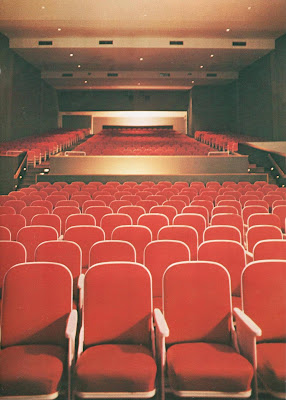
The GCC publicity shots above depict the following: (1) Cinema I, II, III, IV and V at the Greenspoint Mall in Houston, Texas from 1977. Cinemas IV and V are showing “Semi-Tough” and “The Goodbye Girl”, respectively (2) Ticket booth and refreshment counter from South Shore Plaza Cinema I, II, III and IV in Braintree, Massachusetts, also in 1977 (3) A wide lobby shot, also from South Shore Cinema, where John Travolta takes his place alongside the art gallery (4) Mesmerized young folks at the candy counter, unknown location, from 1979. (What do theatre candy bars cost these days, nine bucks apiece?) (5) Another candy counter scene from the same year (6) Ticket window scene, 1979 (7) Those ever-lovin’ famous seats, 1976. Below: (8) a 1976 scene from what I believe is the Chestnut Hill, Mass Cinema. GCC ran a straw poll for every presidential election, usually with uncannily accurate results, and (9) A marquee photo from 1979, featuring Caddyshack, the “Citizen Kane” of my high school years.
Additional posts on the history of General Cinema can be found at this link, or you can search by other topics at the right side of the page.

Monday, September 22, 2008

The Zayre Family Album, 1971

With 10-plus years of successful growth under their belts, Zayre began to look at opportunities to bring some new retail formats under its corporate umbrella. Pictured above in a set of individual photos is the expanded “Zayre empire” as of late 1971. These additional banners each shared key attributes with the main Zayre operation, in product offering (fashions, fabrics, toys, general merchandise) and/or in geography (sharing Zayre’s primary New England trade area).

The first photo, of course, is of the “mother ship” itself. After an impressive five-year run, Zayre was coming off of a disappointing profit year, despite record revenues for 1970 of just under $600 million. At this time, Zayre had over 150 stores, covering nearly every major market east of the Mississippi River. The competitive onslaught of the behemoth Kmart chain was by now beginning to take its toll on the competition, though Zayre would prosper through it longer than most.

The second photo depicts a Shoppers City, one of four Minnesota stores that Zayre acquired in the winter of 1966/67 from Northern Enterprises Inc., of Duluth. Northern Enterprises’ primary business was (of all things) a bus company – the Duluth-Superior Transit Line, to be specific. A couple of years earlier, Northern had bought the retailer in a diversification move as its transit business flagged. The chain’s founders, Melvin Roth and Seymour Rothstein, were kept on to run Shoppers City, an arrangement that Zayre stayed with after their purchase of the chain. Zayre set the company up as a wholly-owned subsidiary called SC Trading Corp. For the first several years, Zayre operated these four stores under their original name, later co-branding them “Zayre Shoppers City” in the early 1970’s. A unique aspect (for Zayre) of these stores was their “family center” arrangement – general merchandise and a full supermarket under one roof.

The third photo shows what is probably the most familiar Zayre-owned nameplate behind Zayre itself and the still-to-come TJ Maxx. Hit or Miss was a chain of discount specialty stores aimed at the young womens’ apparel market. Hit or Miss was a division of Dedham, Massachusetts-based Commonwealth Trading Company, and their first store opened in 1965 in Natick, Zayre’s home base at the time. When Zayre bought Commonwealth in late 1970, there were only 10 Hit or Miss stores. In the ensuing decades, the Hit or Miss chain would become a familiar fixture in shopping centers all over America, reaching a most impressive tally of nearly 600 stores by 1991. There were perennial problems, however, and an unfortunate number of management shakeups and new strategies were tried along the way. Hit or Miss ultimately outlasted Zayre as a retail brand, but not by long - spun off to its management in 1995, the last Hit or Miss stores sadly closed in 2001.

Photos four and five show the Bell Shops and Nugents womens' specialty stores, the Feldberg family’s original retail business. Reaching a peak of nearly 80 units in the 1950’s, the Bell Shops/Nugents operation was trimmed back through attrition as the stores’ leases expired. Settling on some 40-odd locations in the late 60’s, the stores were still struggling until a new strategy was put in place. Up to that point, the stores apparel offering was far too similar to that carried in the Zayre stores. A decision was made to establish a separate buying group charged with upgrading the Bell Shops/Nugents image with a higher grade of merchandise, sold at correspondingly higher prices. This would lead to the opening of some new Bell Shops/Nugents stores right next door to new Zayre units, which did surprisingly well.

The sixth photo shows a Beaconway Fabrics store. Boston-based Beaconway had been the fabric/sewing notions licensee for the Zayre stores, and also operated five stores under their own name in the Massachusetts region. In July 1968, Zayre bought out the Beaconway firm, keeping the individual fabric stores open.

Pictured in the seventh photo is Warwick Shoppers World, a discount chain based in Pawtucket, Rhode Island that Zayre acquired in June 1970. This company was founded by Edward Zwetchkenbaum and had 10 stores at the time of the Zayre buyout, operating under the names Warwick Shoppers World (Warren and Middletown, RI and Worcester and Bellingham, Mass, among others) and Coats Field Shoppers World (Pawtucket, RI and Brockton, Mass). There was also an apparel unit called the New York Lace Store. The stores were advertised as Warwick/Zayre stores. An interesting footnote in Warwick’s history was the tiny chain’s fight against the “Fair Trade Laws” (now-repealed laws that allowed manufacturers to set retail prices) in the late fifties and early sixties. The company made national headlines at the time as they were sued by such big names as General Electric and U.S. Time (Timex), among others, joining the fair trade battle alongside much larger retailers such as E.J. Korvette.

The last photo shows a Spree! store from one of Zayre’s most interesting ventures, a chain of discount toy stores launched in September 1970. The chain reached 13 units by October of the following year, when a 36,000 square foot Spree! store was opened in Enfield, Connecticut. The timing proved to be unfortunate as the Spree! rollout coincided with the meteoric rise of Toys “R” Us and stiff competition from Child World, among others. By 1976, there were only six Spree! units, and those would be gone by year’s end.

But in 1971, things looked different, of course. As the old saying goes, “Nice looking family!”

Sunday, September 14, 2008

Zayre's Fabulous Department Stores

After a slow, careful period of initial growth through the end of the 1950’s, Zayre Corp., as it was now known, began to expand rapidly. Only six Zayre stores were in operation in 1959, the approximate year that Zayre’s volume reached that of the Bell Shops/Nugents stores. By 1962, there were 27 Zayres open, with ten to twenty new ones added annually for many years afterward. That same year, Zayre Corp. became a public company. Headquarters remained in Natick, Massachusetts, moving later in the decade to nearby Framingham.

Zayre set its sights on a much larger market area than that of some Northeastern contemporaries, including Bradlees (owned by Stop & Shop, who would expand outside the Northeast much later on) and Two Guys (owned by Vornado, who would add some West Coast stores in the late 60’s). Starting in 1960, the company embarked on a program to open stores in major markets all across the eastern half of the U.S., with a presence in nearly every state east of the Mississippi by the middle of the decade.

Wisely, they tended to open the stores in clusters, so as to maximize brand presence and advertising efficiency. By the end of 1966, Zayre had 92 stores total (not counting the specialty stores) with major concentrations in greater Chicago (9 stores), Miami (10 stores) and their home turf of Boston (13 stores). Medium-sized Zayre markets at the time included Washington DC (5 stores), Pittsburgh (4 stores) Atlanta, Cleveland and Columbus (3 stores each), Jacksonville, Tampa and Providence, R.I. (2 stores each).

Some of this growth came through acquisition. When Toronto-based Towers Marts, a chain with discount store locations from Ontario to Florida went bankrupt in 1963, Zayre picked up four of their Washington DC area locations – Silver Spring and Wheaton, Maryland and Falls Church and Alexandria, Virginia. Consumers Mart of America (CMA), a no-frills superstore chain with a smattering of locations around the country, was another early discounting casualty, and Zayre announced in March 1965 it would be taking over three Chicago locations (Ashland Ave., Oak Lawn and Palatine) and a couple of units in Florida. In December 1966, Zayre bought out Duluth, Minnesota-based Northern Enterprises, Inc., owner of four Shoppers City stores located in Duluth, St. Paul and Minneapolis. Interestingly (unlike previous acquisitions), Zayre retained the Shoppers City name for these stores.

In Zayre’s early years, their product mix leaned heavily towards soft lines (mainly clothing) due to the Feldbergs wealth of experience in fashion, gained through years of operating the Bell Shops/Nugents stores. As the sixties progressed, Zayre’s product offering resembled that of a more typical discount store, with toys, sporting goods, photographic, records, books, health and beauty products and much more added to the mix. A number of these departments were leased out to concessionaires during Zayre’s first decade, including linens, greeting cards, candy and health and beauty items among others, totaling nearly a third of Zayre’s store revenues. In the mid-60’s, Zayre bought out a good number of these firms, leaving only a handful of departments (accounting for only 12-13% of sales) as leased operations. Zayre was far from the only discounter to actively buy out their lessees at that time – Kmart, Vornado and several others did the same.

In describing Zayre’s stores, a 1966 Barron’s article put it succinctly – “The typical Zayre discount store is about 70,000 square feet and air-conditioned. All outlets are on well-traveled roads with ample parking space. While the stores are pleasant and neat, no attempt is made to create a high-fashion image”. The company itself put a slightly more upscale spin on things in their advertising, which in my opinion was a cut above average discount house ads, even if the stores weren’t necessarily so. For many years, the tagline “Fabulous Department Stores” appeared alongside the chain’s name in their ads. Fabulous confidence at the very least!

The photos above are circa 1963. The locations are unknown save for the last two photos – the TV/Hi-Fi department is from the Monroeville, Pennsylvania store and the night exterior (depicting a free concert on the front sidewalk) is the Beverly, Massachusetts location.

Wednesday, September 10, 2008

A Very Good Start For Zayre

Although the first Zayre department store didn’t open until 1956, the chain’s beginnings date back to 1919, with the formation of The New England Trading Company, an underwear and hosiery wholesaler. Founded in the Boston area by brothers Max and Morris Feldberg, the company began as a supplier to full-line department stores and specialty shops. Ten years later, the brothers launched their first retail operation, Bell Hosiery Shops (later shortened to “Bell Shops”). Within a few years, the Bell Shops product line began to expand beyond underwear and hosiery to include other clothing lines. By the mid-30’s, the Bell Shops were full-blown women’s’ specialty stores, competing against such chains as Lerner Shops and Three Sisters. There were nearly 30 Bell Shops in the New England area by the end of World War II.

In 1946, the company doubled its store count with its buyout of New York City-based Nugents, another women’s’ specialty store chain with a great deal of similarity in approach to Bell Shops. The Nugents chain (whose name would be retained), with its store base in New York, Pennsylvania, Delaware, New Jersey and Washington, DC provided a natural extension of the company’s market area with virtually no overlap.

By the early 1950’s, the company’s sales had reached a plateau, and it became clear to the Feldbergs that fairly drastic changes would need to be undertaken in order for their business to remain viable. Despite classy remodelings, and in some cases the opening of larger stores, the Bell Shops/Nugents stores were losing ground due to two important trends, among others – the decline of downtown business districts (with notable exceptions, such as the Quincy and Malden, Massachusetts locations, where the city fathers had the foresight to provide large downtown free parking areas) and the rise of the “mill” discount store operations, a trend that literally rose up in the company’s backyard.

With the family’s second generation, Stanley H. Feldberg (son of Max) and Sumner A. Feldberg (son of Morris) now in positions of high responsibility, the company began to explore its options. A considerable effort was put into studying the wildly successful mill stores, particularly Cumberland, Rhode Island-based Ann and Hope. The mill stores – Ann and Hope, Mammoth Mart, J.M. Fields and others, shared a common formula for success. With a host of closed, empty textile mills available at dirt-cheap rents, these companies began operation selling mainly clothing, linens and other softlines. Eventually space was leased out to other firms offering such items as shoes, jewelry, tools or appliances, starting the tradition of leased departments in discount stores. As these companies became more prosperous, they began to build their own new stores, either free-standing and/or in shopping centers, allowing much greater visibility along with the many other benefits of custom-built facilities. In a sense, these firms eventually assumed the characteristics of a traditional “chain store” corporate structure.

Having settled on discounting as the logical new direction in which to take their company, the Feldbergs decided to forgo the “mill building” route, preferring to launch with a newly constructed store when the opportunity presented itself. In late 1955, that opportunity came when Stop & Shop, Inc. approached with an offer to build them a store alongside a new Stop & Shop supermarket to be constructed in Hyannis, Massachusetts. In June 1956, the Hyannis Zayre store opened, a whopping 5,000 square feet in size. The store was soon expanded to 7,500 and then 10,000 square feet, and was replaced in 1962 with a 45,000 square foot unit directly behind it. The second Zayre opened in September 1956 in the Roslindale section of Boston, with a much larger footprint of 39,000 square feet. Within a few years, Zayre stores would typically average 70,000 to 90,000 square feet.

Longtime New York Times retail writer Isadore Barmash explained the origin of the chain’s name in a 1985 article – “One day, the Feldbergs and Bert Stern, an advertising consultant, were casting around for possible names for the new operation when Max broke off to take a call. He ended his phone conversation with a typical Jewish phrase: ‘Zehr gut’ or ‘very good.’ Mr. Stern repeated ‘Zehr, where, we need a nice-sounding name.’ The men stared at one another. ‘Zehr – let’s spell it Zayre’ – for very good, they decided.” And thus, Zayre became part of the discounting pantheon.

By 1961, there were fifteen Zayre stores in operation, racking up $50 million in annual sales. Much faster growth would come in the early 1960’s. Zayre was off to a “very good” start, to be sure.

Pictured above is a circa 1962 Zayre store in the standard configuration that so many of us grew up with. Below are exterior and interior shots of the first Zayre store (tiny by comparison) in Hyannis, Massachusetts, shortly after its opening.

Thursday, July 10, 2008

Last Spin of the Turn-Style


The mid/late-1970’s proved to be the Waterloo of a number of discount retail chains with a significant presence in Chicago. The late George Lazarus, longtime business writer for the Chicago Tribune, listed the recent casualties in a 1978 editorial – Topps (Interstate Stores), Korvettes, W.T. Grant and Robert Hall Village. In short order, Jewel-owned Turn-Style would be added to the list.

Turn-Style’s profitable run at the end of the sixties and the dawn of the seventies brought about an acceleration, however mild, of the Family Center program, where the chain grew from a couple of area stores to thirteen by 1976. The last Chicago Turn-Style stores were opened in conjunction with a new Jewel concept – the Jewel Grand Bazaar, a larger (60,000-plus square feet) supermarket format that enjoyed great success in its early years. Loosely based on the European “hypermarkets”, these stores combined the feel of an open air market with huge bulk displays of product. Jewel, widely credited with marketing the country’s first “generic” supermarket product line (in 1977), used the Grand Bazaar stores for its launch. Three Grand Bazaar locations that adjoined some of the final Turn-Style stores were located at 54th Street and Pulaski Road, 87th Street and the Dan Ryan Expressway, and at Grand and Kostner Avenues. In 1974, Turn-Style’s president, Bill Lewis, was reassigned by Jewel to head up a new group, charged with developing a "real" hypermarket for Jewel. It was to include a discount department store, pharmacy and food store under one (very large -200,000 sq. ft.) roof, in what could have been a more upscale precursor to today’s Wal-Mart Supercenters. Sadly, this never materialized.

Turn-Style, which as Lazarus put it, “(had) never been a winner for Jewel” at least held its own into the mid-70’s, but things went downhill quickly from there. In 1975, Turn-Style lost its independent division status and was placed under the Osco group, along with the very successful Osco Drug stores and Jewel’s hapless, soon to be jettisoned Republic Lumber stores.

In 1978, there were 24 Zayre stores and 38 Kmart (who had just snapped up two Korvettes and two Robert Hall Village locations) stores in operation in the greater Chicago area, huge footprints (and a correspondingly huge advertising advantage) in contrast with Turn-Style, which was standing still after all those years with only 13 area units, incomplete market coverage and far less than ideal advertising utilization.

When May Department Stores, Inc., with its growing Venture stores division came calling, Jewel was receptive. On March 7, 1978 it was announced that Jewel would sell 22 Turn-Styles to May for conversion into Venture stores, including locations in Illinois, Michigan, Iowa, Wisconsin and Nebraska. Ten of the 13 Chicago stores were included, with the other three – Harlem-Foster, Niles and Westmont retained by Jewel for eventual conversion to larger Jewel-Osco units. The handful of Boston units went to various tenants, including Zayre.

The top photo, from 1975, shows the 87th and Dan Ryan Expressway Turn-Style/Osco Drug/Jewel Grand Bazaar location. The second photo shows the Quincy, Massachusetts location, originally opened in 1966 and remodeled ten years later, in a photo taken shortly thereafter. The photo gives a nice look at Jewel’s New England family – Star Market, Brigham’s Ice Cream Shop, Osco Drug and Turn-Style. The only name missing, for obvious reasons, is a White Hen Pantry convenience store. The last photo shows one of the last Turn-Styles, the location of which I’m not sure of.

Friday, July 4, 2008

Turn-Stylin'

After moving to quickly establish the first new Turnstyle West (technically it was the midwest) region stores upon buying out the company in 1962, Jewel proceeded much more slowly through the rest of the sixties. Having opened the Racine, Skokie and Harlem-Foster stores, two more Turnstyles would open in 1963, both of them in the Quad Cities – Moline, Illinois in May and Davenport, Iowa, in August. They would be the last new midwest Turnstyles for four years, when a “mini-Turnstyle” (35,000 sq. feet) was opened in Bettendorf, Iowa in 1967.

In 1964 the original Lynn, Massachusetts store, an outdated unit of only 45,000 square feet, was closed. The following February a brand-new 100,000 square foot Turnstyle opened in Quincy, Massachusetts, a Boston suburb. This was part of a Jewel-owned “Family Center” and also included a Star Market and a Brigham’s. Brigham’s was a well-known Boston area chain of ice cream/sandwich/bakery shops that Jewel acquired as part of the Star Market transaction a year earlier. Brigham’s owned a baking division called Dorothy Muriel’s that eventually supplied baked goods to the Star Markets (I can still taste those great corn muffins from my childhood trips up there!). Things remained fairly quiet on the Turnstyle East front as well, with the only real action being the conversion of two Star Home Centers to Turnstyle stores, in Waltham, Mass. in 1966 and Franklin, Mass. the following year.

From a business standpoint, the early years of Jewel’s Turnstyle ownership were very difficult, with fairly substantial operating losses. In retrospect, it’s hard to say whether or not Jewel held off opening more Turnstyle stores in their key market, the Chicago area (where Turnstyle had barely scratched the surface) in order to refine the concept. It had to have taken longer than they planned.

In any event, their act was together by 1968 when a new Turn-Style (the name was hyphenated by this time) / Jewel Family Center opened in the North Point Shopping Center on Rand Road in Arlington Heights, Illinois, a bustling northwest suburban town. The following year, a new store opened in west suburban Glendale Heights. That year, 1969, marked a major turnaround for Turn-Style with all of the chain’s 13 stores operating at a profit.

In November 1971, two Turn-Style / Jewel Family Centers opened on the same day. One was in Schaumburg, Illinois, at the intersection of Golf and Meacham Roads, near the colossal new Woodfield Mall. This store is the one I remember shopping at the most. The other store was in the new “Jewel Village” Shopping Center in west suburban Westmont, Illinois, at the corner of Ogden and Cass Avenues. The Westmont store was located in a Jewel-owned shopping center that was unique in that it was used for a “proving ground” for some new Jewel retail concepts – “Case n’ Bottle” liquor stores, Village Fashions and a fabric/craft shop called “Stitch n’ Knit”. These didn’t end up flying as standalone concepts, although the liquor store idea was later folded into some Jewel stores.

In 1972, Jewel began to roll Turn-Style stores out to other areas, notably the Eisner territory, which was located in Central Illinois and Western Indiana, and had recently been extended to Indianapolis. They even opened some Family Centers in conjunction with non-Jewel supermarkets, pairing up two Omaha Turn-Styles, one with a Bakers supermarket, the other with a Hinky-Dinky.

The next year, Jewel tried its hand at the catalog showroom business. “Intrigued by (that) $2 billion business”, as they officially put it, the decision was made to open a catalog showroom area within five existing Chicago area Turn-Styles, which would be redubbed “Turn-Style Plus” stores. Deerfield, Niles, Arlington Heights, Schaumburg and Chicago (Grand and Kostner Avenues) were the “Plus” stores, each store setting aside an 8,000 selling floor and 15,000 of warehouse space to accommodate the venture. A 350-plus page Turn-Style Plus catalog was published for customers to use to make their buying decisions at home, call in an order (or write one up onsite) then flee to the store to pick it up. The catalog showroom concept was gaining popularity across the US at the time, with companies such as Service Merchandise and Best Products enjoying tremendous growth. The major catalog players in the Chicago area at the time were Bennett Brothers (still in business) and McDade and Company (now gone). The venture was not a success, and only a year later Jewel referred to it as an “experiment”.

The photos above are from the early 1970’s, that golden era of white wine, ferns, and brown mansard-roofed discount (and grocery) stores. The first shows the Jewel Village location in Westmont, Illinois, the second a Turn-Style / Eisner Family Center in Indianapolis, with a mile-long Olds Custom Cruiser in the foreground. The third photo is an unidentified Family Center and the last is of one of the five Turn-Style Plus stores.

And for more Turn-Stylin’, check out John Gallo’s new site, Stores Forever. John has been a longtime contributor to number of the old retail fansites, and has now started one of his own. John had the foresight to photograph many stores in his native Racine, Wisconsin/North Suburban Chicago areas in the 70’s and 80’s. His current post features a great shot of the Racine Turn-Style store as remodeled in the early 70’s, when the former Jewel had been converted to a “Big E” warehouse food store, a short-lived Jewel no-frills concept that fell under the Eisner wing. John has some great ShopKo stuff on there as well.

Sunday, June 29, 2008

Someone Was There at the Turn-Style...

…the girl with kaleidoscope eyes. Yes, it’s time to pay tribute to the only discount store chain to ever be mentioned* in a Beatles song. I’m referring of course to Turn-Style, a presence if never really the major discount player in the Chicago and Boston areas throughout the sixties and seventies.

Turnstyle Operating Corporation (in the early years the name “Turnstyle” was not hyphenated) was founded with their first store in Lynn, Massachusetts in 1957. By the end of 1961, the company had four self-service department stores in the greater Boston area, ranging in size from 45,000 feet to their largest store, a 70,000 square foot unit in Lawrence, Mass.

On February 28, 1962, Chicago’s Jewel Tea Co. completed a year-long acquisition of the Turnstyle organization through an exchange of stock. Having gotten their feet wet in the area of non-food sales with their merger with Osco Drug the previous year, Jewel was keen to expand to the larger general merchandise format that Turnstyle afforded. In combination with their supermarkets (and occasionally an Osco as well) the “Family Center” concept would offer customers the proverbial “one-stop shop” for many of their everyday needs. The Turnstyle acquisition served another purpose for Jewel as well as it became the company’s first expansion territory outside the Midwest, not counting its European investments. The familiarity with the Boston area that Jewel management gained would pave the way for their merger with Star Market the following year.

The Turnstyle stores, as the name implied, had an emphasis on apparel, but carried extensive lines of housewares, small appliances, sporting goods, hardware items and phonograph records among other items. They also featured a pharmacy and a “delightful snack bar in the middle of the store”.

Jewel wasted little time in opening the first Turnstyle units in their primary Midwest market, with the first store, a 110,000 square foot “Turnstyle Family Center” opening in Racine, Wisconsin in March 1962. Exactly a year later, two more virtually identical family centers were opened, one at 9449 Skokie Boulevard in Skokie, IL, and the other at 7342 Foster Avenue in Chicago’s Harlem-Foster Shopping Center.

The photo above features one of the above-mentioned early Turnstyle units. A broader view of the Skokie store can be seen on the Digital Past website (note the Eagle Food Center sign to the left of the photo. This was taken several years before their acquisition by California’s Lucky Stores chain). Below is a March 3, 1963 grand opening ad for the two stores which appeared in the Chicago Tribune.

*unintentionally

Saturday, June 21, 2008

White Hen Pantry, 1967

Mention 7-Eleven, and probably the first thing that comes to most people’s minds are the Slurpees that many of us guzzled as kids. Mention White Hen Pantry, a well-remembered Chicago and Boston-area convenience store chain, and the first things that come to my mind are the incredible iced brownies they used to sell. Over three-by-three inches square and darn near an inch tall, those Burny Bros. babies provided a guaranteed day long chocolate and sugar rush. And it’s a good thing we didn’t know about trans fats in those days.

The 1960’s were the breakout years for the convenience store industry. The first convenience stores – small roadside stores that specialized in sales of ice, milk , bread and few other staple items began to appear in the late 1920’s and early 30’s. Over time, these stores evolved into “small grocery stores”, adding a broader line of foods and various sundries to the mix. Ultimately, many convenience stores would add gasoline sales, either in partnership with a major oil company brand or through “private label” gas purchased through oil jobbers. By the late fifties and early sixties, convenience stores were fairly widespread nationally. The industry at the time was made up of a number of small regional convenience chains and one major player, the Dallas-based Southland Corporation, better known by the name of their stores - 7-Eleven. Ubiquitous in many Texas and Florida markets, The 60’s would see 7-Eleven become a national brand with Southland’s aggressive expansion into the Northeast, Midwest, Rocky Mountain and Southern California markets. In January 1966, Southland announced plans to open its first stores in the Chicago area, with 25 stores scheduled to open within the year, nearly all (initially) in the Northwest suburbs. These stores would report to Southland’s new district headquarters in Rolling Meadows.

Jewel Tea Company, owner of Chicago’s market leading Jewel Food Stores and the recently acquired Star Markets, a popular Boston-area chain, was already well underway with its own convenience store concept at the time. Jewel’s first convenience stores were slated to open in the Chicago area in 1965 under the less-than memorable name of “Kwik Shoppe”.

Around that same time, Jewel made an investment with an Illinois agricultural firm, the White Hen Egg Farm, in order to ensure a steady supply of high-quality eggs to their retail stores. Wisely, they ditched the Kwik Shoppe name (not to be confused with Kwik-E-Mart, heh heh) and adopted the name “White Hen Pantry” for the new stores. Tapping into nostalgia for simpler times with a milk-glass hen dish as their trademark, the first three White Hen Pantries were opened as planned in 1965.

White Hen Pantry was unique within the Jewel organization in that it was a franchised operation, with each store independently owned and operated. For a franchise fee of $15,000 ($12,000 of which went for inventory), Jewel would set a new White Hen owner/operator up with a complete business – store, inventory, training, accounting and distribution services, a fairly sweet deal even for those pre-inflationary times. The new owner/operators were often fairly young (30-ish) married couples, who would run the stores as a true family business. A number of the early White Hen franchisees were previously Jewel Food Store managers who had proven their mettle with the company and were given priority when new White Hen stores were planned. Jewel took no percentage until a given store was profitable, and after that they received a 12% cut of store profits.

A couple of things made White Hen unique within the convenience store industry as well. First, they did not sell gasoline, preferring suburban strip centers for many of their earlier locations, later expanding into urban locations. Secondly, each store had an extensive delicatessen and bakery counter, a particular point of pride and a rarity in those days long before Subway popped up in seemingly every gas station/convenience store on earth.

The White Hen Pantries complemented Jewel’s full-line supermarkets nicely, offering customers extended shopping hours in an era when Jewel and Jewel-Osco stores closed at 9pm in most cases and the great majority of them were closed altogether on Sundays. By 1969, 44 White Hens were in operation in the Chicago area and the first Boston area stores were opened to leverage the Star Market territory there. Eventually, a number of White Hens would be opened in Jewel’s downstate Eisner area as well.

The following 15 years would see steady growth with no major changes to the White Hen operation until 1984, when Jewel was taken over by Salt Lake City-based American Stores Company. American’s chairman Sam Skaggs signaled his intentions to build a food and drug titan, and made it known that convenience stores didn’t fit into his plans. White Hen, with some 240 Chicago locations and 50 Boston locations at the time, would be put up for sale. The White Hen management team, some of whom had been there from the beginning in 1965, expressed their desire to put together an offer to buy the company. Skaggs opted instead to place White Hen on the open market, ripe for the taking to the highest bidder. And the bidders came – Southland/7-Eleven, Convenient Food Mart (a local competitor based in Rosemont, Illinois), Los Angeles-based Atlantic Richfield Company (ARCO), who operated a number of their “Am/Pm Mini-Markets” in the greater Chicago area, and the White Hen management group, who had secured enough funding to be competitive. Happily, the White Hen team won out, and the company “fell into loving hands”, as the Chicago Tribune put it at the time.

In 2001, White Hen Pantry agreed to be sold to Clark Retail Enterprises, who would immediately divest the Boston area stores to a new entity, called New England Pantry, Inc. Clark itself ran into trouble soon afterward, declaring bankruptcy in 2003. A group led by Brandon Barnhart, the former CEO of Clark purchased White Hen in November of that year, and the “pantry” portion of the name was dropped. The end of the White Hen era, at least in the Chicago area, was signaled in August 2006 when White Hen was bought out by arch rival 7-Eleven. The stores have undergone a slow but sure conversion to the 7-Eleven banner since that time.
Note: Larry of the great Diner Hotline, a Massachusetts resident, rightly points out that White Hen Pantries still exist in the Boston area.

The photos below are all circa 1973. The first two views are of a typical suburban store - an exterior (albeit with non-standard signage) and an interior view showing a portion of the vaunted bakery counter. The last view shows the White Hen Pantry that was located on the ground floor of McClurg Court, a high-rise apartment complex that was definitely one of the hotter Chicago addresses in the 1970’s.