Showing posts with label Costa Mesa. Show all posts

Wednesday, December 24, 2008

Sears - Christmastime in the O.C.

“The sun is shining, the grass is green.
The orange and palm trees sway.
There's never been such a day
in Beverly Hills, L.A.
But it's December the twenty-fourth,
and I am longing to be up north”.

--The usually omitted first verse of
Irving Berlin’s classic song “White Christmas”

Well, as you can see, it’s actually a bit overcast, but I’ll bet the grass is green. The orange groves were plowed up a while back to make room for legions of new suburban homes, shopping centers like this one and Disneyland, but there are a few carefully selected palm trees. And we’re not in Beverly Hills, but rather in Costa Mesa, right in the heart of Orange County. More than likely the photo wasn’t taken on Christmas Eve, but it’s definitely from the Christmas season, as evidenced by that hallmark of Southern California style - a gold garland Christmas tree, standing right there atop the Sears.

This photo, shown courtesy of the Orange County Archives, depicts the Sears end of the South Coast Plaza shopping center, which opened at the corner of Bristol Street and Sunflower Avenue in Costa Mesa, California in November 1966 and was still looking prime 15 years later when the photo was taken. Although the shopping center itself was designed by the legendary Victor Gruen, the architect for the Sears store was the firm of (the also legendary) Stiles Clements and his son, Robert. This was one of the very last projects to occur under the elder Clements’ watch, as he passed away in January 1966, while the store was still under construction. A huge store at over 338,000 square feet including the auto center, garden shop and other structures, the South Coast Plaza Sears was the chain’s largest store in the far west at the time of its opening. It still exists.

I recently heard from the grandson of George Scherquist, construction manager for Sears’ Pacific Coast territory from the 1940’s through his retirement in 1968. Mr. Scherquist presided over one of the largest and most impressive store development programs in retail history, and the South Coast Plaza store would have to count as one of his crowning achievements.

Speaking of Sears (and we were), at this time last year I mentioned the wonderful Wish Book Web site, where a fascinating collection of department store catalogs are scanned in full and available for your viewing delight. A number of the catalogs are Christmas editions, including an outstandingly beautiful 1966 Sears Christmas catalog, published the year this store opened. Many catalogs have been added to the site in the past year.

Wednesday, August 8, 2007

Alpha Beta - The Early Acme Years


In the early 1960’s, a number of interesting trends took hold in the grocery industry. First, the progression (which began in the 1940’s) towards ever larger footprints for new stores continued at an intensified pace. Most new stores built in the early sixties were at least 15,000 square feet, with many upwards of 20 or even 30,000. Secondly, supermarket chains began to diversify into new businesses – including drugstores, general merchandise discount stores, quick-service restaurants and other ventures not directly related to their original business.

A third major trend that several large supermarket chains participated in was an expansion into far-flung territory through buyouts of other chains. Some examples are the 1964 merger of Boston-based Star Market into Chicago’s Jewel Tea Company and the purchase of the Los Angeles-based Market Basket chain by Kroger the previous year. Both of these acquisitions established their parent companies in new territory, far from home. Both parent companies, in these cases, wisely chose to maintain the original name and identity of the organizations they purchased.

Philadelphia-based American Stores Company, with a history dating back to 1917, was a major player on the East Coast, with 789 Acme Markets located in Pennsylvania, New Jersey, New York, Delaware, Virginia, West Virginia and Washington D.C. by 1961. In January of that year, American (the company would change its name to Acme Markets, Inc. in 1962, and then revert to its original name in the mid-70’s) became a bi-coastal operation with its purchase of La Habra, California based Alpha Beta Food Markets, a 51-store grocery chain with a devoted customer base throughout Southern California. The new subsidiary was renamed Alpha Beta Acme Markets.

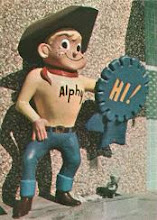
At the time Alpha Beta was acquired by American Stores, the company was aggressively expanding (as were most SoCal area chains) through the construction of new stores and major renovation of many existing stores, a policy that would continue under Acme. Many of the “streamline moderne” facades that were standard issue for AB through the forties and fifties were giving way to a new mid-century modern look – mosaic tile and aggregate facings with gold-anodized mesh screens hanging from the front awning. Alpha Beta’s mascot “Alphy” was given a place of honor on huge neon (or backlit, in some cases) signs that towered above the stores.

Pictured here are three stores from the early Alpha Beta Acme years – Harbor Avenue/Costa Mesa, La Mesa (San Diego) from 1964, and La Habra from the following year.