Showing posts with label Walgreens. Show all posts

Saturday, July 2, 2011

Roosevelt Field Shopping Center, 1965

August 1965 was a hot, tumultuous month for the New York metropolitan area. For one thing, the city was in the midst of a historic water shortage, so severe it was officially declared a disaster by the federal government on August 18. The New York World’s Fair, the last of its kind, was in the midst of its second and final season. Save for a few trademark structures, the Fair would be completely dismantled just a few months later – Disney’s popular “It’s a Small World” exhibit, for example, originally commissioned for the Fair by Pepsi-Cola, was packed up for shipment to its permanent home at Disneyland.

Further along the cultural front, two of the most famous concerts in pop music history took place then and there. On August 15, The Beatles played to a deafening, sold-out crowd of 55,000 people at Shea Stadium, unwittingly inaugurating the ‘stadium rock’ era. The show was filmed, with the boys later overdubbing vocals and guitar in places because of crowd noise, for broadcast on the BBC and later on ABC Television here in the states. On August 28, Bob Dylan played to a crowd of 14,000 at Forest Hills Tennis Stadium. After a seven-song acoustic set, Dylan left the stage and reappeared with a four piece electric band (The Hawks, later known as The Band) - a delight to half the audience present and a heresy to the other half, who signaled their disapproval of Dylan’s startling new sound with jeers and catcalls. History, as it usually does, sided with the delighted. Five bucks and an early ticket order would have gotten you into either show.

And those who lived “on the island” participated in it all. Commuters who worked in the city paid 10 cents a glass for normally free water in restaurants. Families spent one more weekend at the Fair, trying to take it all in before it closed for good. Thousands of local “youngsters” (Ed Sullivan’s term for anyone under the age of 31) attended those soon-to-be-legendary concerts. Of course, there were everyday pursuits as well – boating, little league games, family picnics…and lots of shopping.

If you lived in Nassau County (The non-New York City portion of Long Island is split into two counties, Nassau and Suffolk. Nassau County is closest to the city.), you certainly had your choices where shopping was concerned. Within a ten-mile radius were three of the largest malls in the country – Green Acres Shopping Center in Valley Stream, Mid-Island Plaza in Hicksville, and the biggest (at the time) in the entire country, Roosevelt Field Shopping Center, located 2 ½ miles from Garden City and 5 miles from Hempstead. The photos above, from original slides I recently purchased, depict Roosevelt Field as it appeared in August 1965, some nine years after it originally opened.

Roosevelt Field was named for the airfield that once occupied its site. “Roosevelt” in this case was President Theodore Roosevelt’s son Quentin, an aviation hero of World War I who was shot down over French skies in 1918. In 1927, Roosevelt Field was the launching point of Charles A. Lindbergh’s history-making flight across the Atlantic to Paris’ Le Bourget Field, an event that was wildly celebrated on both sides of the pond. More than a few Americans at the time, especially younger ones, considered “Lucky Lindy’s” flight the most significant national event of their lifetimes. Roosevelt Field would remain an airport until 1951.

In 1950, the Roosevelt Field property came under the ownership of Webb & Knapp, a prominent New York City-based developer. Webb & Knapp was controlled by William Zeckendorf Sr., a colorful, larger-than-life figure who stood out in a city known for colorful, larger-than-life figures. “…the outstanding phenomenon of present-day real estate operations”, the Wall Street Journal extolled Zeckendorf in 1956 - “(he) parlayed Webb & Knapp from a tiny consulting firm, $12,000 in the red, to a publicly-held realty empire with assets of $193.4 million”. Columnist Tyson Freeman quotes from a 1954 Fortune magazine article about Zeckendorf – “...a gifted man. He has a mind of unusual caliber in intuition, rough calculating ability, and resourcefulness; and an imagination that can take fire without appreciable loss of discipline.”

Zeckendorf spearheaded the effort to assemble the land for the UN headquarters along the East River in New York, where slaughterhouses stood, believe it or not, until the mid-1940’s. He designed an automated parking garage, a sort of storage-and-retrieval system for cars, a novel idea for a city where parking places have always commanded high premiums. He bought the Chrysler Building. And he saw the potential for something special in a soon-to-be-defunct airfield his firm bought, a 323-acre chunk of industrial land “in the heart of Nassau County”, if only there were better access to the property.

Better access, as it turned out, was coming. Not long after Webb & Knapp’s purchase of the Roosevelt Field property, plans were announced to extend the Meadowbrook State Parkway to form a connection between two high-traffic area thoroughfares, Northern State Parkway and Southern State Parkway. This new four-lane highway, which would border the property on the east side, would be complete by mid-1956. Zeckendorf made his move, starting out by convincing America’s most prestigious department store firm to take the plunge along with him. A November 10, 1953 Wall Street Journal article announced that “R.H. Macy & Co. and Webb & Knapp jointly announced plans for a $55 million center at ROOSEVELT FIELD, LONG ISLAND N.Y.”, “scheduled to open September 1, 1955”. The actual completion took over a year longer to accomplish.

The shopping center would be the world’s largest – (a massive) “1,387,000 square feet of retail selling space” according to a July 16, 1956 Time magazine article. It would contain Macy’s largest branch store, indeed “the largest branch operation of any department store in the New York area”, as the Journal put it in April 1955, “compris(ing) 300,000 square feet on three floors, plus a 20,000-square-foot outdoor shop”. The Roosevelt Field Macy’s store would be designed by Chicago-based architectural powerhouse Skidmore, Owings and Merrill. Roosevelt Field would be the company’s fifth location in the Greater New York City area, joining their venerable circa-1902 Herald Square flagship -“The Largest Store in the World”, and suburban branches Parkchester (Bronx, 1941), Jamaica (Queens, 1947), Flatbush (Brooklyn, 1948) and White Plains (Westchester County, 1949). A sixth metro area location would open in May 1957, eight months after Roosevelt Field’s debut , at Garden State Plaza in Paramus, New Jersey, albeit under Macy’s New Jersey nameplate, Bamberger’s.

Responsible for Roosevelt Field Shopping Center’s overall design was Webb & Knapp’s director of architecture, I.M. Pei, who came to the U.S. as a student from China in 1934 and was recruited by Zeckendorf in 1948. In 1955 Pei established his own firm, I.M. Pei and Associates, and would go on to design such landmark facilities as the National Gallery of Art’s East Building in Washington , D.C. and the John F. Kennedy Library in Boston, two examples among many in one of modern architecture’s most important bodies of work. As such, it’s easy to think of Roosevelt Field as a relatively minor item in Pei’s portfolio.

In the mid-50’s retail world however, it wasn’t minor. A 1957 Architectural Record article, “Suburban Shopping Can Be Fun!” (Exclamation point added by me.), hailed the center’s design as having “interesting variety within a skillfully organized, dominant architectural pattern”, and “an assuring, human scale everywhere – not easy in the world’s largest center; there is visual intrigue and delight – changing, colorful but always under control; and there is an ordered, easy-to-learn traffic flow for pedestrian and driver. In short – it’s fun to shop here.”

I.M. Pei, in the same article, described his design thusly: “The site plan is essentially a free-flowing ring road surrounding a central building group. The stores form a compact cluster, minimizing walking distances and heightening cumulative drawing power. The relatively narrow malls encourage cross-shopping, double the presentation of merchandise, and heighten the impression of activity. The shopper’s route leads him through streets (Dave’s note: “streets” actually means sidewalks here. With fountains and benches, that is.) of different widths and varying architectural treatments, affording a variety of experiences. Trees, flowers, music, fountains, gay awnings, and bold use of graphic art combine to make the retail atmosphere”. There was a strong unifying theme throughout as well – “a modular system of dark-brown steel frames, rough-faced off-white brick and glass”. And at the opposite end of the center from Macy’s – a skating rink!

On April 26, 1955, The New York Times reported the groundbreaking and official start of construction for Roosevelt Field. As the 16-month construction period rolled on, the rest of the shopping center’s tenant lineup fell into place. Women’s Wear Daily columnist Samuel Feinberg reported that there would be two 37,000 square foot variety stores, Woolworth and Kresge, two 30,000 supermarkets, Food Fair and Grand Union, a number of specialty stores including Hartfields and Oppenheim Collins, men’s stores Wallach’s, Howard and Ripley, and 10 (count ‘em!) shoe stores – “Regal, Father & Son, Buster Brown, Flagg, Florsheim, Thom McAn, Kitty Kelly, Baker and Chandler”. There would also be a 15,000 square foot Walgreens and a Horn & Hardart restaurant. And according to The New York Times, the center would also feature “Tepee Town, sellers of Western, Indian and copper items, including clothing, relics and rugs”. On August 22, 1956, Roosevelt Field Shopping Center opened for business to an adoring throng.

Gigantic as it was, Roosevelt Field was but one of three large regional shopping centers to open in Nassau County that year. Two months later, in October 1956, the other two opened. First was Mid-Island Shopping Plaza (known today as Broadway Mall), located in Hicksville near the Wantagh State Parkway and boasting just under a million square feet. The major draw at Mid-Island was its huge branch store of Queens-based Gertz, a unit of Allied Stores. There was also a J.C. Penney store, Newberry’s and Kresge variety stores, Food Fair and First National supermarkets, a Walgreens and many of same shoe stores and specialty shops as could be found at Roosevelt Field. In 1964, a large “Class A” Sears store opened across the street from Mid-Island Plaza. Within a few years, Hicksville became Sears, Roebuck & Company’s highest volume location in the entire chain. Third in the “Nassau triumvirate” was Valley Stream’s Green Acres Mall, itself built on a former airport site. Here Gimbels was the main tenant, with Penney, Newberry, Woolworth, Walgreen and more of yet again the same names rounding things out. Both shopping centers, like Roosevelt Field, were originally open-air facilities that were later enclosed. And like Roosevelt Field they still exist, with a different “starring cast” of course.

And there were other competitors as well. E.J. Korvette, the great “promotional department store”, was just across the way at Carle Place. S. Klein was “On the Square” (as they always were) a few miles away in West Hempstead. Moving up the retail scale, Lord & Taylor was in Manhasset. Stern’s was in Great Neck in the former John Wanamaker location. Abraham & Straus, B. Altman, Peck & Peck, Best & Co. and W. & J. Sloane were just some of the other (now long gone) big names that were nearby. Despite all this, Roosevelt Field did reasonably well.

It soon became obvious that some tweaks would be needed, however, the first major one concerning Roosevelt Field’s two supermarkets. Less than a year after the center opened, as Women’s Wear Daily columnist Feinberg put it, “it was clear to supermarkets and landlord alike that the two together weren’t rolling up more sales than one should have been doing”. In 1958 Food Fair was allowed to break its lease, turning its location (the more desirable of the two) over to Grand Union, whose former space would be subdivided “into non-food stores”. This action was part of a larger agreement between the two competitors in which Grand Union also agreed to change the name of 25 unrelated “Food Fair” supermarkets they owned in the Washington D.C. area to the Grand Union name, releasing the naming rights to Food Fair, who previously had to operate their own D.C. area stores under a different name –“Food Lane” in this case. (Are you confused yet?) Food Fair also took over a Grand Union location in Richmond, Virginia as part of the same agreement.

A much more serious problem was a consequence of the shopping center’s layout. The original I.M. Pei-designed site plan called for two major department stores, one each at the north and south ends, to create a draw at both ends of the center, maximizing the flow of shoppers through the mall areas where the smaller stores resided. As it was, Macy’s was the only anchor, “drawing a swarm of shoppers to the southern end (of the center)”, while “a number of stores in the northern end have been forced to close”, a Wall Street Journal article later put it. Eventually, the problem resulted in a startling 30% vacancy rate. Something had to be done.

From the start, developer William Zeckendorf “hoped that someday Gimbels would join Macy’s” at Roosevelt Field, a January 1963 Chain Store Age article stated. He had other irons in the fire in the event a Gimbels deal didn’t materialize, however. He approached Ohrbach’s, a New York institution since its early 1920’s founding. Ohrbach’s specialized in mid-priced apparel and had stores in the greater New York/New Jersey area along with a handful of stores in Los Angeles. According to the Chain Store Age article, Zeckendorf and Orbach’s were “just about agreed on a 150,000 square foot store within Roosevelt Field” and had received the requisite blessing from Macy’s when the agreement fell through over “technical hitches”. Ohrbach’s would later open a store in neighboring Westbury.

Another company Zeckendorf reached out to was Alexander’s, a fast-growing New York-based discounter with an upscale “promotional department store” image along the lines of Korvette. In this case, Alexander’s was offered a tract of land nearby due to a clause in the Macy’s agreement that barred discounters (er, I mean promotional department stores) from operating within the center itself. Things progressed to the point where a preliminary lease document was signed and a press release issued – on October 30, 1961, the Wall Street Journal reported that an $8 million, three-story Alexander’s would open on a 27-acre site “across Meadowbrook Parkway from the main shopping center”. Then the deal “blew up”, in the words of Chain Store Age. Alexander’s would indeed come to Roosevelt Field, but not until fully ten years later.

As it turned out, Zeckendorf would finally get his prize. Gimbels agreed to build at Roosevelt Field, setting the stage for a hoped-for duplication of the “profitable battleground like Manhattan’s Herald Square…(where) Macy’s and Gimbles’ (sp) main stores face each other across a street to which they have drawn armies of elbowing shoppers of decades – and a number of surrounding stores have prospered from the heavy traffic”, as another 1961 Journal article put it. This arrangement had already proven out well at Garden State Plaza (again, with Macy’s operating under their Bamberger’s nameplate) in Bergen County, New Jersey. Concerns that the new Gimbels unit was too close to their existing stores at Green Acres (Valley Stream) or Great Bay Shore Shopping Center (Islip, Suffolk County) were allayed by the fact that Roosevelt Field had the best access and widest trading area in the entire region.

While Macy’s approved of Gimbels’ presence at Roosevelt Field, they also had the contractual right (which they exercised) to limit the size of Gimbels’ store to roughly 75 percent of their own square footage, a restriction that would also apply to future expansions. After well over a year of negotiations, impasses, parking lot “reshufflings” and other complications, an agreement was reached and construction was started. Designing the Gimbels store would be a team of three firms including L.A.-based Welton Becket and Associates (designers of the Capitol Records tower, the Beverly Hilton hotel and a host of very cool retail facilities), which added yet another marquee name to Roosevelt Field’s architectural pedigree.

On August 20, 1962, the Roosevelt Field Gimbels store opened with a ceremonial ribbon cutting attended by company chairman Bernard Gimbel, Webb & Knapp’s Zeckendorf and Nassau County executive Eugene H. Nickerson, among others. With 250,000 square feet, three stories and a stylish exterior of “white ceramic glazed brick”, the new store provided a most attractive bookend opposite Macy’s. Equally important, it helped to improve the center’s finances and occupancy rate in short order. Whether the two anchor stores killed each other with kindness à la “Miracle on 34th Street” – (“No madam, we don’t have that, but I believe Gimbels can help you!”) is a matter of conjecture.

The following decade brought about many changes. After teetering for a few years, William Zeckendorf Sr.’s empire, Webb & Knapp, was forced to sell its interest in Roosevelt Field, one of many holdings dumped in an (unsuccessful) attempt to stave off the firm’s devastating collapse in early 1965. In early 1967, the center announced a plan “to enclose its more than 100 stores under one roof with ‘controlled weather’ within” said the Wall Street Journal on March 10th. At the same time, the article went on to state that J.C. Penney would construct a new store there. As it turned out, the Penney opening was five years away, in 1972, on the site of the former skating rink.

The long-awaited Alexander’s store had opened slightly earlier (in 1971) within the mall itself, a reflection of how lease policies have moved towards a “the more the merrier” stance. Also, 1971 saw Roosevelt Field lose its “largest mall” status to Chicago’s new Woodfield Mall, my favorite place in the world at the time. Recent years have seen usual tilt-a-whirl where store names are concerned – Alexander’s became an Abraham & Straus which became a Bloomingdale’s. Gimbels became a Stern’s and is now split between Dick’s Sporting Goods (under the name Galyan’s before their merger), Bloomingdale’s Furniture Gallery and a fitness center. Nordstrom built on in 1997. JCPenney is still there, nearing its 40th anniversary at Roosevelt Field. And Macy’s, the center’s first tenant way back in the beginning? Still there. (Did you have to ask?)

Let’s go back to that August 1965 day, when the sun still shone on Roosevelt Field’s walkways, as seen in the pictures above. These are clearly amateur slides, but they provide an interesting look at a classic shopping center that was no longer quite so new. (To see Roosevelt Field in its pristine 1957 state as photographed by the legendary Ezra Stoller, click here and search "roosevelt field".) Despite the chips in the fountains’ concrete and the oxidation of the “dark-brown steel frames” and strip lighting fixtures, the place retained a degree of charm, in my opinion.

A few points of interest stand out. The first photo, for example, depicts Roosevelt Field’s flagship Macy’s store. Interestingly, though the store was only nine years old, its signage had already been replaced. The original signage featured the (to my mind, very good-looking) upper/lower case typeface that was common on their California division stores and in their print advertising. At some prior to the taking of this photo, the signage was changed to the all-caps style that many other New York division stores used. Next, a couple of pictures show the Howard men’s clothing store and an unidentified lamp store next door. Note the blue “kiosk” to the right in the second photo. In the shopping center’s earlier days, this surface was typically filled with promotional posters done in a European style.

The fourth photo, showing the Marine Corps Recruiting Center at the edge of the Roosevelt Field parking lot, is especially poignant in the context of the year it was taken, 1965, the first year of major escalation of the Vietnam War. In March of 1965, 3,500 Marines arrived in Vietnam – the first U.S. combat troops to be deployed there. By the end of 1965, more than ten times that amount were there. Most eventually came back home, but far too many didn’t. Something to reflect back on for the 4th of July.

On a (much) lighter note, the fifth photo depicts one of Roosevelt Field’s many fountains in front of the Woolworth, Thom McAn, Buckner’s Bridal and Formal Salon and Ripley’s men’s store. The Buckner store replaced Stevens, a women’s apparel shop that was previously in that space. Then, a close-up of what the 1957 Architectural Record article called a “squatty mushroom” fountain (The fountain in the previous photo was called a “high jets” fountain. Both types featured “amber, blue and green underwater lights...“for nighttime use”. This photographer dug fountains, no?)

The next three views look toward the sleek, grooved storefront (which unfortunately just peeks out in these photos) of the still fairly new Gimbels store. Note the ladies in their bright summer dresses. There are bicycles in the background, a reminder of a time long ago when a parent’s chief concerns could be summed up in two phrases – “Don’t spend all your money!” and “Don’t be late for dinner!” The red neon of the Walgreens sign can be seen to the upper left of the bicycles.

The last photo shows a yellow sign pointing to the “Continental Court” off to the left. This area featured a fountain with granite bench seating and “music from hidden sources”. What type of music do you suppose they played – The Beatles? No, it was a good ten years before Top 40 rock songs would typically be heard at your local mall. Dylan? Hardly. Muzak versions of those artists? No, it was “restful classical music”. Whatever they played, in that setting, would have been music to my ears.


Plan view of Roosevelt Field after the opening of Gimbels, from Chain Store Age magazine, January 1963.

Tuesday, February 2, 2010

The Art and History of Cermak Plaza

What in the world would ever cause a strip mall to become famous? Thousands of them have been built over the last 60 years. Because of their utilitarian nature and the relative ease of facelifting, remodeling or expanding them, a high percentage of them still stand. Over time, the "lucky ones", if such an analogy makes sense, continue to house "Class A" retailers - well-known department and specialty stores and major chain supermarkets. In others, the tenant mix has shifted to "dollar stores", off-price retailers and independent grocers. Still others are home to flea markets, thrift stores, used bookstores and the like. All serve a purpose in their communities.

But you can spruce them up, modernize them, give 'em facelifts until their ears meet, and there's not the remotest chance these things will bring fame. No, it takes something drastic. And that's exactly what happened in the case of Cermak Plaza, a circa-1956 shopping center in Chicago's near west suburbs, when it became home to some huge (and hugely controversial) modern art pieces in the 1980's.

Berwyn, Illinois, is eight miles directly west of Chicago's Loop. The physical layout of the city is very much a continuation of Chicago's perfect grid (the town of Cicero sits in between), with row upon row of two-flats, three-flats and bungalows with small but well-manicured lawns. Among the city’s streets are some major thoroughfares - Harlem Avenue and Roosevelt Road, for example, which constitute Berwyn’s western and northern borders respectively. Oak Park Avenue and 26th Street are a couple of others, and Ogden Avenue (U.S. 34), a major highway spanning from Chicago’s West Side all the way to Aurora, cuts a diagonal through Berwyn. Through the decades, the heart of town, from a retail standpoint at least, has been 22nd Street, more commonly known as Cermak Road. The road is named in honor of Anton J. Cermak, the late mayor of Chicago, who was cut down by an assassin’s bullet intended for President-elect Franklin D. Roosevelt at a public appearance in Miami in 1933.
In the early 1950’s, Berwyn’s retail scene looked pretty much like that of most American cities and “inner-ring” suburbs (pretty much the only type of suburb around in the early part of the 20th century). There were usually a few major commercial strips, lined end-to-end with variety stores, butcher shops, grocery stores, single-screen theatres and all manner of specialty shops. Smaller city streets were punctuated with corner grocery stores, dry cleaners, candy shops and other mom-and-pop operations. Sometimes the major chains could also be found in corner locations off the beaten path – in the late 1920’s, for example, Berwyn boasted no less than 11 A&P stores, according to the pictorial book “Berwyn” by Douglas Deutchler. As mentioned, however, Cermak Road was the “main drag” retail-wise. In the 1950’s, the Cermak Road Business Association even issued their own trading stamps, called “Blue Stamps”, that were issued by merchants up and down the strip. I’m not sure if they were redeemable for kolaches or not.

The decade of the 1950’s saw the American shopping center come into its own. In 1949, the Urban Land Institute compiled a list of major shopping centers opened or in development at that date, arriving at a total of 67. In July 1953, there were 158 centers on the list, and in May 1957, six months after Cermak Plaza’s opening, the tally amounted to a whopping 720 shopping centers, only to grow from there. Americans had discovered a new way to shop, and they loved it.

On January 10, 1954, an article in the Chicago Tribune announced a five million-dollar shopping center to be constructed on a 30-acre site at the corner of Harlem Avenue and Cermak Road in Berwyn. The parcel was known as the “old Gage farm”, and had recently been owned by the city of Chicago, interestingly enough. The developer of the shopping center would be New York City-based National Plazas, Inc., which was headed by Emil Muller and David W. Bermant, who by that time had developed “15 similar shopping centers” in various U.S. cities. The center’s name would be “Cermak Plaza”, and it would be run by Bermant’s management company. (Five years later, National Plazas would open Mt. Prospect Plaza, just down the street from the future location of Randhurst.)The article named some prospective tenants – among others, there were Walgreens, J.C. Penney, Hillman’s Pure Foods, F.W. Woolworth, Thom McAn shoes and a “large eastern variety chain”, which turned out to be one of G.C. Murphy’s few ventures into the Chicago market. The center’s architectural design would be provided by Rochester, New York-based R.E. Van Alstyne and Anthony J. Zelenka, a local architect based in neighboring Cicero. Zelenka would also design “a new branch of J. Sterling Morton High School” (known as Morton West), which would open directly behind the shopping center.

The next two years would be fraught with problems, which started right away when a group of Berwyn residents sued to halt the project, citing traffic hazards. The lawsuit, which was originally filed by six homeowners whose property adjoined the tract, gathered the support of 1,600 petitioners within days of the project’s original announcement. In October 1955, after a grueling 21-month battle that led all the way to the Illinois Supreme Court, the plaintiffs finally dropped the suit, and the way was cleared to begin work.

While still under construction, Cermak Plaza stayed in the news in the worst possible way when it became the scene of a murder. On June 6, 1956, a masonry contractor was shot and killed while working inside the shell of the future shopping center. The assailant turned out to be his business partner, who apparently felt that the other man had cheated him out of his share of the Cermak Plaza while contract while he was out on sick leave. The Tribune reported of four eyewitnesses to the shooting. Eventually the culprit was convicted and sentenced to 99 years for the crime.

After weathering these crises and wrapping up months of construction, the opening for Cermak Plaza was finally announced for November 29, 1956, just in the nick of time for the Christmas shopping season. The center’s 21-store opening lineup included a number of national names – J.C. Penney, F.W. Woolworth, Kinney Shoes (years before they would be owned by Woolworth), Thom McAn, Lerner Shops and Walgreens – along with some well known Chicago-based chains – Jewel Food Stores, Hillman’s Pure Foods (a Jewel competitor for whom this would be their 11th store), A.S. Beck Shoes, Suburban TV and Record and the ever-popular Fannie May Candies.

In an era where gloriously over-the-top Grand Opening festivities were the norm, Cermak Plaza’s fetes certainly didn’t disappoint. The Jewel Food Store opened on November 15, two weeks before the rest of the shopping center, to a host of grand opening giveaways and contests. The most exciting of these was a free helicopter ride for a “lucky lady” each half-hour throughout the day. The first ride, according to a Tribune article captioned “She’s up in the air about shopping”, went to Mrs. Louis Filicetti of Elmwood Avenue. For her part, Mrs. Filicetti declared it was the “first time she’d been up in anything except an elevator”. Clearly, a new era of thrills had descended upon Berwyn.

Not to be outdone, the Plaza’s main festivities, held on the “official” opening day of November 29th, brought the appropriate pomp to the occasion. Close as it was to Christmas, Santa made an appearance, flanked by eight live Alaskan reindeer (top that, Marshall Field’s!). The crème de la crème, however, was a live appearance by Frankie Yankovic, “America’s Polka King!”, and his band. Never before or since has there been such a perfect match of artist and grand opening. Those of us who grew up watching far too much TV in the 70’s and 80’s would probably best know Mr. Yankovic from several K-Tel record commercials he was featured in through those years. One can only hope he changed the lyrics of “The Pennsylvania Polka” to “The Cermak Plaza Polka” on that day. I mean, please!

In April 1957, another key tenant joined the Cermak Plaza lineup when Sears, Roebuck and Co. opened a new “Class B” store there, replacing the existing Sears unit at 5938 Cermak Road in Cicero. The addition of the Sears store transformed the shopping center’s configuration into an “L-shape”, although the Sears was detached from the rest of the center. In the early 1960’s, Sears expanded their Berwyn location to add an auto center, and the plain signage was replaced with the much bolder 60’s serif version.

Interestingly, the iconic aqua and white signs with their huge, bent arrows did not appear until the shopping center was nearly two years old. In a September 25, 1958 Chicago Tribune article, a dedication ceremony for the signs was announced for 7pm that night. Today, of course, some folks would laugh at this, while others would place it on a level of importance with the signing of the Magna Carta. (I think you know where I stand.) It brings this picture to my mind – a couple at home as they’re getting ready to leave. The husband, who we’ll call Ralph, is standing impatiently in the gleaming pink-tiled kitchen on the top floor of a three-flat. “Bernice, c’mon, are we going to the dedication or what?” (Note: In this part of the world, the phrase “or what?” can be affixed to almost any sentence. It’s a figure of speech, not an actual request for alternatives.) It’s a good thing we can’t hear Bernice, but through the bathroom door I think I could make out something about Ralph’s “blankety-blank bowling night”. Meanwhile, Chester, their 13-year old son, yells up to the third-floor window from the front yard – “Hey Maa! I need two bucks – we’re goin’ for pizza! Can you hear me or what?” He’s got a handful of pebbles ready in case they didn’t hear him.

Well, it could’ve happened.

Through the balance of the 1950’s into the following decade, it would be safe to say that Cermak Plaza was king of the retail hill for its area. In the mid-1960’s, however, some competition began to enter the picture. Across Harlem Avenue from Cermak Plaza, in what would be called North Riverside Plaza, E.J. Korvette opened one of its “Korvette City” retail complexes in 1965, complete with a two-story “promotional department store”, furniture and carpet center, supermarket, and auto center. In 1967, Jewel left Cermak Plaza and moved into the Korvette supermarket space as a Jewel/Osco, where it remains to this day. (After Korvette’s demise in 1980, Kmart took over the main store. It now jointly houses a Petco and a Kohl’s store.)

The big change would come in 1975 with the opening of North Riverside Park Mall, developed by Melvin Simon and Company, just west of the Korvette complex. Prior to that, area residents would have to drive west to Oakbrook or Yorktown to shop at a “real mall”, but now the area would have one of its own. Anchored by Carson, Pirie, Scott & Co., Montgomery Ward and J.C. Penney, who would vacate their outdated 60,000 square foot Cermak Plaza location in favor of fancy new 266,000 square foot digs, North Riverside Park quickly and thoroughly stole any remaining thunder that Cermak Plaza could have claimed, including the coveted (and lucrative) role of host to community events. Service Merchandise, one of our family’s favorites, soon took over the old Penney space at Cermak Plaza.

My first exposure to Cermak Plaza came around this time, when my family moved from the Northwest suburbs to the Near West suburbs (Riverside, which is just across Harlem Avenue from Berwyn). In some ways it felt like I’d moved to another state altogether. The most striking differences, to me, were the slightly heavier Chicago accents and the strength of the ethnic traditions, particularly in older suburbs such as Berwyn, compared to the much more recently settled Northwest ‘burbs. Of course, these traditions always seem to often translate to food, and the Bohemian (Czech) baked goods and the incredible Italian food (Benny’s and Salerno’s Pizza, Novi’s Beef, Mazzone’s Italian Ice and Turano bread – yess!) soon became favorites of mine. Another way the strong sense of pride expressed itself was in the annual “Houby Day” parade, a tribute to, of all things – a mushroom. That’s right, “houby” means mushroom in Czech, and on one Saturday morning each Fall our high school band would pile into the buses and trek over to Austin Boulevard in Cicero to take our place in the parade, whose route ended at Cermak Plaza. There I was, trying to stay in step among the politicians running for office in their convertibles, garden club floats and shriners dressed as genies on flying carpet go-karts. We gave the best years of our lives to that mushroom.

One day, I noticed some scaffolding in the Cermak Plaza parking lot, surrounding what looked for all the world like a giant mud pie on a pedestal. As it turned out, what was taking place was the creation of a gigantic piece of modern art, the work of Nancy Rubins, an artist based in New York City’s Soho district. The “pork chop-shaped” sculpture, called “Big Bil-Bored”, would stand three stories tall and was embedded with the flotsam of the American consumer culture – old portable televisions, fans, bicycles, hubcaps and other debris. The work was commissioned by Cermak Plaza owner David W. Bermant, an enthusiastic, high-profile patron of modern art. When the inevitable press questions came, Bermant responded from a socio-cultural perspective one doesn’t generally expect from shopping center owners: “People can look at Nancy’s work and see their own life”, he told the Chicago Tribune in November 1980 as the sculpture neared completion. “At first I thought the plaza merchants would kill me. This piece shows the stuff they sell for what it is. But I decided to do it anyway because it was important.” (Now that’s putting the “b” in subtle!)

As you would probably expect, the community went apoplectic over the sculpture. “It’s a hunk of junk, a monstrosity”, according to one angry resident quoted in the Tribune article. “Why don’t those people do something constructive like sweeping the street instead of dirtying it up?” Judy Baar Topinka, the local state representative, weighed in on behalf on her constituents to the Berwyn/Cicero Life newspaper: “Is this the image that Berwyn wants to present to the world, a portal on a major thoroughfare? Instead of rejuvenation, revitalization, beautification and progress, the message that is being sent is that we're riding high on the scrap heap. It is, at best, the worst public relations move I have ever seen put forth.” Finally the mayor of Berwyn, Thomas Hett, conceded that due to the fact that it was on private property, little could be done. “But let me tell you, I don’t see how anyone in their right mind could have approved the thing.” In any event, Big Bil-Bored was there to stay.

My own attitude towards the sculpture was initially very negative, and I wish I could say that type of art has grown on me in the years since, although in time I kind of got a kick out of all those 1950’s-era toasters staring at me as I walked out of Walgreens or Service Merchandise. What has changed is that I’ve come to greatly admire Bermant’s courage in daring to stand out from the crowd - a bold and exciting move, worthy of note.

Over the following decade, Bermant would commission several more modern art pieces, mostly much smaller in size, for Cermak Plaza. Several of them still exist, and all are catalogued in detail on this excellent site. One that can still be seen at the Plaza is artist Dustin Shuler’s “Pinto Pelt”, which is essentially the hide of a Ford Pinto, mounted taxidermy-style, to the side of the Plaza optometrist’s shop. Given the Pinto’s unfortunate reputation, that’s probably the safest place for it.

The next large piece of modern art to appear at Cermak Plaza wasn’t a sculpture or statue, but a building. When Yankee Doodle Dandy, a Chicago-based hamburger chain, went out of business in the early 1980’s, it freed up the valuable corner parcel at the intersection of Harlem Avenue and Cermak Road. The “Home of the Dandyburger” was torn down, and in the spring of 1984, a new McDonald’s restaurant with a very unique design rose in its place. Designed by SITE, which according to a Tribune article was “an art and architecture organization known for its exploration of new ideas for the urban visual environment”, sections of the store were elevated, leading to an unusual “floating” appearance that I remember really digging. (The restaurant’s natural tan-colored brick, like that of many McDonald’s, has since been repainted in a two-tone color scheme that to me lessens the “floating” effect.) Much credit for the modern design, of course, must go to Bermant, who “encouraged them to build a restaurant that would excite interest in the center and would complement the art works that we have already placed at Cermak”.

Important Update: After publishing this post, I came across an intriguing bit of information about the 1984 “floating” McDonald’s at Cermak Plaza. I mentioned the new paint job and how it seemed to lessen the "floating" effect. I’ve never been able to put my finger on why it’s looked so different in recent years, but now I know. Simply put, it no longer floats! I discovered an article on this blog, with photos that show the former “floating” areas – they’ve been bricked in! Aaaugh! Why it was done, I don’t even want to know. For those who didn’t see the once-unique store before this happened, I feel bad.

On a happier note, I received some interesting information from Michael, a Berwyn resident as a youth, who with his family continued to visit the area years after moving away. The corner parcel, where the formerly unique McDonald's stands, was home, as mentioned, to a Yankee Doodle Dandy from the late 60’s through the early 80’s. Prior to that, according to Michael, it was a Peter Pan Snack Shop, that looked exactly like this one. The Peter Pan Snack Shops were owned by Boston-based General Drive-In, which later became General Cinema Corporation, a subject covered on this website last year.

The crowning achievement, as far as Cermak Plaza’s art works went, would have to be Spindle, built in 1989 by L.A.-based artist Dustin Shuler, who also created the Pinto Pelt. Spindle consisted of eight cars impaled on a giant metal spike, like a stack of skewered “guest checks” next to the cash register of one of Chicago’s great Greek-owned family restaurants. Even though it no longer exists, Spindle is easily the most recognized image associated with Cermak Plaza.

For his part, Bermant was ever vigilant in defending the art works he had procured for Cermak Plaza and his other shopping centers as a means of differentiation and cultural enhancement. As he told an Associated Press interviewer in 1990: “What makes it different from any other shopping center? I’ve got the same crappy merchants selling the same crappy stuff.” (Bear in mind that the “crappy merchants” who populated Bermant’s shopping centers represented a “who’s who” of American retail. I’d love to have met this guy!) David Bermant passed away in 2000 at the age of 81.

Unlike the Dixie Square Mall, being featured in a Hollywood film was not essential to Cermak Plaza’s fame, but a fleeting appearance in the 1994 comedy film Wayne’s World (based, like The Blues Brothers, on a popular Saturday Night Live sketch) did much to help spread it. For the five of you who may not know, the main characters in Wayne’s World are Wayne and Garth (played by Mike Myers and Dana Carvey), two teenage heavy metal fans from Aurora, Illinois, with their own cable access TV show, where they pontificated about music, movies and most of all, “babes”, and as Wikipedia mentions, “trick(ed) their unsuspecting guests into saying vulgar words”. Classy stuff! (Or at least funny, usually.) Wayne’s favorite line was “Party on, excellent!”, and despite the fact that Mike Myers is a Canadian native, he pulled the suburban Chicago accent off well. (Note: “ax-cellent” or “excell-ennt” were alternative pronunciations of “excellent” common to early 1980’s Chicago, most often used to describe the latest REO Speedwagon or Journey album.)

The movie contains a night shot of The Spindle, with the Sears store in the background, as well as a brief shot of the neon-lit Cermak Plaza sign. This follows my favorite scene in the movie, the “Stan Mikita’s Donut Shop” sequence, probably a play on the Tim Horton’s coffee shop chain, which I believe hadn’t yet migrated from Canada to the states at the time of the film. Stan Mikita was a legendary player for the Chicago Blackhawks in the 60’s and 70’s. Bobby Hull may have been more famous, but Stan was the cult hero. A few years ago, a friend of mine from work told me of how he ran into the long-retired Mikita at a Florida resort while he was there for a trade show. “Dave, I can die now”, he said. I’m a fan as well, but I don’t think I’d take it that far. (When we lived in Nashville in the late 1990’s, we split season tickets for the first three seasons of the NHL expansion Predators, and I was struck by the politeness of the Nashville hockey fans. They obviously hadn’t learned “the art of expressive language” that we were so accustomed to in Chicago. Last I hear, though, they’re really starting to get the hang of it!)

Just as controversy surrounded the introduction of Cermak Plaza’s most notable art works, Big Bil-Bored and Spindle, it also surrounded their demise. Big Bil-Bored, having survived nearly two decades of public outrage and various attempts to force its removal, was becoming an appreciable safety hazard due to severe rusting of its embedded metal artifacts. In 1998 it was dismantled. Guess they just don’t make junk like they used to.

The destruction of Spindle, which through the years had become a true Berwyn trademark, caused more consternation. In 2007, Walgreens made known its desire to vacate its in-line location at Cermak Plaza in order to build a free-standing store with a drive-thru pharmacy at the edge of the shopping center’s parking lot. The spot they had in mind, as reported at the time, was exactly where Spindle stood. This time, there were allies in the battle – the Berwyn Arts Council and the Berwyn Mainstreet Committee headed up a valiant attempt to raise money to move the sculpture to another location within the parking lot in order to accommodate the new Walgreens store. On July 22, 2007, participants in Chicago Critical Mass, a monthly bike ride that attracts hundreds of cyclists, descended on Cermak Plaza to raise awareness of the need to “Save the Spindle”, citing anger about “corporate interests erasing (the) town’s identity”. It would be of no avail. The decision was made to sell the sculpture on Ebay, but the auction, with a $50,000 starting bid, found no takers. On May 2, 2008, it came down. Somewhere recently I read that the location of the new Walgreens, which is up and operating, is actually slightly east of the Spindle location. A painful thought, but oh, well.

Recent years haven’t been kind to the shopping center from an occupancy point of view, either. The Sears store closed in 1993, replaced by a Circuit City, which closed along with the rest of the chain last year and is now vacant. The Service Merchandise store has sat empty since that chain’s 2002 closing, with the signs amazingly still intact eight years later. The recently vacated Walgreens space also sits empty. Some Bermant-style imagination would certainly come in handy now.

About a year back, two new signs were erected at Cermak Plaza. While considerably shorter than the original signs, they represent an effort to emulate the original 1958 look, albeit with directory boards added. The new signs are internally lit plastic as opposed to the porcelain and neon of the originals. One wonders why they didn’t just restore the classic signs, the support posts of which could have easily accommodated the addition of the directory boards. The appearance of the new signs has caused concern among Cermak Plaza aficionados, fearful the classic neon tower signs aren’t long for this world, although it’s strictly a minor rebellion compared to the “Save the Spindle” outcry. In my opinion, they deserve points for even attempting to capture the look of the old signs, something rarely bothered with in these cases. And the color match is pure Pantone perfection.

I’m trying to think of ways to snag a V.I.P. invitation to the dedication of the new signs. To miss out on this event would be unthinkable, but I’m stumped. Wait a minute – I’m a blogger, right? And bloggers are sorta “members of the press”, aren’t we? Then I’ll just ask for a press pass! Yeah, that’s it! That’s the ticket!

Oops, sorry…wrong Saturday Night Live sketch.

Most of the photos above are the work of Jeanette Archie, taken circa 1991. My sincere thanks to Jeanette and her husband Joe for allowing me to use them here. While the Big Bil-Bored and Spindle sculptures are the main motifs of the photos, they afford a nice view of the surrounding stores, most of which have changed greatly through the intervening years. Many thanks also to James Quinn for the close-up of the classic 1958 sign, and to Noah Vaughn for the photo of the new sign, with the new Walgreens resplendent in the background.

And now, some artifacts:

First, a trade ad for National Plazas from Chain Store Age magazine, showing the company’s current and planned shopping centers, with Cermak Plaza topping the latter list. Next are two teaser ads (November 22 and 25, 1956) for Cermak Plaza, followed by the main Grand Opening ad on the 29th. The Jewel Food Store grand opening ad, from November 15, is next. Following that is a wonderful photo of the Cermak Plaza Sears as it originally appeared. My very special thanks go to the Sears Holdings Archives for allowing the use of this photo. After that, an opening day photo of the J.C. Penney store, which many of us remember in its later incarnation as a Service Merchandise. Last up is an artist’s rendering of the unique Cermak Plaza McDonald’s.

Thursday, December 24, 2009

Walgreens at Christmastime, 1965

It’s a minute before 9am on a morning close to Christmas, as a Walgreens store manager opens up for business. All is quiet now, but things will get busy as the day rolls on. Then as now, Walgreens was super busy at Christmastime - and the perfect place to pick up that Old Spice or Jean Naté gift set for that special relative, so they could store it next to the one you got them last year.

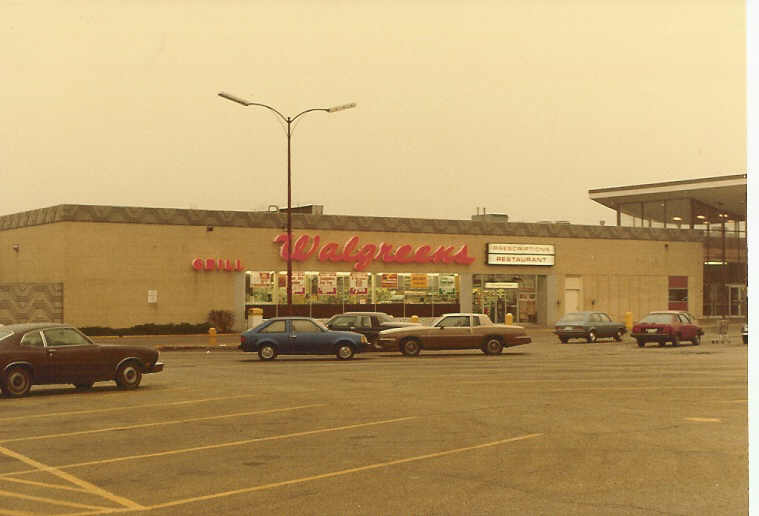
Unfortunately, I don’t know the location of this store, other than to say it was one of a growing number of stores that Walgreens opened in enclosed mall locations during the sixties. If you click to enlarge the first photo, you can see the oval sign and entranceway in the background for “The Grill”, one of the in-store restaurants that Walgreens operated in those days. This store is configured similarly to the Dixie Square Mall location in south suburban Chicago (which opened in 1966 and also had a “Grill” location), although these photos pre-date Dixie Square by at least a year.

Hope everyone is enjoying a great Christmas Eve!
Update 2/16/10 - A bit more research has convinced me that this is the Belvidere Mall location in Waukegan, Illinois. Labelscar has done a fine post on this shopping center, featuring a vintage exterior shot by the late John Gallo.

Friday, January 9, 2009

The Opening of Dixie Square Mall, 1966

The photos above were taken in the fall of 1968, two years after the grand opening of the Dixie Square Mall, located in Harvey, Illinois, a far south suburb of Chicago, on the Dixie Highway (Illinois Route 1) between 151st and 154th streets. Dixie Square, often referred to in its early years as “Dixie Square Shopping Center”, and later on occasionally as “Dixie Mall”, is undoubtedly the most famous “dead mall” of all time. The subject of a new book, a film project, countless websites and more devotees than blackstrap molasses, Dixie Square has become a most unlikely icon of American pop culture.

Why all of this notoriety, one would reasonably ask? There are a number of reasons – first, there’s the simple fact that it was a new, enclosed mall with major anchors (Penneys and Wards), built during an era when many localities were seeing …well, their first new, enclosed malls with major anchors. Secondly, for a medium-sized mall, Dixie Square had some very appealing, high-concept design features. Third, the mall was only open for twelve short years, an extremely brief lifespan. Fourth, amazingly, substantial portions of Dixie Square still stand, more than 30 years after the mall’s closure – a fascinating, albeit dangerous, modern-day ruin.

But the most significant reason, far and away, was the 3 minutes and 30 seconds of celluloid immortality the mall gained in its most celebrated role, a year after it had ceased its primary function. Dixie Square was the site of the famous indoor car chase scene (plus some preliminary hijinks in the mall’s parking lot) in the 1980 film classic The Blues Brothers.

As mentioned, there are some great websites, filled with the fine work of (very brave) modern-day photographic explorers that are dedicated to preserving the history of Dixie Square Mall, so I won’t attempt to go into comprehensive detail here. Instead, I’ll try to touch on some of the major points of Dixie Square’s storied history.

On March 26, 1964 the Blue Island Sun-Standard announced the pending approval by the city of Harvey of a petition to annex the 58 acre site of the rundown Dixie Hi Golf Course for development as a shopping center. On October 12th of that year the annexation was formally approved, and the development group, led by Meyer C. Weiner, broke ground soon afterward.

Architects Hornbach and Steenwyk of Grand Rapids, Michigan were engaged to design the “L-shaped” center, which would feature some 60 stores, including two anchors - Montgomery Ward and Penneys (each with an unattached Auto Center), with a Jewel Food Store, a Walgreens drug store and Illinois’ largest Woolworth’s rounding out the major tenants. The latter two stores would each feature a restaurant, Walgreen’s “Grill Room” and Woolworth’s Harvest House.

The first portion of Dixie Square to operate was the Montgomery Ward store, which opened to the public on October 21, 1965, preceding the rest of the mall by nearly a year. The single-story Wards unit would be Dixie Square’s largest store at 182,000 square feet, including the 20-bay auto center.

On August 31, 1966, with 24 of the planned 60 stores already open and another 12 ready to launch, a dedication ceremony was held, featuring singer Mel Torme and a number of local celebrities. Among these celebrities was WCFL’s “Trooper 36-24-36”, the Top 40 station’s on-air traffic reporter Jane Roberts, a beautiful blonde who frequently made public appearances on the station’s behalf in white short-shorts and the station’s call letters “prominently displayed” on her outfit. (That’d go over well today, eh?) During this time, Jane Roberts was also a regular on WCFL’s legendary “Chickenman” radio segments, a send-up of the wildly popular Batman TV show.

On November 10-12, 1966, Dixie Square’s “official” grand opening was held, hailing the completion of the mall and especially that of its eagerly awaited second anchor, the impressive 2-story, 144,000 square foot Penneys store. Like the dedication ceremony, this too was a grand affair, featuring country music comedians Homer and Jethro, accordionist Art Van Damme (visions of a “Dixie Square Polka” are dancing in my head), and WGN-TV’s "Ringmaster Ned" Locke of the Bozo’s Circus show, a beloved ( and today, fondly remembered) figure of Chicago television, among others.

The real star, though, was the mall itself. Featuring a 60-foot tall tower sign which “(could) be seen from the Illinois Tollway and the Calumet Expressway” outside, sculpture-laden fountains and “ultra-real” tropical foliage (read: artificial) indoors. A truly stunning feature was the “Wonderfalls” display in the mall’s atrium. Engineered and built by Navan, Inc., a division of military aircraft and aerospace manufacturer North American Aviation, the Wonderfalls were tantalizingly described in a Dixie Square grand opening ad in the South End Reporter: “'Flowing' columns emerging magically from the ceiling and dropping 25 feet to disappear mysteriously in a planting of rocks, flowers and trees”…"From a distance, the columns appear to be marble; closer inspection reveals that the columns are composed of liquid falling as droplets in precise paths. Dixie Square’s flowing columns are produced with a special spaceage liquid descending stretched strands of Nylon. The liquid is much heavier than water so that it clings to the strands in droplet shapes as it descends. More than a quarter million droplets are in motion in the five columns at any given moment”.

Through the balance of the sixties, Dixie Square Mall was very successful, drawing large crowds and hosting a wide variety of community events including contests of all sorts, celebrity appearances, Christmas choir programs, Santa appearances (arriving by helicopter, no less!) and all of the wonderful ballyhoo associated with malls of that era.

In 1970, another major anchor was added to Dixie Square. Jewel Companies, Inc., decided to double their investment, so to speak, in Dixie Square with the addition of a Turn-Style discount department store at the rear of the mall. As mentioned, a Jewel Food Store was already in place.
For the city of Harvey, however, things were changing. In 1970, the city was at the approximate midpoint of a huge demographic shift which led to racial tension, described in detail in this Encyclopedia of Chicago article. As the article mentions, Harvey’s “rates of crime, unemployment and poverty were among the suburbs' highest”, and compounding its problems, the city had “lost its industrial and commercial base”. These were hardly ideal conditions for a thriving mall (or much of anything else, for that matter), and Dixie Square’s fortunes would fall precipitously over the next few years.

To make matters worse, the Dixie Square property was the site of a number of sad incidents, including assaults, murder, and the accidental death of a well-known stuntman as he neared completion of a pole-sitting event in the mall’s parking lot. The cumulative effect of these tragic events did much to tarnish Dixie Square’s image.

Despite these setbacks, efforts were made to keep Dixie Square viable. As late as the fall of 1974, such high-profile celebrities as the Harlem Globetrotters (arguably at the peak of their popularity at the time) were booked to entertain mall customers for Dixie Square’s 8th anniversary. Some decorative upgrades were also implemented around this time, including the installation of a huge, funky architectural tent canopy at the mall’s entrance, which is clearly visible in the Blues Brothers sequence. The canopy was designed by a Wisconsin firm called Chrysalis East (a great 70’s name if there ever was one), who provided the massive fabric structures for both permanent installations and special events, including Chicagofest, a series of concerts that were held at Navy Pier in the late 70’s and early 80’s and featured scores of major musical acts ranging from Muddy Waters to Pablo Cruise to Alice Cooper. Coincidentally, the Blues Brothers played there a couple of times (’79 and ’80, I think. Sure wish I’d seen them.), and Sinatra played there in 1982 (Really wish I’d seen him. I did see Cheap Trick, though. How’s that for varied musical taste?).

These efforts did little to slow Dixie Square’s downward slide, and by the mid-70’s vacancies starred to appear, with increasing frequency as time passed. The beginning of the end came on August 30, 1976 when Montgomery Ward announced the closing of its Dixie Square store, effective October 4th. The Southtown Economist quoted the Wards district manager as follows: “Over the past several years we have invested heavily in the nearby Evergreen Park, Munster and Matteson stores, all within a five-mile radius of the Harvey store”. It would become a familiar mantra as other chains began to pull out of Dixie Square in droves. In early 1977, the Karoll’s Men’s Store, pictured above, closed and moved to nearby Homewood. Polk Bros. had already closed – steering their customers to (a good bit further away) Burbank.

One of the strangest aspects of Dixie Square’s demise had to do with the Turn-Style store. With its discount pricing approach, one could have easily expected the Dixie Square Turn-Style to do strong business in light of the area’s declining median income. Problem was, the store was located in the back of the mall with no sight line from Dixie Highway. Out of sight, apparently it was out of customers’ minds as well, as the intriguing advertisement below (from 1972, when the store was a mere two years old) tried to address. When Jewel decided to shutter the Turn-Style operation in 1978, most of the stores went to the May Company for conversion to Venture stores. Sadly but understandably, May passed on the Dixie Square location.

In January 1978, the other shoe dropped when the Penneys store (known of course as JCPenney by this time) closed, its customers referred to the year and a half old Orland Square Mall Penneys. A full year later, closeout merchandise from area JCPenney stores was hauled into the Dixie Square location for one final blowout sale, nicknamed all-too-appropriately “Dixie’s Last Gasp”. The final holdouts were Jewel and Walgreens, both of whom pulled out in mid-1979. Dixie Square Mall passed into history, likely to soon to be forgotten.

Until Dan Aykroyd, John Belushi and director John Landis came along. Aykroyd and Belushi, two members of the original Saturday Night Live cast (and ardent Blues fans), had developed the concept for “The Blues Brothers” through a series of skits on the show starting in 1976. What appeared at the start to be mostly a comedy effort quickly gained a measure of musical credibility as the pair assembled a crack group of legendary session players, including guitarist Steve Cropper, saxophonist “Blue” Lou Marini, bassist Donald “Duck” Dunn and other top-flight musicians. And Belushi and Aykroyd turned out to be decent singers as well, or were at least a good fit for the songs they picked. Of course, humor was still a huge part of the equation, with the funky sunglasses, the “fercocter” suits (That description is from the movie, and I have no idea if it’s vulgar or not. Or even if it’s spelled correctly.), and the crazy stage moves. By the time their record album Briefcase Full of Blues came out in 1978, they were a national sensation. The movie project was announced soon afterward.

The script (written by Aykroyd and Landis) called for an indoor chase scene, and since the story was set in Chicago, and much of the actual shooting took place there, Dixie Square’s availability came at the perfect time. Of course, the planters, benches and much of the rest of the décor were gone, replaced with trellises, carts and other items that would easily break away when hit by the cars. The Jewel Food Store was restocked, at least in front of the camera’s eye, and the mall’s store signs were all relit. A number of retailers showed up in the “fictional Dixie Square” that weren’t part of the actual mall, including an Oldsmobile dealership. It’s my understanding that the Dixie Square Penneys store sported the 1960’s logo (a true classic and one of my all time favorites) throughout its entire existence, and that the signs were pulled down after the store closed. For the purposes of the filming, the company supplied the new (and still current) “JCPenney” logo signage, presumably to maximize promotional value. Most notably, since Walgreens didn’t want to be associated with the film (Guess it didn’t fit their concept of a “drive-thru” pharmacy! Ok, I’ll go back to my room.), the space was taken by a willing Toys “R” Us.
Living in the Chicago area and being in high school at the time, the excitement I saw surrounding the film was palpable. On several occasions, the local news covered the filming as it progressed around town, with such news flashes as “Film crew damages homeowner’s sidewalk!” and other vitally important stories. It all served to build interest, and we awaited the movie’s Summer 1980 release with bated breath.

We weren’t disappointed. It had a great story, musical legends including Aretha Franklin, Ray Charles, James Brown, John Lee Hooker and Cab Calloway, a hilarious role from Carrie Fisher (after the very serious Princess Leia) and great comedic actors including John Candy, but topped of course by Belushi and Aykroyd. For those of us from Chicago, it held a special charm with so many local icons forming the backdrop of the movie – Wrigley Field, the CTA, Lower Wacker Drive, the Civic (Daley)Center, and on and on. Oh, and a great chase scene filmed inside some mall I’d never heard of...at least not yet.

“The Blues Brothers” stands as a true modern classic, shown frequently on cable TV and available on DVD. In 1998, it spawned a (not exactly classic) sequel. Many dreams and schemes for the redevelopment of Dixie Square Mall have been floated over the years, some as recently as 2007. But it still sits there, awaiting its own sequel - that elusive combination of civic vision and corporate investment to return to Harvey what it once had – a safe, up-to-date shopping center.

In the meantime, of course, the legend of Dixie Square Mall continues to grow.

A very special thanks goes to Dan Steenwyk, Paul McVay and Michael Brown for making these photos available. All of the photos are © 1966 by Steenwyk Architects, ALL RIGHTS RESERVED.

Top to bottom, the photos can be described as follows: An angled view of the Penneys and Walgreens stores at the main entrance to the mall, a square-on view of the Penneys entrance, an interior view looking towards Penneys’ inside entrance, the wonderful Wonderfalls, a close-up of the mall entrance between the Penneys and Walgreens, a close-up of another mall entrance, (the Wards store is to the right, and the Baskin-Robbins sign can be seen peeking out of the left edge), the Wards inside entrance with some impressive metalwork (on the impressive fountains), and the Wards Auto Center against the chilly fall evening sky.

Below are some early newspaper ads, including one that puzzled me at first. The December 1965 “Sidewalk Superintendents Wanted” ad is probably not a solicitation for supervisory help as I thought at first glance, but instead a nudge to the curious to come out and watch the mall’s construction progress, hopefully spreading the exciting word afterward. In today’s environment of litigation and OSHA standards this would be a definite no-no today. The second ad is for the October 1965 Montgomery Ward grand opening, the third from November 1966’s official Dixie Square Mall grand opening, and the last, the somewhat desperate Turn-Style ad referenced above.

Some additional notes: A couple folks have informed me that the interior scene where the cars crash into the Jewel Food Store was actually filmed inside the Penneys store, mocked up to look like an interior entrance for Jewel. Apparently this particular Jewel did not have a major inside entrance from the mall. I would guess the film crew pulled down the outside "JEWEL" signage and reinstalled it inside for filming. Also, for an up-to-the-minute (or at least up to this past January 11) look at Dixie Square, Jon Revelle has kindly sent along links to some excellent new photos and a great video (complete with soundtrack - and snow!).