Showing posts with label Detroit. Show all posts

Tuesday, January 1, 2013

Happy New Year!


All right, so this one might be a little obvious- a photo showing a “Happy New Year” sign for a New Year’s Day post, but I like it a lot. This photo, a 1985 original snapshot, depicts the tri-faced tower sign for the Macomb Mall in Roseville, Michigan, a northeast suburb of Detroit, an area where cool shopping center signs were the order of the day, it seems. When the photo was taken, the sign (and the mall) was already 21 years old, but believe it or not it still stands today, just one year shy of Macomb Mall’s golden anniversary.

There have been a few changes over the years, naturally. Crowley, Milner and Company (background of the photo), a proud department store presence in the Detroit area since 1909, prospered in the shadow of its much larger department store competitor J.L. Hudson Company for decades. Things grew tough by the 1990’s however, and despite valiant efforts to reinvent itself and to introduce new formats, Crowley’s closed its doors in 1999, selling out to Columbus-based Schottenstein Stores, owners of Value City. The Macomb Mall store, along with two other locations, was reopened under the name of “Crowley’s Value City.”  These were closed in 2008.

In 1985, a MainStreet store (division of Federated Department Stores) was opened, later becoming a Kohl’s in 1988, amid the wild selloff of Federated assets that followed in the wake of the Campeau takeover that year.

The script-signed Sears store was magnificent. Built at the peak of the company’s power, it’s an enduring reminder of that great institution’s glory days.  

Regarding the tower sign, this was actually the second of this design to be installed in the area – in 1962, two years prior to Macomb Mall’s opening, its developer Schostak Brothers & Company opened Livonia Mall, northwest of Detroit, with the same two anchors – Sears and Crowley’s.  Livonia Mall was torn down in 2009 and a new shopping center, Livonia Marketplace, occupies the site.

A third area center, Troy’s Oakland Mall, was developed by a different company yet sported signs that were very similar to the Livonia and Macomb signs, with a just a few differences. Once again, Sears was the main anchor (opened in 1965, it preceded the rest of the mall by a couple of years), but this time it was Crowley’s competitor Hudson’s supplying the local department store flavor. Hudson’s was later converted to Marshall Field’s and is now (cue the rimshot) a Macy’s. The signage that exists there now is, shall we say, less than inspired.

At any rate, thanks for joining me as we begin a new year of Pleasant Family Shopping. I hope you’ll stick around as we continue to explore the great architecture, the good, bad and just plain crazy business decisions, the strange coincidences and the tender moments of America’s retail past.

Oh, and please…drive with care!      

Tuesday, November 11, 2008

Barney Kroger - The Cincinnati Kid

The history of Kroger, like that of so many companies born in the same era, is a great American story. The roots of today’s Kroger Company reach back to 1876, when 16-year old Bernard Henry Kroger took a job selling coffee and tea door-to-door for The Great Northern and Pacific Tea Company in his hometown of Cincinnati. Kroger, one of ten children born to German immigrants, worked hard to help support his family, who lived in a flat above a dry goods store the family owned. After two years, Kroger left Great Northern to join the William White Company, another coffee and tea firm, leaving that firm shortly thereafter for the Imperial Tea Company.

When Imperial began to run into trouble, the owners asked young Kroger (who had been working a wagon route up to that point) to manage the company’s store for a 10% cut of the profits, which at the time were virtually nonexistent. Convinced he could turn things around, he took up the challenge. A stickler for quality with more than a bit of starch in his personality, Kroger built a following for the store. Interestingly, as Progressive Grocer noted, “It wasn’t a wealthy clientele. They were wage-earners’ wives who came back to shop, and told their friends…” Having saved up $372 from a year of toil, a considerable sum in 1883, Kroger approached the Imperial Tea owners with an offer to buy a one-third interest in the company. They refused, offering an increased share of the profits instead. Adamant about owning a stake in the game, Barney decided to strike out on his own.

With an additional $350 borrowed from a friend, Kroger opened “The Great Western Tea Company”, a tiny store on Cincinnati’s Pearl Street, replete with fire-engine red paint and gilt lettering, with a horse-drawn wagon sporting the same colors. Through some initial setbacks, including the loss of the horse and wagon in an unfortunate train crossing accident, a flood which destroyed the store’s initial stock, and an attempt by his landlord to increase his store’s rent (forcing Kroger to move to a less attractive location on a side street), Kroger persevered.

Within months, Kroger opened a second store, and by mid-1885 had added two more for a total of four units. By 1893, after ten years on his own, Kroger had 17 stores and was considered one of the most successful businessmen in Cincinnati. In 1902, The Great Western Tea Co. was reincorporated as The Kroger Grocery and Baking Company, which would remain the company’s legal name for the next 40 years. The word “baking” in the company’s name reflected an important aspect of Kroger’s business. At the turn of the century, Kroger made a splash by announcing his plans to set up the company’s own bakery, selling loaves to Kroger customers at half the average going price, then 5 cents each. Not only would this help build business for his stores, but it also would enable Kroger to capture a bigger chunk of his customers’ bread budget, beyond just bulk flour, butter and egg sales. As he acknowledged to a New York Times interviewer in 1901 - “In Cincinnati, with its large percentage of thrifty Germans, bread is usually baked in the home”. At two for a nickel, Kroger projected sales of 25,000 loaves per day to those thrifty folks.

Another innovative step Kroger took was born out of the company’s 1904 acquisition of the Nagel butcher shop chain in Cincinnati. After initially operating the meat markets separately, Kroger made a decision to integrate them into his grocery stores. Over the initial objections of his butchers, who resented the loss of their independence and the new bookkeeping requirements Kroger imposed, these early forerunners of the “complete food market” proved to be a huge success and had a great influence on the chain food store business as a whole.

With a solid base in Cincinnati, Kroger began to expand to other areas, first to nearby Hamilton, Ohio, then to Dayton and Columbus, where the company had 15 and 8 stores respectively by 1910. These initial forays were followed by an expansion drive (which reached a fever pitch by the late 1920’s) to other cities and the smaller towns in between- Detroit, St. Louis, Peoria, Indianapolis, Toledo, Cleveland, Grand Rapids, Youngstown and Charleston (WV), to name some examples. Much of this growth was accomplished through acquisition – 109 Piggly Wiggly and 43 Kohn Stores in the St. Louis and Central Illinois areas, 108 Piggly Wiggly stores in Louisville, 114 Bowers grocery stores in Memphis and the surrounding area, (along with yet more Piggly Wigglys) and Universal Stores of Madison, Wisconsin. In the coming decades, acquisitions would continue to provide a major vehicle for Kroger’s growth.

In late 1926, rumors began to fly that Kroger would merge with Philadelphia-based American Stores Company, possibly in combination with First National Stores or the H.C. Bohack chain. While some talks were held, these plans never came to fruition, and in my opinion would likely have not gone over well in light of the beginnings of a movement against chain store “monopolists” (or more accurately, oligarchs) that would gain sentiment as the 30’s rolled on.

In December 1927, B.H. Kroger sold his stock in the company, staying on as chairman but stepping down as president, turning that responsibility over to William H. Albers. Later on, he would repurchase a huge block of Kroger stock to help bolster confidence in the company through the depression years that followed. In November 1931, with nearly 4,900 stores in operation, he retired altogether. Barney Kroger passed away in July 1938, leaving behind a company that 70 years later is the largest company in America whose mainline business is supermarkets – an admirable legacy.

These photos are undated – the top photo showing a “B.H. Kroger” store circa the dawn of the 20th century. Below is a typical Kroger from the early 30’s, near the end of Mr. Kroger’s tenure with the company.


Tuesday, April 29, 2008

Kmart's Mid-Sixties Ascent

In contrast to its discount image, in the mid-sixties at least, the opening of a new Kmart could arguably be considered a town status symbol. Adding an average 35 stores per year at the time, Kresge would step up its pace even more as that tumultuous decade rolled on, tallying nearly 60 new Kmarts a year by 1970. Development was particularly heavy in the southern and western states, where Kresge had virtually no presence prior to 1960. The company continued to open a small number of new Kresge stores (only 2 in 1965, for example), but by then the writing was clearly on the wall, and all significant resources were plowed into the Kmart program. Surprisingly, a number of the Jupiter stores (a format that was developed to “ride out” the leases of fading Kresge stores) did well, and Kresge found itself in the unexpected position of signing new leases for those locations. Kresge also lost its founder during this period. Sebastian Spering Kresge passed away at the ripe old age of 99 in October 1966, having lived to see Kmart's initial triumphs.

During 1965, Kresge bought out two of Kmart’s original lessees – Holly Stores, Inc., the operator of Kmart’s womens’ and girls’ clothing departments, and Dunham Stores Corporation, who ran the sporting goods departments. A few years later, Kresge would combine the sporting goods and automotive supplies groups into a wholly-owned subsidiary called Kmart Enterprises.

As several of the photos show, Kmart heavily promoted their own private label goods, and many of them became respectable sellers. I vividly remember the first branded Kmart item I owned, a set of 10 (or so) magic markers (the package referred to them as “Water Colors”) in the familiar teal and gold Kmart packaging. My brother and I treated them like prized possessions. That was until we kept leaving the caps off, and one by one they dried out…

The first photo, from 1964, shows the majestic Rocky Mountains looming behind a Denver Kmart (with lots of room to expand!), with a nice snow cover over all. Following are five interior views from 1966, showing a service desk, always front and center in Kmart stores, a toothpaste display (lab tested!), a display of Mattel “Cheerful Tearful” dolls, and one of telescopes (must’ve been a popular featured item in discount stores back then) and lastly a typical supermarket aisle. Below is a nifty 1964 Kmart ad heralding the second Fresno, California store. This ad is interesting in that it shows the geographic distribution of the earliest Kmarts, although the stores are listed in alphabetical order by city, not chronological order.

Saturday, April 26, 2008

What's the Frequency, Kmart?

The transformation that the Kresge company underwent with the introduction of Kmart was dramatic, to put it very mildly. Among the most impressive aspects were the sheer speed and scale of the rollout. Once the final decision was made to push forward with Kmart, Kresge president Harry Cunningham gave a mandate to Kresge’s real estate department that at least 60 leases be secured for new Kmart sites to accommodate the planned rapid-fire growth. As mentioned, there were 18 Kmarts in operation at the end of 1962. 35 would be added in 1963, 35 more in 1964, and 34 more in 1965. By the end of the decade, there would be over 270 Kmarts in all regions of the United States, as well as Canada and Puerto Rico.

Aside from four small-footprint stores that were used in part for development purposes (Kresge called them “bantam” K-marts), the average square footage of the earliest Kmarts was 60,000, growing to 75,000 within a couple of years and to over 90,000 square feet by the end of the 60’s. In the following decade, they would consistently exceed 120,000 square feet.

The simple, rectangular, box-like design of the Kmart stores was a definite aid in the speed at which the stores opened, with average construction time at a brief six months per store. Another key factor was Kresge’s insistence on building free-standing stores in most cases, thereby avoiding frustrating (and costly) delays at the hands of shopping center developers. Kmarts were often located near other stores, but were rarely connected to them.

Kresge sought to open at least two (often more) stores in quick succession within a given market in order to maximize advertising dollars. The first major market, for obvious reasons, was the Detroit metro area, Kresge’s hometown, where seven Kmarts were operating within the first two years. Atlanta, Denver, Knoxville, Fresno and Charlotte were among the other early multiple-store markets.

The store carried a full line of merchandise, including clothes, kitchen items, home improvement and auto accessories , sporting goods, a camera department (remember the “Focal” brand?), electronics (or “Television and Hi-Fi” as such departments were then commonly called), jewelry, and in many cases, a full-line supermarket. A number of the departments were leased, among them sporting goods, cameras and jewelry.

Most notably the supermarkets were leased, from a number of different operators. The early Kmart supermarket lessees were moderate-sized grocery firms, including Borman Food Stores, Inc., the first operator of the some of the K-mart supermarkets in Michigan, Illinois and Indiana. Even small family-owned grocers got in on some of the action. When the Benton Harbor, Michigan Kmart opened in 1963, for example, the supermarket portion was operated by John Sassano, an independent grocer based in Hobart, Indiana. The largest operator of Kmart supermarkets would be Detroit-based Allied Supermarkets, who signed on with the company in June 1964. Allied up to that point had operated food stores in the Midwest, Texas and Oklahoma under the names Wrigley and Humpty Dumpty, among others. They would eventually operate grocery units in a great many Kmart stores all over the country well into the 1970’s. The supermarket areas averaged 20-24,000 square feet and were all thoroughly branded “Kmart”, regardless of the operator. There even was a line of private label items, including Kmart potato chips!

The stores were big, fairly colorful, and most importantly featured discount prices across the board. And then there were the “special buys” (later called “bluelight” specials) to drive high-volume sales on select items. Kmart’s selling prices were set at Kresge headquarters in Detroit, and interestingly, the individual Kmart store managers were given the authority to lower prices to beat local competition, but they were forbidden to raise them. “Charge It!” banners abounded.
Customers showed up en masse, and most of them instantly became regulars. A retailing legend was born.

The photos, dating from late 1962/early 1963, show some of the earliest Detroit area Kmarts, including an exterior view (the Kmart logo would be tweaked slightly on future stores), and views of various departments. The woman shopping in the supermarket area resembles Barbara Billingsley, TV’s Mrs. Cleaver. She’s shopping the detergent aisle, and if you look carefully you can see some boxes of Tide, that most photogenic of consumer products, to her lower right. There's a mezzanined furniture area visible behind the camera department, a feature of a number of early stores. I find the last photo very touching, because it seems to feature a real-life mother and daughter, not professional models. The mom looks like the kind who would have had fresh cookies baking in the oven when you showed up home from school.

Monday, April 21, 2008

S.S. Kresge's Pre-K Days


Before discount stores popped up all across America, there were the variety stores. For decades, Middle America shopped at these stores for their basic needs – housewares and kitchen items, linens, basic clothing, shoes, school supplies, toys and so on. Most of the larger variety chains had their origin in the decades immediately preceding or following the beginning of the 20th century. They were fittingly known as “5 and 10 cent stores” in the early days, for the simple reason that most products sold for one of those two price points. Even as late as the early sixties, when the chains had long since begun carrying higher priced items, they were still popularly referred to as “dime stores”. Until well into the 1940’s, they were almost exclusively found in downtown locations, with shopping center locations slowly becoming part of the mix from that point on. Many variety stores had snack bars or luncheonettes. The chains’ stores had a similar look, especially from the exterior, with the signage style for a number of them virtually the same (until the early 1950’s at least)– a narrow, red sign across the full width of the storefront, with gold or silver serif lettering. Even many of the store names followed a recognizable pattern – F.W. Woolworth, J.J. Newberry, W.T. Grant, S.H. Kress, G.C. Murphy and…. S.S. Kresge.

S.S. Kresge Company, based in Detroit and officially founded in 1911 by Sebastian Spering Kresge, was the number three variety chain in the US at the dawn of the sixties, behind F.W. Woolworth and W.T. Grant. At the end of 1960, Kresge had 759 variety stores, mostly located in the Midwest and Eastern states. The company’s first stores in California wouldn’t even open until 1961, and their presence in the growing Southern states at this point was minimal at best. By all appearances, Kresge was a staid, conservative, regional retailer, expanding at a relatively steady, deliberate pace.

Behind the scenes, however, an exciting development was taking place at Kresge. Faced with the same challenges that were affecting the variety store category as a whole – declining profitability, increased labor costs, stores that were becoming too old, too small and too urban, and impacted by the success of upstart discounters such as E.J. Korvette, Kresge embarked on a plan to scope out the discount industry for themselves.

In 1957, Harry B. Cunningham, the energetic 50-year old head of sales for Kresge embarked on a new mission, one that would take him all over the country over the next two years. Cunningham was placed in charge of a project to explore the discount industry up close, visiting stores, taking note of what worked and what didn’t with an eye toward Kresge’s own entrance into the discount store business. Cunningham liked the potential he saw, and the initial plans and strategies began to come together. In March 1961, with Cunningham now at the helm of the company, the decision was made to go full steam ahead with “Kmart”, Kresge’s discount store concept.

To coincide with this, the decision was made to accelerate closing of many of the older, outmoded Kresge stores. In a number of cases, Kresge was locked into long-term leases on these older, less than desirable locations, so a third store format was devised to make use of those stores. Those Kresge stores would be converted to “Jupiter” stores, a bare-bones discount operation specializing in a limited line of high-demand, basic goods at deep discount prices. Robert Drew-Bear, in his excellent book “Mass Merchandising” cites that the Jupiter format “made it possible to move items such as price-maintained men’s underwear with extreme speed, whereas the same line barely moved as a (Kresge) store item”.

On January 25, 1962, the first store under the Kmart name opened, one that was generally thought of as a “test” Kmart in California’s San Fernando Valley, a store of only 24,000 square feet. The first “official” Kmart, a 60,000 square foot store, opened in the Detroit suburb of Garden City, Michigan on March 1 of that year. By the end of 1962, 18 Kmarts would be in operation.

It was an impressive start for an initiative that would profoundly change the S.S. Kresge Company and indeed American retailing in general. Within a few short years, the Kmart stores would leave not only Kresge’s variety store competition, including Woolworths and Grants, in the proverbial dust, but a good number of other retailers as well.

The first artist’s rendering is of the Kresge store at Pontiac Mall (later Summit Place Mall) of Pontiac, Michigan and dates from 1960. The second one, in color, is from an unknown location, 1959. Below is the Kresge store located at Winrock Center, in Albuquerque New Mexico, from 1961 along with renderings of the new formats - Jupiter and Kmart, from the same year.
Note: Thanks to the anonymous commenter who was kind enough to provide us a link to some vintage 1964 Kresge store "mood music" - Fantastic!


Thursday, April 17, 2008

Remember...TYFSAK!


From the tail end of the 60’s well into the early 80’s, my family and I often shopped at Kmart. (In my case, the one at Algonquin and Golf Roads in Arlington Heights, Illinois. A Lowe’s now sits on that site.) I was always intrigued by a small, fluorescent light red sticker with black type that read “Remember…TYFSAK!” that seemed to be on every cash register in the store, right next to the numeric display. Tyfsak?! What in the world is that? For me, it became the Great Mystery of Kmart. Somehow, eventually, the nickel dropped and I figured out that it stood for “Thank you for shopping at Kmart”, the phrase all conscientious Kmart checkers exclaimed at the end of every successful transaction. Guess I could have asked, but that would have taken all the fun out of it.

The photo above is of a Detroit-area Kmart, Christmas season 1965, when Kmart was beginning to knock the traditional retail world back on its heels.

Sunday, December 2, 2007

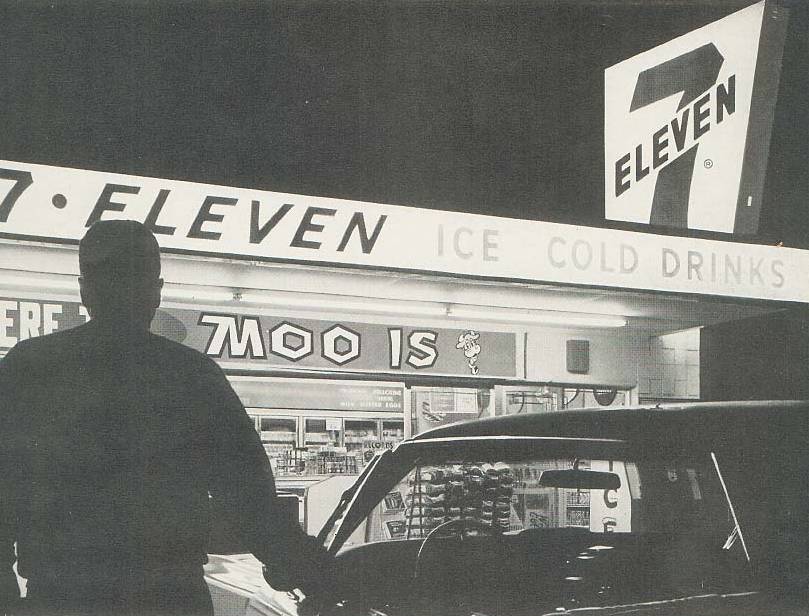
Sixties, Slurpees and the Sev


The 1960’s saw two major developments in the history of 7-Eleven and its parent, the Southland Corporation. The first was a continuation of the company’s rapid geographical expansion, which would result in 7-Eleven becoming a virtual nationwide presence by the end of the decade. The second was the 1967 introduction of the company’s signature product, the Slurpee.

In March 1964, Southland made what would probably be its most important single acquisition, the 100-store Speedee Mart chain, with stores in all of the key markets in California. With this purchase, Southland not only picked up a solidly managed operation in the country’s most dynamic markets, it gained a crucial foothold in the field of franchising. Speedee Mart was a successful franchise-based operation. In the coming years, franchising would serve as rocket fuel for Southland’s expansion plans. For a couple of years after buying out Speedee Mart, Southland would maintain the Speedee Mart name, augmented with 7-Eleven’s logo.

7-Eleven entered the Chicago market in 1965, and within two years had 14 stores in the area. The following year, they acquired the 86-store handy-Pantry chain in Georgia and Tennessee, and in 1968 they bought out Gristede’s, an upscale chain of 115 small grocery stores in the metro New York area. Not long afterward, the company would add the New England, Detroit and Buffalo markets as well. Southland also bought out a number of prominent local dairies in the 60’s as well, both to supply dairy products to the 7-Eleven stores and in some cases, home delivery. These dairies included Wanzer’s in Chicago, Adohr Farms in California, Midwest Farms (multiple Midwest locations), Velda Farms in Florida and Embassy Dairies in DC.

Look carefully at the first photo, which dates from 1965, and you’ll see that the drinks the kids are enjoying are in fact not Slurpees but Icees, an independently owned frozen drink that’s been around since 1959 (and until very recently was sold in cups of the exact same design as those pictured). In 1965, Southland launched a test in three stores utilizing a new and fairly expensive piece of equipment, the Mitchell frozen drink machine. The test far surpassed the company’s expectations, and plans were quickly laid in place to install machines in 100 more stores, followed by the green light to implement them chain-wide in all of the chain’s stores. It was determined that a slightly different process (using the Taylor frozen machines) and an exclusive brand name was needed to firmly link the new frozen drinks with 7-Eleven in consumers’ minds, and thus the Slurpee was born (One might assume that from that point forward, Icees were forevermore banned from 7-Eleven premises, but in fact the Icee machines were used in a number of their stores for several more years).
A huge success, the Slurpee proved that if a company can effectively appeal to the kids’ market, then more often than not their parents are locked in as well. McDonald’s would realize this on an even larger scale with introduction of the “Happy Meal” twelve years later. Another benefit 7-Eleven gained from the Slurpee was a multitude of packaging and promotional possibilities (which were also areas McDonald’s would later excel in with the Happy Meal), mostly revolving around collectors’ cup designs, which my friends and I treated like gold - Baseball Tradin’ Cups, Superhero Tradin’ Cups, Star Wars and even Rock Group Tradin’ Cups (my brother had a J. Geils Band tradin’ cup, which looked pretty nasty after a year of dishwashing, trust me). For a couple of years we lived close to a 7-Eleven in Arlington Heights, IL where my brother and I stopped in on a near-daily basis.

In later years, 7-Eleven would tilt the scales back toward more adult tastes by heavily promoting a new line of gourmet coffee. A few years ago, my childhood 7-Eleven experience was repeated in a strange way. I was working with a customer in Long Island, New York, for which I had to fly in for meetings every few months over the course of a year. We would start the meetings about 8am. Invariably, about an hour into the meeting, regardless of the importance of the topic being discussed or who else was there, the main guy would stand up and say “This coffee’s crap, let’s go to the Sev”. Of course, we would all load up into his car and drive the few blocks to the friendly local 7-Eleven (I’ve called them “The Sev” ever since) where I admit the coffee wasn’t bad at all. I didn’t save the cups this time, however.

The second photo is an interior from 1964, the third an exterior from the following year.

Monday, July 9, 2007

Serving You Better....Saving You More


Time for a tip of the hat to another major Chicago-based grocery chain - the late, great National Tea Company. Through the first half of the twentieth century, National was one of the largest Chicago-area chains, but gradually lost its market dominance to Jewel (and later to Dominick's) through the 50's and 60's. In its heyday, National was a force in many key Midwestern markets - Chicago, Minneapolis, St. Louis, Detroit, Milwaukee and several smaller cities.


By the time I came around in the 60's and early 70's, National was fading fast. My folks shopped at two different National stores on an infrequent basis, one on the corner of Elmhurst Rd. and Dempster St. in Mount Prospect, which was torn down and replaced by a Venture/A&P combination around 1975 or 6, and another on Kirchoff Rd. in Rolling Meadows which was right next to a Topps "Discount City" Department Store. The Mt. Prospect store resembled the one shown in the third photo above. The Rolling Meadows store was kind of cool-looking. It was opened in 1961 and had only been open a few years before it was was remodeled and given a very "60's" white facade (which it shared with the Topps store) with both store names rendered in the National logo-style neon block lettering. The Topps lettering was green neon and the National lettering was red neon (or maybe vice-versa - hey, it's been a long time!). They looked fantastic at night. The last I saw of it, which was about a year ago, the building still stood - although I believe it was vacant. The 60's facade has long since been replaced.


The photos above are circa 1958. The locations are unknown, although the first store sports a Sanders Bakery sign, indicating that it must have been a Detroit-area store. Sanders was a well known bakery in the Detroit area and was featured in the National stores there.