Showing posts with label Acme. Show all posts

Wednesday, December 12, 2012

A 1950's Christmas in Martinsburg


It’s always amazed me how Kodachrome film can make an over 50-year old scene look like it took place last night. That’s certainly the case here in this beautiful night shot of a Christmas shopping crowd at a Peoples Drug store in Martinsburg, West Virginia, from an original slide I bought some time back.

But this was well over fifty years ago, probably closer to sixty, an infinitely simpler time compared to today’s warp drive existence. This was prior to the “shopping center era” for most communities across America, and prior to the “mall era” for all but a handful. These were the early postwar years, just before the boom, a time when doing a big chunk of one’s Christmas shopping at the corner drugstore was still an entirely reasonable proposition. When the main Christmas gifts one received, oftentimes, were the ones that still matter most today –time spent and meals shared with loved ones.  Oh, and maybe a new Falcon Pipe for Dad and a bottle of Tussy Wind and Weather Lotion for Mom, of course.

Peoples Drug, the leading drugstore chain in the greater Washington, D.C. area, had a history that spanned the 20th century itself, save for a few years on either end.  Founded in 1904 with a single store at 824 7th Street in D.C., the company had grown to nearly 160 stores by the end of 1955, with locations in six states (Maryland, Virginia, West Virginia, Pennsylvania, Ohio and Tennessee) in addition to those in the District. The Peoples name lasted until the early 90’s, a few years after their acquisition by CVS.

I don’t know the address of this location, and being a night photo there aren’t enough visible details to date the building with any accuracy. As always, I’m hoping someone can help us here. The signage, however, sports the wonderful late 30’s/early 40’s deco lettering (“drugs”) that many drug chains (and variety chains like Kresge and Murphy) used from time to time on corner locations.

To the extreme right of the photo you’ll notice another retail icon – a tower sign for the Acme grocery store. Now there have been lots of Acmes out there – Acme of Akron, Acme of Virginia, Acme Co. (makers of rocket-powered roller skates, dehydrated boulders and the “Do-it-Yourself Tornado Kit”), but I think this store was part of the best known Acme of all, the Acme Markets division of the Philadelphia-based American Stores Company. For many years they operated a small number of stores in the West Virginia panhandle.   

All I know is I’d have loved to have done at least some of my Christmas shopping there.  A Stetson hat and a time machine, and I’m there!   
     
One quick note - I’m so sorry for the long gap between posts. I’d like to be able to say I was “waiting for the end of the world” as the Mayans would put it (or was that Elvis Costello – I never get these things straight), but I can’t. I’m working on some new things to put up here, some holiday related and some not, between now and Christmas.

In any event, I hope each one of you is off to a great holiday season, or will be soon! 

Friday, October 24, 2008

A Leisurely Day at Alpha Beta, 1966


Here’s a magnificent example of modern day Spanish-style retail architecture – built in 1965! This 1966 photo is shown courtesy of the Orange County Archives, thanks to Chris Jepsen for the tip. This Alpha Beta supermarket opened in March 1965 at the Rossmoor Leisure World Shopping Center in Laguna Hills, coinciding with the opening of the adjacent huge retirement community of the same name. Though the architectural look of this store is heavily employed today, it was exceptional at the time even for Alpha Beta, most of whose new stores had more of a “sixties look” (whatever that means). The store would have easily fit right in with those opened five, ten or more years later. Shopping here would definitely have been my idea of leisure - yours?

Update 10/25/08 - Although gas stations aren't part of the normal fare on this site, I went ahead and added the other Leisure World area photo from the O.C. archives - a Chevron station pic from the same year, 1966, to show how the Spanish-themed architecture carried over through the entire development. This photo has a couple of other interesting aspects - the "mini unisphere" globe in the background which was the logo for Leisure World, and the hand painted "gas war" sign. "Gas wars" were a staple of American life in the years prior to the 1970's energy crisis. Competing stations on opposite corners would cut their price by a penny or two (which was a lot when gas was just 26 cents a gallon!), and the others would scramble to follow suit. Makes me wish the Exxon station down the street would duke it out on my behalf!

Thursday, December 13, 2007

Grand Union, Independent Innovator


Grand Union held its own through the Depression years and made slow but steady progress through World War II. By the war’s end, however, the company faced a new challenge, perhaps less from external forces than from a growing friction between company president J. Spencer Weed and Lansing P. Shield, vice-president and number two man in the company. Weed was extremely conservative in his approach, and was dead-set against joining the industry trends toward building larger, suburban stores and self-service. Over the years, Shield would emerge as Weed’s polar opposite, full of energy and ideas for transforming and expanding the (then fairly young) supermarket concept and eager to push Grand Union out onto the industry’s leading edge.

The relationship between Weed and Shield (I know, together the names sound like a lawn care product, don’t they?) reached a final breach in mid-1946 when Weed entered into negotiations with the American Stores Company (parent of Acme Markets) to sell Grand Union out. American was multiples larger than Grand Union, with 1,964 stores at the end of 1945 vs. Grand Union’s 320 stores. The merger deal was officially announced in the New York Times on October 8, 1946.

Aghast at the prospect of having spent 22 years in building up Grand Union only to hand its future over to another firm, Shield vigorously opposed the merger. Ultimately, enough key stockholders and directors agreed with Shield that the deal was called off, as announced in the Times on November 5th. Weed stepped down from Grand Union’s presidency immediately, and within a year would retire from the board of directors as well, leaving Shield in full control of the company.

Shield moved quickly to convert the Grand Union stores to self-service and to ramp up the company’s building program. In the next ten years, he would spearhead the development of new concepts in store layout, breaking away from the traditional “aisle format” into a sort of departmentalized “island” concept. Grand Union was also an early leader in the use of color in their stores, carefully selecting hues for each area to maximize sales appeal.

Not only was Shield a grocery industry innovator, he was an inventor as well. The Food-O-Mat, as Fortune magazine called it, was Shield’s “personal, patented invention”, and was first used to handle canned goods. The key feature of the Food-O-Mat was its gravity fed design, with shelves that sloped downward toward the customer aisle, while stockers would replenish cans from a hidden back aisle, behind the wall. One advantage of this design was that restocking could take place during a regular shift as opposed to overnight, or to getting in the way of customers while they shopped. The Food-O-Mat became so successful that it was soon adapted for a number of other uses, including cosmetics. Grand Union eventually set up a subsidiary to manufacture and market the Food-O-Mat to other chains (both food and non-food), including Macy’s, Kroger and even direct competitors like spurned suitor Acme, among many others.

The first photo is of the Glens Falls, NY store exterior from 1947. The second, from the same year, shows the Food-O-Mat in the Monroe, NY store. The third and fourth photos show a wider store view and a close up of the “Meateria” (definitely my nominee for scariest department name ever) from unidentified stores in 1948 and 1949. Just for fun, in a tip of the hat to Grand Union’s Route Division, the last photo shows a route truck and salesman’s car from the Syracuse, NY branch in 1947.

Friday, October 5, 2007

An Ideal Selection

Here’s a nice display of Acme Markets products, circa 1965/6 - an era when many supermarkets were just beginning to recognize the revenue potential of house brands and thus began sprucing them up to maximize sales. The “eye” logo on the packaging of some of these items preceded the stores’ new image (as featured in the previous post) by a couple of years. I notice that some of the products are labeled under their main brand “Ideal” but also under the “Farmdale” or "Glenside" brands, leading me to wonder if Acme sold under the other brands on a wholesale basis or through their Rea and Derick Rexall stores. Also, check out the "One Whole Chicken" in a can on the top shelf. Mmm!

Tuesday, October 2, 2007

Acme's Swingin' Sixties Look


Acme’s stores of the nineteen-sixties could scarcely have looked more different from those of the previous decade. In 1960, a new design was implemented that featured a peaked roof with a full façade of glass. The “Acme” script was discarded in favor of a block-lettered logo at first. After a year or so, a new Acme logo (that to me, at least, still looks modern) with a unique “eye” shape was introduced, completing the image that is still well-remembered today. Also, the design was modified somewhat - the gable portion of the facades was now filled in with opaque panels instead of glass and small sections of stone veneer appeared on the sides. The first photo, featuring the initial “new look”, shows the Newtown Square, PA Acme, a store that was built around 1960, after a 1967 expansion added a side wing. The second photo features the King of Prussia, PA store from 1962, the third the Upper Darby, PA store which opened in August of 1963, and the fourth the Pottstown, PA store (with an Acme-owned Rea and Derick Rexall store barely visible in the distance) which opened in March, 1964.

In 1962, American Stores Company changed its corporate name to Acme Markets, Inc. In retrospect, this move is somewhat surprising in light of the fact that they had just completed the acquisition of a second major banner, and in the next few years would add several other businesses to their corporate family. The name would finally revert back to American Stores in 1974. This “second major banner”, of course, was Southern California’s Alpha Beta Food Markets, which became part of Acme on January 16, 1961, and instantly established Acme on the West Coast with the major presence of a well-respected supermarket brand. Acme would make substantial investments in Alpha Beta’s growth in the coming years, including new and remodeled stores and a massive new distribution and office complex in La Habra, California. Under Acme, Alpha Beta would enter the Bay Area market with its first store in 1967.

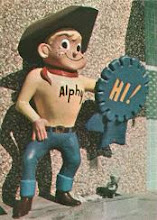
The 1960’s also saw Acme’s diversification into the restaurant and pharmacy arenas in both their Eastern and Western regions. The first Alphy’s coffee shops were opened in the SoCal area around 1966 or so. The Alphy’s restaurants (similar in concept to a Denny’s or Sambo’s) were typically located near Alpha Beta store locations in shopping center outparcels. In 1962, the company opened the first four of their Hy-Lo Drug Stores, and would ultimately place a few of these in former Alpha Beta locations. Only a relative handful of Hy-Lo’s were ever opened. In the East, Acme purchased the 47-unit Rea and Derick, a Rexall Drug franchisee, in September 1964. Also, in 1968, Acme obtained franchise rights from Rocky Mount, NC-based Hardee’s Food Systems to operate Hardee’s restaurants in their home Philadelphia region. The Alphy’s and Hy-Lo operations were managed from the Alpha Beta hub in La Habra, while the other businesses, of course, reported to the Philly corporate offices.

Sunday, September 30, 2007

The Men of Acme, 1956

Authoritative 1950's-style announcer voice: "Remember this, folks! When better markets are built, Acme Men will build them! Just look at these Acme Men...Men of foresight...Men of ingenuity...Men of zeal!"*

Zeal notwithstanding, Acme’s late 1950’s stores were fairly plain as a rule, with the only standout aspect being the “Acme Markets” logo (which by this time had evolved into a cool automobile fender-style script) above the awnings. The example shown below in a 1957 photo is typical of the period and portrays the design seen in a multitude of shopping center and free-standing Acme locations. From an architectural standpoint, much more interesting things would come from Acme in the 1960's.

Acme closed the 1950's with 870 stores, of which only 50 remained of the service type, the rest being self -service, and nearly $900 million in fiscal 1959 sales. Acme's co-founder and longtime president Samuel Robinson passed away in 1958.

*Not an actual commercial.

Friday, September 28, 2007

Acme Markets Nighthawks, Early 1950's

Nice 1954 artist's rendering of an Acme Market, neon blazing at night. Kind of reminiscent of Edward Hopper’s famous painting “Nighthawks”, isn’t it? I mean, except for the setting being a grocery store instead of a café…and the location probably a shopping center instead of a dimly lit downtown street…and a larger group depicted instead of three brooding, lonely patrons and a soda jerk…Ok, let’s forget that comparison.

The picture, based on this prototype, does show that by the early 50’s, Acme was moving into larger footprint stores and designing to blend into shopping centers.

Thursday, September 27, 2007

Acme - Clean, Bright, Sparkling White


A paraphrase based on a Jewel Tea ad, but one that certainly applies here. Like its future stablemate, Acme Markets of the 40’s and early 50’s featured gleaming white porcelain facades. For the most part, the stores displayed the “Acme script” signage shown here, rendering a great iconic look that was used heavily in Acme newspaper ads. Most Acmes, like nearly all grocery stores of the era, ranged between only 5,000 and 10,000 square feet, lending to the quaint appearance. Ironically, these stores could still be spotted occasionally in urban Philadelphia and other areas as late as the early 1970’s, with some examples surviving even later than that.

Acme Markets was the trade name of American Stores Company, which had been in business for 30 years when these photos were taken. At the time, the company founder Samuel Robinson was still on their Board of Directors. In 1947, Acme had 1,921 stores, mostly in Eastern Pennsylvania and portions of the surrounding states. They battled head-to-head with “Grandma”, (the A&P, as fondly referred to by its longtime employees) and fellow Philly-based Food Fair for dominance in the ferociously competitive Philadelphia market, among others. One of the biggest challenges facing Acme (and most of the other major supermarket chains) during the era was the conversion of their stores from counter service to the self-service format. Evidently it was an arduous process, as even five years later, in 1952, only 55% of Acme’s stores were self-service units.

Here are a couple of links to some photos of similar Acme stores – a great 1966 photo featuring a 40's era Acme store at Wyoming and Rising Sun Avenue in Philadelphia, and another shot from 1991 of the Lambertville, NJ Acme in an incredibly good state of preservation. I’m curious to know if that one’s still around.

Saturday, August 11, 2007

Alpha Beta - Keepin' It Local


One of the great features of Alpha Beta supermarkets from the early 50's through the 70's was the company's practice of showing the town's name on the face of the local stores. If there were multiple Alpha Beta markets in the same town, the name would often reflect the area of town, street or shopping center in which the store was located. It's suprising to me that over the years, no other retail chain (to my knowledge at least) has picked up on this fairly inexpensive way to help strengthen the identity bond with their local communities.
These 1957 photos are from the pre-Acme ownership era, and show the Covina store (opened in 1953) and the newer La Puente store.

Wednesday, August 8, 2007

Alpha Beta - The Early Acme Years


In the early 1960’s, a number of interesting trends took hold in the grocery industry. First, the progression (which began in the 1940’s) towards ever larger footprints for new stores continued at an intensified pace. Most new stores built in the early sixties were at least 15,000 square feet, with many upwards of 20 or even 30,000. Secondly, supermarket chains began to diversify into new businesses – including drugstores, general merchandise discount stores, quick-service restaurants and other ventures not directly related to their original business.

A third major trend that several large supermarket chains participated in was an expansion into far-flung territory through buyouts of other chains. Some examples are the 1964 merger of Boston-based Star Market into Chicago’s Jewel Tea Company and the purchase of the Los Angeles-based Market Basket chain by Kroger the previous year. Both of these acquisitions established their parent companies in new territory, far from home. Both parent companies, in these cases, wisely chose to maintain the original name and identity of the organizations they purchased.

Philadelphia-based American Stores Company, with a history dating back to 1917, was a major player on the East Coast, with 789 Acme Markets located in Pennsylvania, New Jersey, New York, Delaware, Virginia, West Virginia and Washington D.C. by 1961. In January of that year, American (the company would change its name to Acme Markets, Inc. in 1962, and then revert to its original name in the mid-70’s) became a bi-coastal operation with its purchase of La Habra, California based Alpha Beta Food Markets, a 51-store grocery chain with a devoted customer base throughout Southern California. The new subsidiary was renamed Alpha Beta Acme Markets.

At the time Alpha Beta was acquired by American Stores, the company was aggressively expanding (as were most SoCal area chains) through the construction of new stores and major renovation of many existing stores, a policy that would continue under Acme. Many of the “streamline moderne” facades that were standard issue for AB through the forties and fifties were giving way to a new mid-century modern look – mosaic tile and aggregate facings with gold-anodized mesh screens hanging from the front awning. Alpha Beta’s mascot “Alphy” was given a place of honor on huge neon (or backlit, in some cases) signs that towered above the stores.

Pictured here are three stores from the early Alpha Beta Acme years – Harbor Avenue/Costa Mesa, La Mesa (San Diego) from 1964, and La Habra from the following year.