Showing posts with label Washington DC. Show all posts

Thursday, October 30, 2008

You're the Topps, Baby!

The sixties were the golden age of many things, depending upon your perspective. Rock and roll music, television, movies, sports, comics, cars, the suburbs, malls, you name it – if it existed during that tumultuous time, there are legions of folks who will claim that decade as the peak of the form, whether they actually lived during that time or not. To me, the sixties were definitely the golden age of the discount store, and the Interstate Stores banners, Topps and White Front, were among the most interesting of the bunch. In the Chicago suburbs, where I grew up, Topps was a fast-growing player in those years.

The first Topps “Discount City” was opened on October 15, 1956, in Hartford, Connecticut. Founded by Frank Beckerman and Selwyn Lemchen, the company’s initial slogan was “Profits in Pennies”. The company grew steadily in its early years, adding stores in West Haven, Middletown and Fairfield, Connecticut, Springfield, Massachusetts, Albany, New York and in far-flung Chicago, among others, by the beginning of 1960. Soon afterward, the Hartford store was replaced with a larger unit and a new Topps opened in Berlin, Connecticut. By the fall of 1960 there were ten stores in the chain.

The Topps stores averaged 60,000 square feet and proudly claimed “more than 100 departments”, running the gamut from housewares, baby furniture, auto accessories, sporting goods, shoes, records and toys to all manner of clothes for the whole family. That wonderful discount store oasis, the snack bar/cafeteria, was featured in every store.

Topps’ growth and success coalesced with a successful experiment that New York City-based Interstate Department Stores was conducting at the time. A staid, traditional chain of medium-sized department stores whose history dated back to 1916, Interstate had 47 old-line department stores in 1958 when it leased an old textile mill in Copley, Pennsylvania and equipped it with sales counters, shelves and garment racks, opening it for business as a discount store operation - the company’s first. When the Copley store racked up two million dollars in sales against only $12,000 in rent expense that first year, Interstate soon realized which side its bread would be buttered on.

Among Interstate’s top management, one of the most enthusiastic supporters of the Copley project was Sol W. Cantor. Described in the New York Times as a “lean, intense retailer…well schooled in the traditional department-store business”, Cantor, who would soon be named company president, forcefully led the charge into the discounting arena. In 1959, Interstate bought out White Front Stores, a 30 year old Los Angeles firm with only two stores but an impressive $20 million in annual sales. By 1966, Interstate would open 20 new White Front Stores was looking towards expansion to San Francisco, Seattle and Portland.

A year later, in September 1960, Topps Department Stores, Inc. was acquired by Interstate Stores at a cost of $ 4 million. Interstate now had footholds in several Eastern states and the Chicago area to go along with their newly acquired Los Angeles territory. Over the next six years, as the Times reported, Interstate would open 35 new Topps stores, increasing the average square footage per store from 60,000 to over 80,000 square feet.

One important change in the Topps stores under Interstate’s ownership was in the merchandise mix. Heavily weighted towards softlines (clothing, linens, etc.), Interstate introduced appliances, automotive supplies, sporting goods and other lines until the softlines/hardlines mix approached 50%. White Front, whose reputation was heavily built on appliance sales (in the early 1960’s, the Interstate organization was General Electric’s largest appliance customer on the west coast, and was Admiral’s largest customer altogether), required an opposite strategy - the new White Front stores featured extensive clothing lines for the first time, although hardlines would continue to dominate there.

Most of the new Topps stores were opened in partnership with supermarkets to maximize their customer drawing power. Several of the Connecticut Topps stores, for example, opened up with Food Mart stores riding shotgun. Food Mart was an independent chain based in Holyoke, Massachusetts and founded in 1949 by Frank Castaldo. In the Chicago area, the Topps stores were paired with National Food Stores. National Tea Company, founded in 1899, had long been a leader in the Chicago grocery market.

Topps continued to expand into new markets and to beef up their existing ones as the sixties progressed. In August 1962, for example, three Topps stores were opened in the Cleveland area in a single day. The same year, 1962, saw Topps grow to eight stores in Chicagoland - Waukegan, Rolling Meadows, Niles, La Grange, Joliet, Chicago Heights, Highland (Indiana) and Addison. My family shopped occasionally at the Rolling Meadows store, which was paired with a National Food Store. The combination was called a “Topps-National Super City”.

By 1968, Interstate had 60 Topps stores, along with 28 White Front units, 32 traditional department stores (these were being slowly phased out by this time) and 8 toy superstores. The previous year, Interstate had bought out the Washington D.C. –based Children’s Supermart chain, the forerunner to Toys "R" Us. Around that time, (now company chairman) Sol Cantor, noting that it had taken Interstate 38 years to reach the half billion annual sales mark, boldly predicted that the next half billion would only take 5 years – in effect, Interstate would be a billion dollar company by 1972.

It wasn’t to be. The early seventies provided a rude awakening for many discount chains, and Interstate’s stores, Topps in particular, suffered some of the worst hits. In 1971, 10 Topps stores were closed, including three Columbus, Ohio units that were sold off to Gray Drug. The combination of rising costs and increased competition continued to take its toll, and by 1972, the company began to post substantial losses. Plans were announced to close an estimated 14 White Front stores that year. A 1972 Los Angeles Times article quoted a stock market analyst who assessed the company’s troubles as saying “improved merchandising at the discount department stores appears necessary for meaningful profits”. Interstate chose instead to close more stores. By 1973, 19 Topps stores and 19 White Front stores were closed. “Profits in pennies” would have looked good at that point.

In early 1974, having posted a $60 million loss the previous year, Interstate pursued an unsuccessful attempt to acquire the variety and discount stores owned by McCrory Corporation. McCrory’s stores were profitable and had a net value of $120 million, which would have offset Interstate’s losses. With the McCrory opportunity gone, Interstate filed for Chapter 11 bankruptcy, hoping to reorganize. Unable to obtain further credit from their suppliers to continue stocking the stores, the US Government soon forced the company into Chapter 10 receivership. Forty-one 41 Topps stores were closed by that time, and Interstate announced the immediate closing of 11 more Topps stores, with the remaining 9 to be closed “in due course”. Plans were already underway to sell the remaining White Front stores. Company chairman Sol Cantor resigned, and a trustee was appointed to oversee the liquidation process and to ensure the viability of Interstate’s remaining golden asset, Toys “R” Us. Eventually Toys “R” Us founder Charles Lazarus would take charge of the company (which emerged from bankruptcy in Spring 1978 and was renamed Toys “R” Us Corp.), leading it to success far beyond anything Interstate had ever known previously.

We didn’t shop there often, but one memory stands out, dating from around 1973 or so. One evening my dad, brother and I were shopping at the Rolling Meadows Topps store. The store was near empty (not surprising given the state of the company at the time), and in the main aisle stood a bearded, rumpled, outdoors-type dude of about thirty years of age, standing all alone next to a table with a stack of slim hardcover books on it. It was a book signing, at Topps, of all places! It turns out he had written a book of poetry, and just asked the store manager if he could sell his books there (anything to build traffic, I guess). Upon closer examination, the books themselves looked a bit rumpled as well, and the author launched into an explanation about a canoe trip he had recently taken, with a case of his books onboard (he didn’t explain that part). The canoe capsized, soaking the case of books. The guy’s story was so offbeat, my dad actually bought one of his books!

The first five photos, an exterior and four inside shots date from 1967, the remaining two color shots, including “The Scene” (Here come da judge, baby!) are circa 1970. The black-and-white photo above is of a Baltimore Topps store from 1967, very similar in appearance to the store in the first photo. Pictured below are a new Topps store which opened in 1962 at 467 Main St., East Hartford, Connecticut, and a circa-1960 Chicago area Topps coupled with a National Food Store.

Sunday, June 15, 2008

Bargain Town is now Toys "R" Us!

It had to be the rare late 60’s/early 70’s Chicago area kid who was unfamiliar with the famous Bargain Town! Bargain Town! Bargain Town! commercials that ran incessantly on area kids’ shows during those years. These commercials were a fixture, particularly on the popular Ray Rayner and Friends show, which ran on WGN from 7 to 9 am, starting long before the station was syndicated nationally on cable TV. If you’ve never heard of Ray, ask anyone who grew up in the Chicago area between 1960 and 1980 and you’re likely to see a big smile form on their face. This was an era in which a number of TV stations in major markets produced their own programming for the “youngsters”. Somewhat corny, often made on a low budget, yet nonetheless very creative, these shows are fondly remembered by many. Today, an A.M. flip across most cities’ channels yields six different versions of “Good Morning America”, while the kiddos are banished to the likes of Nickolodeon (“krabby patties, anyone?”) or the Disney Channel (“stay tuned for Lilo and Stitch 9!”) Certainly those were better times in some ways.

Children’s Bargain Town, Inc. was a chain of toy “superstores” founded in Chicago in 1957 by Larry Hochberg. Up to that point, toys were very frequently purchased by middle-income families at very small, family-owned toy stores or in variety stores such as Woolworth’s or Kresge’s. More well-to-do clientele would shop at the toy departments of the large department stores of the day, and then of course there was Sears and their legendary Wish Book. Over time, the superstore concept would come to dominate toy retailing, at least until Wal-Mart’s juggernaut in the 1990’s.

In 1969, Hochberg, whose company had grown to 8 Chicago area stores, sold Children’s Bargain Town to Interstate Stores, Inc. who had bought out another toy chain two years earlier. Hochberg, after staying on with Interstate for a very brief period, would go on to start up Sportmart, a Chicago-based sporting goods superstore chain. Interstate Stores, led by Sol Cantor, was the parent company of two prominent discount chains, Topps Discount City, whose stores were primarily in the eastern and Midwestern states and White Front stores, a west coast operation. Interstate also had a smattering of older traditional department stores, mostly in the east. Cantor was eager to replicate Interstate’s discounting success in the toy realm, and had set a goal for Interstate to operate 100 toy superstores within the following three to four years.

Interstate’s “other” toy chain was the similarly named Children’s Supermart, Inc., which they bought out in January 1967, when it had four Washington, DC area stores that went by the name of “Toys “R” Us”. Founded in Washington DC by Charles Lazarus in 1948, the first store bearing the Toys “R” Us name was opened in Rockville, Maryland in 1957. Lazarus stayed on to run the Toys “R“Us operation after the Interstate buyout.

By 1970, when the photos above were taken, Interstate was expanding their operations aggressively, and the toy division (which they continued to operate under the two separate nameplates) was no exception, more than doubling in size. At that time (’70), they had 11 Toys “R” Us units in the DC area, Baltimore, and the newly entered Los Angeles market. That year also saw 10 Bargain Towns in the Chicago, Milwaukee and Detroit areas.

The expansion drive that proved to be beneficial for the toy store divisions turned out to be disastrous for Interstate’s discount stores, Topps (in particular) and White Front. A combination of factors - the overexpanded condition of those chains, hit and miss merchandising, the wobbly early 70’s economy and the overwhelming competitive presence of Kmart in their key markets forced Interstate into bankruptcy in May 1974.

It became clear that the toy division was the only remaining star in the Interstate galaxy, so the decision was made to move forward under one banner, Toys “R” Us. An advertising campaign was launched to announce the renaming of the Children’s Bargain Town stores. Soon, we Chicago kids would learn the new mantra – “Bargain Town! Bargain Town! Bargain Town! is now Toys “R” Us! Toys “R” Us! Toys “R” Us!”, and Geoffrey the giraffe made his first Chicago appearances. For some years before and after the name change, Toys “R” Us used “the Children’s Bargain Town” as a tagline in their ads, and in many instances the slogan appeared on a small sign above the stores’ entrances.

Interstate’s discount divisions were scrapped altogether, and in July 1976 Charles Lazarus, Toys “R” Us founder was named president and CEO of the entire company. In April 1978, Interstate emerged from bankruptcy a very different company, with great prospects for future success that would be realized in the decades ahead. At this same time, the company (appropriately enough) was renamed Toys “R” Us, Inc.

A few more notes on the photos – on the Bargain Town photo, a Kentucky Fried Chicken store is visible in the distance, and what I believe may be a Shakey’s Pizza sign is peeking from behind the toy store’s signpost (it would probably take forensics to verify this). The second photo show the famed 70’s -80’s Toys “R” Us quasi-mansard prototype in one of its earliest examples. The third photo (below) features pool tables, pedal cars, wagons, trikes and good old Murray tractors (I had a Murrray bike!) from one of the two chains, don’t know which. As said, these photos are from 1970. The last item is a full-page Christmas ad from 1971 that appeared in the Washington Post. Just seeing the names of the toy companies makes me nostalgic – Gilbert, Skilcraft, Kenner and the rest which have long since disappeared with the consolidation of the industry. Add to that late, great group Marx, Schaper, Mego, Buddy L, Ideal…the list goes on and on.


Saturday, March 15, 2008

Live from Korvette City!

We interrupt our regularly scheduled posts to bring you this special report live from the “Korvette City” in Baileys Crossroads, (near Arlington) Virginia in the metropolitan Washington, DC area!

Live in 1965, that is. This special footage was sent to me by Robyn Carter, an Arlington native, retro retail and postwar culture fan. Filmed in 8mm color in 1965 by Robyn’s grandmother, Izola Grubb, this footage comes to us through the courtesy of Robyn’s aunt, Sue Kuhlman, who worked there during the store’s early years. The clip, (twenty seconds long but looped three times to provide a longer look) shows a pan shot of the entire face of this 1964-built “Korvette City”, an integrated shopping center containing a Food Center, furniture and carpet store, and a two-story department store. An auto center would have been at the edge of the property.

Mrs. Grubb, an avid 8mm moviemaker, shot a large number of reels of family film over the years, and one day decided to film the exterior of the store where her daughter Sue worked. Oh, that more people would have done that kind of thing, especially during that era when stores looked so cool! It’s a wonderful look at not only the store in its prime (on a very busy day, you will observe), but the cars and even a couple of happy shoppers. Thanks so much, Sue and Robyn, for sharing it with us!

A little background on the Baileys Crossroads Korvette – the store, located at 1335 Leesburg Pike, opened on April 30, 1964 and was the second Korvette to be opened in the metro DC area, the first having opened in Rockville, Maryland. A newspaper account of opening day at the Baileys Crossroads store describes a “day-long traffic jam" that "stretched bumper to bumper from Alexandria nearly to Seven Corners on Rte. 7 and from the Arlington County line to Lake Bancroft on Columbia Pike". Wow! The grand opening of most any shopping center was a major event in those fairly innocent times, but Korvette (despite the nagging emergence of operating and profitability problems and home office turmoil) still enjoyed a hugely positive reputation with the public. A Korvette opening was definitely front page news in 1964.

A year after this store’s opening, Korvette would merge with Long Island-based Hill’s supermarkets to help stem a growing management crisis, and the supermarket portion would be redubbed “Hill’s/Korvette”. Sadly, only a year after that, Korvette would sell off their supermarkets altogether, with the DC area units going to Food Fair. The furniture and carpet store would go not long afterwards, but the main department store and auto center soldiered on for several more years. Korvettes (there was an “s” at the end of the name by this time) began to close stores in the late 70's and folded entirely in 1980.

Robyn was kind enough to film for us the shopping center as it exists today, shown below. The main anchors of the storied old Korvette City are now TJ Maxx and Burlington Coat Factory, two chains that often find homes in classic old shopping centers.

More Korvettes information can be found here, or you can search by other topics at the right of the page.

Sunday, December 2, 2007

Sixties, Slurpees and the Sev


The 1960’s saw two major developments in the history of 7-Eleven and its parent, the Southland Corporation. The first was a continuation of the company’s rapid geographical expansion, which would result in 7-Eleven becoming a virtual nationwide presence by the end of the decade. The second was the 1967 introduction of the company’s signature product, the Slurpee.

In March 1964, Southland made what would probably be its most important single acquisition, the 100-store Speedee Mart chain, with stores in all of the key markets in California. With this purchase, Southland not only picked up a solidly managed operation in the country’s most dynamic markets, it gained a crucial foothold in the field of franchising. Speedee Mart was a successful franchise-based operation. In the coming years, franchising would serve as rocket fuel for Southland’s expansion plans. For a couple of years after buying out Speedee Mart, Southland would maintain the Speedee Mart name, augmented with 7-Eleven’s logo.

7-Eleven entered the Chicago market in 1965, and within two years had 14 stores in the area. The following year, they acquired the 86-store handy-Pantry chain in Georgia and Tennessee, and in 1968 they bought out Gristede’s, an upscale chain of 115 small grocery stores in the metro New York area. Not long afterward, the company would add the New England, Detroit and Buffalo markets as well. Southland also bought out a number of prominent local dairies in the 60’s as well, both to supply dairy products to the 7-Eleven stores and in some cases, home delivery. These dairies included Wanzer’s in Chicago, Adohr Farms in California, Midwest Farms (multiple Midwest locations), Velda Farms in Florida and Embassy Dairies in DC.

Look carefully at the first photo, which dates from 1965, and you’ll see that the drinks the kids are enjoying are in fact not Slurpees but Icees, an independently owned frozen drink that’s been around since 1959 (and until very recently was sold in cups of the exact same design as those pictured). In 1965, Southland launched a test in three stores utilizing a new and fairly expensive piece of equipment, the Mitchell frozen drink machine. The test far surpassed the company’s expectations, and plans were quickly laid in place to install machines in 100 more stores, followed by the green light to implement them chain-wide in all of the chain’s stores. It was determined that a slightly different process (using the Taylor frozen machines) and an exclusive brand name was needed to firmly link the new frozen drinks with 7-Eleven in consumers’ minds, and thus the Slurpee was born (One might assume that from that point forward, Icees were forevermore banned from 7-Eleven premises, but in fact the Icee machines were used in a number of their stores for several more years).
A huge success, the Slurpee proved that if a company can effectively appeal to the kids’ market, then more often than not their parents are locked in as well. McDonald’s would realize this on an even larger scale with introduction of the “Happy Meal” twelve years later. Another benefit 7-Eleven gained from the Slurpee was a multitude of packaging and promotional possibilities (which were also areas McDonald’s would later excel in with the Happy Meal), mostly revolving around collectors’ cup designs, which my friends and I treated like gold - Baseball Tradin’ Cups, Superhero Tradin’ Cups, Star Wars and even Rock Group Tradin’ Cups (my brother had a J. Geils Band tradin’ cup, which looked pretty nasty after a year of dishwashing, trust me). For a couple of years we lived close to a 7-Eleven in Arlington Heights, IL where my brother and I stopped in on a near-daily basis.

In later years, 7-Eleven would tilt the scales back toward more adult tastes by heavily promoting a new line of gourmet coffee. A few years ago, my childhood 7-Eleven experience was repeated in a strange way. I was working with a customer in Long Island, New York, for which I had to fly in for meetings every few months over the course of a year. We would start the meetings about 8am. Invariably, about an hour into the meeting, regardless of the importance of the topic being discussed or who else was there, the main guy would stand up and say “This coffee’s crap, let’s go to the Sev”. Of course, we would all load up into his car and drive the few blocks to the friendly local 7-Eleven (I’ve called them “The Sev” ever since) where I admit the coffee wasn’t bad at all. I didn’t save the cups this time, however.

The second photo is an interior from 1964, the third an exterior from the following year.

Thursday, November 29, 2007

7-Eleven - How Conveeenient

Today, pulling up to a gas station that does not have a convenience store attached is a very rare thing indeed. At virtually any gas station, be it a mom-and-pop operation, a small regional or citywide chain or a major chain that may or may not be oil company owned, the convenience store is an expected part of the deal. The “service stations” with their auto service bays and tow trucks parked out front are just about consigned to history, their operators long ago having realized that selling soft drinks and food were much more profitable than towing and servicing cars.

More than any other company, the Dallas-based Southland Corporation, better known by the name of its stores, 7-Eleven, pioneered the convenience store concept. Originally, Southland’s drawing card was not gasoline but ice, which was a sought-after commodity in the early part of the 20th century when many homes did not own electric refrigerators. Gasoline would come later. The Southland Ice Company was formed in 1927 through the combination of four local Dallas-area ice companies by entrepreneur Claude S. Dawley. Through the 20’s into the 1930’s, Southland gradually added milk, ice cream and other food items for the convenience of its customers. The company really took off under the leadership of Joe C. “Jodie” Thompson, who joined one of Southland’s predecessor ice companies in 1922 and would become Southland president in 1931, a position he held for thirty years until his death. In the late 20’s, Southland adopted the name Tote’m for its stores, with a genuine Alaskan totem pole as a store logo (they were later painted on the buildings). In the 30’s and 40’s, Southland bought out a number of other small chains in north Texas, maintaining their original names.

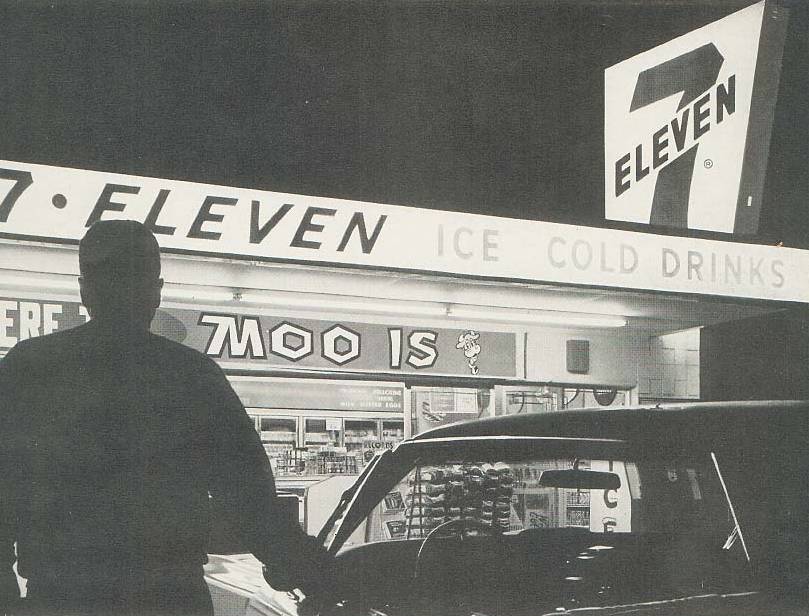
In 1945 the company decided it was time for a common identity and a new image for all of their stores, which by that time had evolved into mini-supermarkets, minus the meat and produce sections. With an ad agency’s help, they decided on “7-Eleven”, a catchy name that played off the stores’ operating hours. The first of a succession of green and red logos was adopted, and all existing stores were converted to the new image in 1946. Interestingly, 7-Eleven offered curb service for decades. The stores utilized an “open front” design with roll-up garage-style doors across nearly the full face of the store, which were kept open when weather permitted (which in Texas, of course, is most of the time). The open front design was maintained well into the 1960’s, although by then the door design was changed to a glass sliding type.

By 1950, with 80 stores under its belt, Southland opened its first stores outside of the north Texas area with a move into Austin that year and Houston in 1952. The first stores outside of Texas were opened in the Jacksonville and Miami, FL areas in 1954. From here, Southland moved into other markets at a breathless clip, adding Washington DC, Baltimore, Philadelphia, Kansas City, Salt Lake City, and several others by 1963 for a total of more than 1000 stores. Mr. Thompson passed away in June 1961, and the company leadership passed to his eldest son John. Southland didn’t miss a beat, and through the rest of the sixties and well into the seventies the company would experience phenomenal growth.

The sign and the two exterior photos (showing the sliding-door storefront) date from 1964. Note the promotional banners above the doors, a tradition that continues with 7-Eleven stores today. The photo of the impeccable counter man and his well-dressed customer (whose car appears to be still running outside – those were the days) is from 1966. “Oak Farms” was located in Dallas and was one of several regional dairy (and I guess, bakery) firms that were owned by Southland.