Showing posts with label Huntington Beach. Show all posts

Sunday, September 13, 2015

Fighting Inflation at Alpha Beta


Here’s a wonderful set of photos featuring two stores from one of Southern California’s most fondly remembered supermarket chains – the late, lamented Alpha Beta. The photos were taken in the early 70’s by Werner Weiss, webmaster of the Yesterland website, a superb tribute to the early years of Disneyland. Yesterland, one of the most celebrated and influential nostalgia sites on the web, marked its 20th anniversary online last year. Though Alpha Beta had stores all over SoCal (and several in other regions as well), these were both located in “The O.C.” – Orange County, Alpha Beta’s home turf.

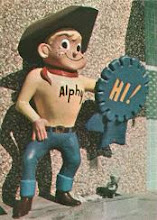
What can you say about the store in the first photo, other than it was a stone cold 1950’s classic? Opened in June, 1958 in the Hillview section of Santa Ana, at 17th Street and Tustin Avenue, this store, with its massive pylon and iconic “Alphy” sign, perfectly exuded the optimism, excitement and humor of the “anything is possible” postwar Southern California. The store didn’t seem much worse for wear sixteen years later, in 1974, when this photo was shot, but you’d have to think it looked more natural with a parking lot full of tailfins.

The rest of the photos are interior shots from the Alpha Beta store in Huntington Beach, at the corner of Brookhurst Street and Hamilton Avenue. I haven’t been able to verify the exact opening year of this store (Alpha Beta’s “No. 126”), but according to Werner, who worked there in college and took these photos in the fall of 1972, it was a new store then. The store sports the “ranch style” roofline that Alpha Beta had favored since the mid-sixties.

What strikes me the most about these photos, even the one of the older store, is how reflective the scenes are of 1972-74 American life, due to the overwhelming presence of one word - “discount” – plastered all over the interior of the store, and in huge letters across the storefront windows.

These were the years when new words and phrases began to creep their way into dinner table conversations across the country: “inflation”, “cost of living” and “Consumer Price Index”, for example, because these things were directly affecting what was on the dinner table. It was an era of rampant, unprecedented inflation, when consumer dollars seemed to shrink by the week. Despite some fairly extreme governmental steps taken to stem the tide (a wage-price freeze, dollar devaluation, etc.), it continued for years.

The scene that evokes this strongest for me personally is in the fifth photo down, the “new ideas” display, with boxes of Tuna Helper, in three glorious flavors, clearly visible on the second shelf. My family ate so much of this stuff (and its sister meal enhancer, Hamburger Helper) in those years that I still feel General Mills should have awarded us a walnut plaque with a golden Betty Crocker spoon mounted to it.

In response to the situation, the major supermarket chains, including such Western-based heavyweights as Safeway, welterweights such as Albertsons, and more regionalized operations like Alpha Beta (then a division of a middleweight, Philly-based Acme Markets) practically fell over themselves trying to attach the word “discount” to their storied names. Certainly this was a national trend, however, with appended names galore - Acme “Super Saver” stores, Food Fair’s accelerated conversion to “Pantry Pride Discount Foods”, and numerous others. Then there was A&P’s disastrous WEO (“Where Economy Originates”) program, but that’s a saga unto itself.

But there had been a precedent for this not that many years before, however. The early 70’s weren’t the first time the major food chains were forced to respond to an economic pinch. There was a dry run of sorts in the fall of 1966, when consumer complaints about supermarket pricing galvanized into a national movement, with boycotts occurring at stores across the country. Numerous press photos exist of bouffanted housewives carrying protest signs, a scene that led some in the press to coin the unfortunate term “girlcott” (Ugh.) to describe the situation.

The 1966 boycotts were short-lived, but in their aftermath, a number of chains experimented with standalone discount formats. Alpha Beta was one of them, with their experimental “Fad” (“food at discount” – nifty, right?) stores. Concerned about price competitiveness but unwilling to risk the Alpha Beta name on a discount venture, the first Fad store, a converted Alpha Beta unit, was opened in Costa Mesa in April 1967.

The location was chosen for its very close proximity to another Alpha Beta store, allowing the company to compare shopping patterns at the two stores and to answer the following questions, as outlined in Esther Cramer’s great book The Alpha Beta Story: “Would the housewife change her shopping habits if operating hours were reduced and games and giveaways were eliminated? Would the volume of sales increase to the necessary level if prices were lowered?” The answers, as it turned out, were “yes”.

As a result, three additional Fad stores were opened that year, followed by yet three more in 1968. Most importantly, it led to a change in pricing policy for the main Alpha Beta stores, which was rolled out in two phases – discounting of all health and beauty items effective in September 1967, and discounting across the entire store effective New Year’s Day 1968. Trading stamps and other promotional gimmicks were dropped, and even the famous tagline on their signs was changed, from “First in Foods” to “Best for Less”. In September 1971, having applied the lessons learned, the Fad name was discontinued and the (by then 11) Fad stores were converted to garden variety Alpha Betas.

So bargain-based grocery shopping turned out to be anything but a fad.

My thanks again to Werner Weiss for letting me know about his wonderful photos, and to the Orange County Archives for making them available. And for those who are curious about what the Fad stores looked like, here’s a typical example from a circa 1967 Alpha Beta Acme Markets promotional photo. 


Monday, July 19, 2010

Wards in Huntington Beach, 1966

The circa 1965 artist’s rendering above shows the Montgomery Ward store that opened the following year at Huntington Center, an indoor shopping mall located in Huntington Beach, California, at the intersection of Edinger Avenue and Beach Boulevard, near the San Diego Freeway. Huntington Beach, located in Orange County, is officially nicknamed “Surf City USA”, a nod to its 8.5 mile long beachfront on the Pacific Coast.

Now I’ve never been handy with a surfboard (by virtue of the fact that you actually have to stand up on the things), and every time I’ve set foot in Pacific waters they’ve been freezing, but I do like to explore old stores. And to the best of my knowledge, unless something’s changed recently, this baby still exists! Abandoned, boarded up and likely falling apart, but still standing.

Things were very bright in the early 1960’s, though, when shopping centers were popping up all over the country, and as mentioned with ridiculous frequency on this site, nowhere was the action more…uh, active than in Southern California. All the conditions were right for phenomenal growth – exploding population, youth-dominated culture, growing middle-class affluence (with thousands of aerospace and defense-worker families in the area) – and that’s exactly what took place.

By the mid-sixties, Montgomery Ward had designated SoCal as the centerpiece of its expansion strategy. In a speech before the Los Angeles Chamber of Commerce in May 1966, at which point new Wards stores had recently opened in Covina, Ventura and Fullerton, and would be soon forthcoming in Huntington Beach, Norwalk and Rosemead, Wards president Ed Donnell declared the company’s intention to make the greater L.A. area its “largest metropolitan district”. Going forward, one out of five new Wards stores would be opened there. At the time there were 7 full-line retail stores and 12 catalog stores in the area, while the company’s largest district, Chicago, had 12 full-line stores and 27 catalog outlets.

I have to think that beyond the obvious appeal of the dynamic Southern California market, there was another possible reason behind this. Prior to his tenure at Wards, Donnell was Sears, Roebuck and Co.’s Los Angeles district manager, part of that company’s “Far West” territory. The Sears stores in SoCal were in a class by themselves – much larger average size, often very striking architecturally, and a strong first place in sales. As a result, that region was by far the most important in power and influence within Sears. To go head-to-head with his former company in their best area would have been an extremely hard thing to resist. (A great read for those interested in retail history is “The Big Store” by Donald Katz, a history of Sears that emphasizes the 70’s-mid 80’s. The book’s opening story, about the demotion of a Sears executive from the hallowed West Coast top spot to the same but far less prestigious job in Chicago, is told in a riveting fashion. Seriously, who needs James Patterson when you can read this stuff?)

In April 1964, two months after the Beatles’ three consecutive appearances on the Ed Sullivan show, the Long Beach Press-Telegram announced plans for a new shopping center in Huntington Beach, to be anchored by The Broadway, a well-known local department store chain, J.C. Penney and Montgomery Ward. Initially slated to open in the fall of 1965, only The Broadway’s store ended up being ready at that time. The rest of the center would open a year later. Huntington Center’s official grand opening festivities kicked off on November 16, 1966, at which time the Beatles were all growing moustaches and had begun work on their Sgt. Pepper album. (Ok, I’ll can the Beatles references from here out.)

Beatles. (Sorry!) Early press reports had mentioned the Wards unit would be Huntington Center’s largest store, but as it turned out, the Penneys store surpassed it slightly, with The Broadway coming in a not-too-distant third in the square footage sweepstakes. All three anchors had freestanding auto centers. Some of the other notable tenants at Huntington Center included women’s specialty shops such as Lerner Shops and Mode O’Day, men’s retailers Harris and Frank and Bond Clothes, the legendary See’s Candies (I literally cannot pass one of their stores without buying something), local mainstay Thrifty Drugs and Food Fair, a major player in the supermarket world up and down the East Coast but still a relative newcomer to California.

And so it continued for the next 30 years or so. A new wing was added in 1986, including a fourth anchor, Mervyn’s. But time and the myriad changes in retail would eventually take their toll on the mall and of course, on Wards itself. In 1992, J.C. Penney left for the greener pastures of nearby Westminster Mall, taking over the J.W. Robinson space left vacant by the Robinsons-May Company merger. A 1996 merger brought about the closure of The Broadway, when parent Broadway Stores (formerly Carter Hawley Hale) was bought out by Federated Department Stores, who would convert the Fashion Island Broadway store in nearby Newport Beach to a Bloomingdale’s.

In early 2001, Montgomery Ward, the last original anchor at Huntington Center, closed down when the chain itself ceased operations. In 2004, a massive redeveloping of the mall took place, in which most of the enclosed mall was torn down. In its place rose a new, upscale open-air “lifestyle center” now known as Bella Terra Mall. The one original structure to be reused was The Broadway store, now a Kohl’s with a three-toned paint job over the store’s funky 60’s textured walls.

The Wards store, now detached from the mall, sits to the side, abandoned and unloved - except by fans of old retail, that is. This website has some great photos taken in 2006. Since then, the signage has been removed but the labelscars are still visible, and of course the unique bas-relief “MW” logos still exist.

See it while you can – on the way to the beach, of course!

Pictured below, just for fun, is the Wards store in Ventura, another attractive store which featured the same architectural style (including the simple, elegant pendant lighting) as the Huntington Beach location. This store opened at the Buenaventura Shopping Center six months before the HB store, on March 2, 1966.

Chris Jepsen of the great O.C. History Roundup website informs us that plans are afoot to build a Costco on the Wards side of the former Huntington Center. So if you want to see it, you'd best "carpe the diem, seize the carp", or something like that!