Showing posts with label 7-Eleven. Show all posts

Monday, July 5, 2010

Ah, 4th of July Memories!

One of the great things about our national holiday is the opportunity to enjoy a picnic meal and play games in the great outdoors. Something about that fresh air combined with the smell of good food – you just can’t beat it. Our family is no different – we love it!

And where do you think we went yesterday – some lame state park or other place like that? No way!

We went right down to our local 7-Eleven and set up our picnic right there in the parking lot! It was so convenient, and the great thing is you can pack extremely light – almost everything you could need is right there in the store. You have to be careful when sending your kids in to buy things, though – or they’re likely to come out with extra stuff (read: candy) everytime!

Now I know you’re probably thinking (among other things) “Wow, I’ll bet that pavement is really uncomfortable to sit on!” Not at all. After ten minutes or so, your butt falls asleep – problem solved!

The only issue we ran into involved one of our favorite outdoor games – lawn darts! Sure, those things are dangerous even in a soft, mushy backyard, but on concrete they bounce like a son of a gun! (“Ooh, sorry about that! I’ll run into the Sev for some gauze and adhesive tape!”)

All in all we had a great time, though. Why, we’ve even begun to scope out Walgreens locations for Labor Day – goodness knows there are enough to choose from!

Today is the third anniversary of this website. I just want to say that your readership, comments and emails and lately, your patience – are deeply appreciated.

Hope you’ve had a wonderful holiday as well!

Dave

(Oh… and I really do like state parks!)

Wednesday, December 5, 2007

New Looks for 7-Eleven in '67

The first four of these photos date from 1967, by which time 7-Eleven was beginning to vary their store appearance. The open front design was beginning to be phased out, and many of the existing open front stores underwent renovation to a more conventional window and door arrangement. This was ostensibly to allow the efficient use of newly-added air-conditioning units, but one could assume it was done to address security concerns as well.

Most of the new designs included some form of mansard roof with architectural shingles. Spanish tile was used to nice effect on selected Western and Florida area stores, and some even had cedar shake roofs. A very attractive colonial motif (complete with a rooftop cupola), pictured in the third photo, was implemented in a number of the company’s Eastern and Midwest markets, including Chicago.

I remember the colonial design well, and in at least one instance that I know of, Southland applied it to an entire shopping center, called (appropriately enough) "The Southland Center", which opened in late 1967 on Algonquin Road near the Wilke Road intersection in Rolling Meadows , a northwest suburb of Chicago. This center, in addition to having a 7-Eleven, housed a snack shop (which I remember much more than that particular 7-Eleven), a beauty shop, barber shop, and a number of other small stores. It had a two-story section in the middle, where Southland’s Chicago-area regional offices were housed. It still stands, but sadly the colonial façade has been refaced with stucco (an all-too-common fate of 50’s and 60’s era shopping centers) in a style I like to call “yecch modern”. Hilariously, the cupola still exists as before. Southland, the 7-Eleven and all of their original tenants, like Elvis, have long since “left the building”.

The last photo is from 1968 and shows a sign with the company’s brand new logo, no doubt a very familiar sight to all because it's the same one in use today. Behind the sign is a Southland –owned “Midwest Farms” dairy truck, sporting the new image that Southland rolled out for all of its dairy divisions that year.
Update 7/17/10 - Thanks to AB for identifying the location of the Spanish-tiled store in the second photo - still operating as a 7-Eleven at the corner of Las Olas Boulevard and 16th Street in Fort Lauderdale, Florida!

Sunday, December 2, 2007

Sixties, Slurpees and the Sev


The 1960’s saw two major developments in the history of 7-Eleven and its parent, the Southland Corporation. The first was a continuation of the company’s rapid geographical expansion, which would result in 7-Eleven becoming a virtual nationwide presence by the end of the decade. The second was the 1967 introduction of the company’s signature product, the Slurpee.

In March 1964, Southland made what would probably be its most important single acquisition, the 100-store Speedee Mart chain, with stores in all of the key markets in California. With this purchase, Southland not only picked up a solidly managed operation in the country’s most dynamic markets, it gained a crucial foothold in the field of franchising. Speedee Mart was a successful franchise-based operation. In the coming years, franchising would serve as rocket fuel for Southland’s expansion plans. For a couple of years after buying out Speedee Mart, Southland would maintain the Speedee Mart name, augmented with 7-Eleven’s logo.

7-Eleven entered the Chicago market in 1965, and within two years had 14 stores in the area. The following year, they acquired the 86-store handy-Pantry chain in Georgia and Tennessee, and in 1968 they bought out Gristede’s, an upscale chain of 115 small grocery stores in the metro New York area. Not long afterward, the company would add the New England, Detroit and Buffalo markets as well. Southland also bought out a number of prominent local dairies in the 60’s as well, both to supply dairy products to the 7-Eleven stores and in some cases, home delivery. These dairies included Wanzer’s in Chicago, Adohr Farms in California, Midwest Farms (multiple Midwest locations), Velda Farms in Florida and Embassy Dairies in DC.

Look carefully at the first photo, which dates from 1965, and you’ll see that the drinks the kids are enjoying are in fact not Slurpees but Icees, an independently owned frozen drink that’s been around since 1959 (and until very recently was sold in cups of the exact same design as those pictured). In 1965, Southland launched a test in three stores utilizing a new and fairly expensive piece of equipment, the Mitchell frozen drink machine. The test far surpassed the company’s expectations, and plans were quickly laid in place to install machines in 100 more stores, followed by the green light to implement them chain-wide in all of the chain’s stores. It was determined that a slightly different process (using the Taylor frozen machines) and an exclusive brand name was needed to firmly link the new frozen drinks with 7-Eleven in consumers’ minds, and thus the Slurpee was born (One might assume that from that point forward, Icees were forevermore banned from 7-Eleven premises, but in fact the Icee machines were used in a number of their stores for several more years).
A huge success, the Slurpee proved that if a company can effectively appeal to the kids’ market, then more often than not their parents are locked in as well. McDonald’s would realize this on an even larger scale with introduction of the “Happy Meal” twelve years later. Another benefit 7-Eleven gained from the Slurpee was a multitude of packaging and promotional possibilities (which were also areas McDonald’s would later excel in with the Happy Meal), mostly revolving around collectors’ cup designs, which my friends and I treated like gold - Baseball Tradin’ Cups, Superhero Tradin’ Cups, Star Wars and even Rock Group Tradin’ Cups (my brother had a J. Geils Band tradin’ cup, which looked pretty nasty after a year of dishwashing, trust me). For a couple of years we lived close to a 7-Eleven in Arlington Heights, IL where my brother and I stopped in on a near-daily basis.

In later years, 7-Eleven would tilt the scales back toward more adult tastes by heavily promoting a new line of gourmet coffee. A few years ago, my childhood 7-Eleven experience was repeated in a strange way. I was working with a customer in Long Island, New York, for which I had to fly in for meetings every few months over the course of a year. We would start the meetings about 8am. Invariably, about an hour into the meeting, regardless of the importance of the topic being discussed or who else was there, the main guy would stand up and say “This coffee’s crap, let’s go to the Sev”. Of course, we would all load up into his car and drive the few blocks to the friendly local 7-Eleven (I’ve called them “The Sev” ever since) where I admit the coffee wasn’t bad at all. I didn’t save the cups this time, however.

The second photo is an interior from 1964, the third an exterior from the following year.

Thursday, November 29, 2007

7-Eleven - How Conveeenient

Today, pulling up to a gas station that does not have a convenience store attached is a very rare thing indeed. At virtually any gas station, be it a mom-and-pop operation, a small regional or citywide chain or a major chain that may or may not be oil company owned, the convenience store is an expected part of the deal. The “service stations” with their auto service bays and tow trucks parked out front are just about consigned to history, their operators long ago having realized that selling soft drinks and food were much more profitable than towing and servicing cars.

More than any other company, the Dallas-based Southland Corporation, better known by the name of its stores, 7-Eleven, pioneered the convenience store concept. Originally, Southland’s drawing card was not gasoline but ice, which was a sought-after commodity in the early part of the 20th century when many homes did not own electric refrigerators. Gasoline would come later. The Southland Ice Company was formed in 1927 through the combination of four local Dallas-area ice companies by entrepreneur Claude S. Dawley. Through the 20’s into the 1930’s, Southland gradually added milk, ice cream and other food items for the convenience of its customers. The company really took off under the leadership of Joe C. “Jodie” Thompson, who joined one of Southland’s predecessor ice companies in 1922 and would become Southland president in 1931, a position he held for thirty years until his death. In the late 20’s, Southland adopted the name Tote’m for its stores, with a genuine Alaskan totem pole as a store logo (they were later painted on the buildings). In the 30’s and 40’s, Southland bought out a number of other small chains in north Texas, maintaining their original names.

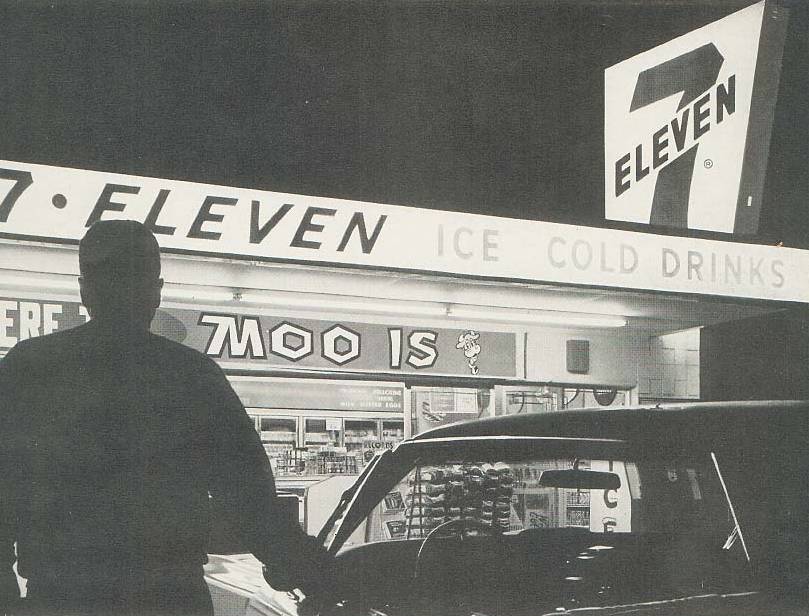
In 1945 the company decided it was time for a common identity and a new image for all of their stores, which by that time had evolved into mini-supermarkets, minus the meat and produce sections. With an ad agency’s help, they decided on “7-Eleven”, a catchy name that played off the stores’ operating hours. The first of a succession of green and red logos was adopted, and all existing stores were converted to the new image in 1946. Interestingly, 7-Eleven offered curb service for decades. The stores utilized an “open front” design with roll-up garage-style doors across nearly the full face of the store, which were kept open when weather permitted (which in Texas, of course, is most of the time). The open front design was maintained well into the 1960’s, although by then the door design was changed to a glass sliding type.

By 1950, with 80 stores under its belt, Southland opened its first stores outside of the north Texas area with a move into Austin that year and Houston in 1952. The first stores outside of Texas were opened in the Jacksonville and Miami, FL areas in 1954. From here, Southland moved into other markets at a breathless clip, adding Washington DC, Baltimore, Philadelphia, Kansas City, Salt Lake City, and several others by 1963 for a total of more than 1000 stores. Mr. Thompson passed away in June 1961, and the company leadership passed to his eldest son John. Southland didn’t miss a beat, and through the rest of the sixties and well into the seventies the company would experience phenomenal growth.

The sign and the two exterior photos (showing the sliding-door storefront) date from 1964. Note the promotional banners above the doors, a tradition that continues with 7-Eleven stores today. The photo of the impeccable counter man and his well-dressed customer (whose car appears to be still running outside – those were the days) is from 1966. “Oak Farms” was located in Dallas and was one of several regional dairy (and I guess, bakery) firms that were owned by Southland.