Showing posts with label Penneys. Show all posts

Friday, May 3, 2013

The Modern Side of J.C. Penney


“Picked at random, a single J.C. Penney Co. store can be a remarkably unimpressive establishment.” So went the opening line of a long and generally laudatory September 1950 Fortune magazine article about the then nearly 50-year old retailer. The statement was true enough of the majority of J.C. Penney stores of the day. While certainly not unpleasant, a “low-key handsomeness” was about the most one could credit to the typical Penney store design.

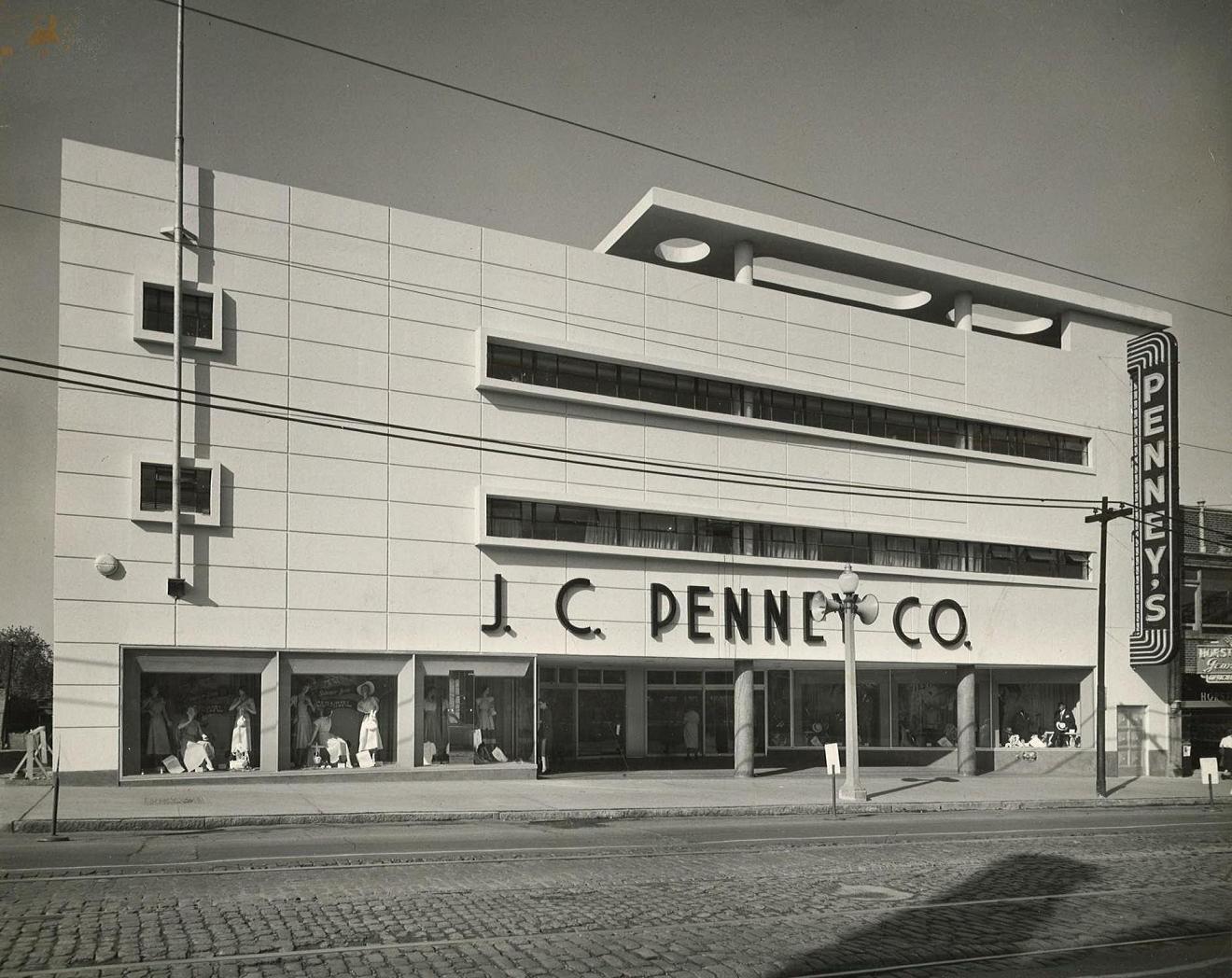
But scattered among their 1,600-plus stores at the time were a number of bonafide architectural gems –fine examples of deco and moderne styling that undoubtedly stood out from their respective city blocks at the time. A fortunate few of these buildings, including the two pictured above, survive today – though neither one has housed a J.C. Penney for years. One thrives as part of a major specialty retail chain, while the future of the other is less assured. In the first photo, the rented searchlight (note the name of the company, “Film Ad Co.” – with all the movie premieres in town, these were probably fairly easy to come by in the L.A. area) is on site and ready to go for the grand opening of the new Penney store at the corner of 3rd Street and Wilshire Boulevard in Santa Monica, California, which opened in 1949.

This store was designed by Milton L. Anderson, a little-known Los Angeles-based architect, who also designed fine-looking Penney stores in San Bernardino and Burbank around the same time. Like his more renowned counterpart, Stiles Clements (the store directly faced a Clements-designed Ralphs grocery store across the street), Anderson designed in the Spanish Colonial Revival style in the late 1920’s, a popular Southern California architectural motif in the era just prior to the advent of art deco/streamline moderne, which he later embraced.

The specific style of this building, according to a 2006 City of Santa Monica Landmark Assessment and Evaluation report, is classified as Late Moderne, a school that “borrowed the horizontality, curved canopies, and curved corners from the Streamline Moderne style, and the flat roof, window bands, and boxy form of the International Style… Broad cantilevered rectilinear or curved canopies were also a character-defining feature… (as were) soaring sign pylons that dominated (a) building’s facade.” The report underscores the store’s most notable design feature, the “cylindrical fluted tower on the building’s northeast corner that rises above the roofline to form a prominent anchor to the retail store building as seen from Wilshire Boulevard and 3rd Street.”

The store (which replaced J.C. Penney’s original 1930’s-vintage Santa Monica unit at 1328 3rd Street, just up the block) both predated and survived Penney’s “full-line era”, roughly the early 1960’s through the early 1980’s, when the company sold large appliances, sporting goods, automotive and other assorted hard goods in addition to the Penney staples of clothing, linens, towels and the like. In all likelihood, the Santa Monica store, due to its location and relatively small size, never ventured far beyond the company’s traditional soft goods offerings.

In 1965 a three-block area of 3rd Street, encompassing the Penney store and other retailers, was closed off for conversion to a pedestrian mall. Known since then as the “3rd Street Promenade”, it remains successful today, no doubt owing to its limited scope, successfully avoiding the pitfalls of overreach that have doomed conversions like it in other cities.

The store survived under the Penney flag into the mid-1990’s, a point when the vast majority of these had long since been supplanted by large, regional mall-based stores. (Amazingly, a similar store hung in there all the way until last summer.) Since 1998, the store has been a prominent location for Banana Republic, the upscale banner of Gap Inc. The famous façade has been preserved (sans the Penney signage, of course), and $7 million worth of interior renovations were carried out. As of this writing, it looks like The Gap is putting this one up for sublease. Perhaps another supplier of high-end khakis will show some interest in this beautiful building.

Even more striking, perhaps, is the second store pictured, which opened the same year at 5930 Easton Avenue (later renamed Dr. Martin Luther King Drive) in St. Louis, Missouri, in an area of town known as the Wellston Loop. Once again, Penney engaged the services of a local architect, William P. McMahon & Sons, and once again a stunningly-designed building resulted.

McMahon, a St. Louis native, had already enjoyed a long career at that point, having designed homes, churches and various commercial buildings around town beginning in 1907. By the 1930’s he was working in partnership with his son, Bernard, a recent architectural school graduate who favored Modernism and would spend time in California, where streamlined design reigned supreme. By the time the Penney project rolled around, Bernard had long since mastered the form. Not to be outdone, the elder McMahon brought his own Modernist sensibilities to the job, honed through aerodynamic design work he did for a military aircraft manufacturer during World War II, when building design commissions were slow in coming.

The Wellston J.C. Penney store is considered a prime example of the International Style of Modernism, according to a 2006 report submitted to the National Register of Historic Places. It “typifies (the International style) through its rejection of ornamentation, incorporation of horizontal ribbon windows with cantilevered surrounds and dependence on regularity to organize the primary façade rather than axial symmetry.” (The difference between ‘regularity’ and ‘symmetry’ being “lots of windows or other structural features placed at regular intervals” as opposed to “the strict symmetry of a Greek temple”, the historical precept upon which much architecture was, and is, based. This excellent series of articles explains the concept better than I could ever hope to.) The building’s crowning feature, literally and figuratively, is its floating partial canopy, with cutouts that “frame views of the sky.”

Penney had opened their first St. Louis store two decades earlier, in 1928, at 2604 North 14th Street, and two others quickly followed – at the corner of Morganford and Gravois in 1929, then at 5976 Easton Avenue (doors away from the featured store) in 1930. This gave the company locations “north, south and west of downtown” respectively, according to the NHRP report.

Interestingly, “Unlike St. Louis’s three largest department stores, Stix Baer & Fuller, Scruggs-Vandervoort Barney and Famous Barr, J.C. Penney chose not to build a central store downtown. Instead, Penney’s focused on a decentralized model of retailing along the lines of Woolworth’s and other national chains by locating multiple in neighborhoods where its customers lived”, the report says. (This wasn’t necessarily true of Woolworth’s or Penney’s in other large cities, though, as both chains had a number of major downtown flagship stores by this time. But St. Louis was an exception.)

The Wellston store’s location enabled it to capitalize on the migration of St. Louisans to the suburbs while continuing to draw a fair amount of business from city dwellers. (Penney opened a second very successful neighborhood location the following year, 1950, at the Hampton Village Shopping Center, with the polar opposite architectural theme – a “Colonial Williamsburg” motif. That store remains open today.)

As late as 1967, the Wellston store still qualified as a key link in the Penney chain, and as such it was approved for an extensive “New Image” makeover that year, putting it in league with their new mall-based showplaces at Northwest Plaza and South County Center. By 1976, however, things had changed. In the report’s words, “the trends that enabled the Wellston store to be successful through the 1950s and 60s propelled shoppers even further westward; changing neighborhood demographics hastened the company’s departure.” That year, the Wellston J.C. Penney store closed. For the last 37 years it has stood vacant.

The building has been the subject of controversy in recent years, and nearly met its demise a few years ago when the local alderman withdrew his previous support for its preservation. Fortunately, St. Louis is blessed with a preservation community that’s second to none, and with a disproportionate number of great mid-century architectural blogs that tend to put the word out about such things. The best of the bunch, in my opinion, is B.E.L.T. – “The Built Environment in Layman’s Terms”, written by Toby Weiss (who also sings in a band called The Remodels – how great is that?). She recently informed me that the building has indeed been added to the National Register of Historic Places, and that the referenced alderman “has backed off on wanting to tear it down.” Other than that, all is quiet.

Of course, the key to survival of any historic retail building is a viable tenant. Maybe someone offering mid-priced khakis will give it a go.

As always, my special thanks to the J.C. Penney Archives at Southern Methodist University’s DeGolyer Library for the use of these great photos.

Monday, December 24, 2012

It's Christmastiiiiime in Ford City!


It was the one indoor marching band event of my high school career. Early one Saturday morning each December, we’d pile into the buses for the 20 minute drive south, passing through towns such as Argo (Always brought to mind a box of corn starch. Still does.) and Summit to Ford City Mall for their annual indoor Christmas parade. There we’d join with other school bands, animal acts, clowns and assorted dignitaries marching the halls of the shopping center, while sound bounced off the terrazzo floor and storefronts.

We used these cheesy (on this site, that word always carries the best connotation) little songbooks called “Christmas Favorites” or something like that, which the school had probably owned since the 1950’s. I can still picture the red, green and white cover and yellowed pages. Our go-to song was that deeply meaningful Yuletide carol “Up on the Housetop.” The crowds, mostly families with young kids or older folks, always seemed to have a good time. So did we, although those memories tend to grow fonder with passing time (and with forgetting the “getting up early” part).    

These incredibly great photos come to us courtesy of Rick Drew. Rick’s Dad worked in mall management at Ford City during the mall’s early years. I would date these photos, based on the styles and store names to approximately 1968-70, some ten years before I assaulted the corridors there with my trumpet playing.

I’d love to tell the story of Ford City, one of Chicago’s most historically important malls, in full here someday, but only have time for a few brief notes at the moment. Ford City Shopping Center, opened on August 12, 1965, was “Chicago’s first all-weather, enclosed shopping center.”

The structure itself was originally built during World War II as a bomber engine plant. In the late forties, portions were used for the Tucker Car Corporation – an American dream that should have come true, and a story movingly told in one of my all-time favorite films, Tucker: The Man and his Dream. Later on it became an aircraft motor plant again, operated by Ford Motor Company, hence the name. For a few years in the early 60’s, before the mall development project, it sat vacant.

Initially, there were 82 stores, several locally-owned, with national chains F.W. Woolworth, Lerner Shops, Bond Clothes, ThomMcAn shoes, Wurlitzer pianos and organs and SupeRx Drugs (the yellow “s” at the left edge of the first photo) along with a National Tea Company food store. A General Cinema twin theatre opened soon afterward. The two anchors, at opposite ends of the center in classic “barbell” fashion, were Penneys and Chicago-based Wieboldt’s.

At 178,000 square feet, the Penneys store was the company’s largest single-floor unit at the time. Interestingly, as late as 1975, this Penneys store continued to outsell those at newer, much larger area malls, including the behemoth Yorktown Center (1968) and Woodfield Mall (1971). A year after Ford City opened, another Penneys opened 15 miles to the south at Harvey’s fabled Dixie Square Mall.  
  
The Wieboldt’s store initially had a restaurant and a supermarket, an interesting feature of many of their locations in the early 60’s, including Randhurst. What really strikes me about this store was that the signage, interior and exterior, was red instead of Wieboldt’s signature green, used virtually everywhere else. When I saw these pictures it was a shock, like seeing a blue Coca-Cola can or purple arches above a McDonald’s sign. So wrong, yet looking at these photos…so right. (These posts always have a way of turning melodramatic at some point, don’t they?).

In any event, they sure knew how to decorate the place for Christmas. Hope you’re having a great one!

Wednesday, September 26, 2012

Bring Back the San Fernando Penney's!

You know, there must be some people who read this site regularly and wonder – “Dave, you’re a blogger. Why don’t you ever take a stand on anything? You never weigh in on the big issues of our time. You’re always on the fence. Asleep at the wheel. Out to lunch. AWOL!”

Well, friends, I want you to know that I hear you, and today I’m answering the call! And the issue I herewith weigh in on is one that is, or should be, near and dear to our classic retail-loving hearts. It can be summed up in one phrase:

Bring back the San Fernando J.C. Penney.

When a national retail chain closes shop in a long-standing location, it’s typically news – in the local area, that is, and not far outside it. But this summer, when J.C. Penney ended an 80-year tenure in San Fernando, California (the city of San Fernando, specifically, which lies within the San Fernando Valley, part of Greater L.A.), it set off a furor that popped in and out of national headlines for weeks.

On Saturday, July 28th, despite rallies in the local community, online petitions, celebrity pleas, tons of local news stories and national coverage from the likes of the Huffington Post, the public radio show Marketplace, Bloomberg Businessweek (Plain old “Business Week” was much more concise, right? But hey, it’s his magazine now!) among others, J.C. Penney shuttered the San Fernando store, which had existed in its current location since February 1953.

Official comment from JCP on the matter has been terse, putting it charitably. “We would not have moved forward with this difficult decision if we did not believe it was absolutely necessary for the future growth of our company”, the company’s press response read.

Speculations behind the closing have been raised (and shot down) from several angles, with some alleging the closing was part of an effort to trim costs in light of huge losses JCP has experienced this year as a consequence of its controversial rebranding/repositioning efforts.  Others contend the small store (60,000 square feet with just over half of that space devoted to selling, three floors, no escalators), long an anomaly for Penney, is a poor fit for the rebranding concept. Still others claim the San Fernando location itself has been unprofitable for years.

It’s easy to understand why San Fernando residents are upset about losing their Penney store, an obvious point of pride for the community. The store has been an anchor for their downtown at a time when most big-name retailers long ago abandoned downtown locations for the “wide open spaces” we refer to today as malls and shopping centers. Certainly it was handy – while Penney has no shortage of huge stores in The Valley, it’s hard to beat “down the block” for convenience, even though selections were limited compared to standard Penney stores. There’s the longevity factor – the San Fernando location far outlasted the hundreds of downtown Penney stores built through the decades up until the late 50’s. Indeed, had JCP opted to close it down in 1970 or 1980, the uproar might never have materialized.

Lastly, the store’s timeless deco-influenced facades, front and rear, remain a thing of beauty. Most late 1940’s/early 1950’s Penney stores across the country were very plain in appearance, while the San Fernando unit exemplifies the extra effort that many national retailers poured into their California locations. Just two years ago, the building’s owner, Ashkenazy Development, spent some $350,000, including the services of a historian, to restore the facades and the “Penney’s” blade sign, which reportedly hadn’t worked for nearly forty years. 

The story took a nasty turn on the second night after the store’s closing, when residents discovered sign crews (after dark, with the company name on their truck covered up) pulling the “J.C. Penney Co.” lettering off the back of the building and one worker preparing to go after the neon blade sign with a torch, all in violation of an order to leave them alone pending a historical preservation hearing. The removed letters were reinstalled the next day.

At this late date, it seems unlikely that J.C. Penney will reopen the store, but you have to admit it would be a great public relations gesture and would serve to counteract some of the negative publicity the company has received in recent months. The “Save San Fernando’s JCPenney” site features a couple of interesting concepts for expansion, should JCP reverse their decision. At any rate, the store’s designation as a historic site appears to be assured. Rightfully so.

Our goal here, of course, is to depict great stores like this in their heyday, and once again I thank the J.C. Penney Archives at the DeGolyer Library at Southern Methodist University for their invaluable cooperation in supplying these photos – festooned in Grand Opening glory, followed by an interior view, then front and rear facade views from after the festivities cooled down.

As a postscript, here’s a sidenote from the “Basic Data Sheet”, a centrally-maintained dossier of sorts, for this store, last updated in 1971 and now part of the JCP archives. It’s interesting to note who Penney’s regarded as competition in those days -within a four-mile radius, there were department stores: Ohrbach’s, The Broadway, Robinson’s, a small Sears “hard-lines” store, discounters White Front, Kmart, Gemco and Cal Stores (sister division of Baza’r stores). “Fantastic Fair” one of my ultra-faves, is also listed, but I’m pretty sure they were gone by that time. (I’ll have to do a 10-part series on that one someday.)There were also the variety stores Grants and Newberrys, and apparel stores Scotts, the Melody Shop and Sally Dresses. The Penney’s unit outlasted them all.


Monday, July 2, 2012

J.C. Penney, King of the Soft Goods


Reaching its silver anniversary in 1927, the J.C. Penney Company found many reasons to celebrate. The amount of Penney stores had more than doubled since 1920 to more than 750 locations “in practically every State in the Union” according to the New York Times (close to it - 45 of the then 48 states), and annual sales of nearly $116 million.  

By this time the founder himself, James Cash Penney, had largely turned over leadership of the company to others while he vigorously pursued various philanthropic interests, most importantly a program to enhance America’s agricultural production. A farm boy at heart, Penney donated millions towards the development of dairy cattle herds, soil improvement initiatives and crop science, particularly in the South.  An October 10, 1929 article in the Atlanta Constitution summed it up as follows: “In his breadth of vision, unselfishness of purpose and devotion to the upbuilding of our agricultural interests, Mr. Penney is doing a work which stamps him as one of America’s outstanding citizens”.    
Two weeks after the article appeared, though, came the great Wall Street crash - the prelude to years of hard times for many American individuals and institutions. J.C. Penney the company weathered the depression reasonably well, although it would be five years before it again reached the lofty peak of its 1929 sales of $209 million. For J.C. Penney the man, however, those years were devastating. 

As it happened, Penney literally “gave away” his personal fortune during the 20’s and early 30’s, funding the various farm interests and other good causes to the tune of millions, with little awareness of the increasing gravity of the country’s (and his own personal) economic situation. In 1931, Penney’s lawyers advised him he was “virtually broke”, a story recounted in author Bill Hare’s “Celebration of Fools: An Inside Look at the Rise and Fall of JCPenney”, a rattling read. A number of top Penney managers, in an effort led by Penney president Earl Sams, pooled money to buy the founder a new set of shares in own namesake company, and for the first time in years the company paid him a salary. These were the first steps towards setting Penney, “an incalculable asset to the company that (he) founded and built”, as Hare wrote (in Sams’ voice), back on his feet. “After three years he would cease taking the salary, and by 1940, when the company declared a dividend of $5 per share, he owned 51,000 of them. But the going was rough at first.”
This incident also sparked a much-publicized spiritual awakening in the despondent Penney’s life, which occurred during a visit to the famed Battle Creek (Michigan) Sanitarium, founded by John Harvey Kellogg (brother of W.K. Kellogg, the cereal king). Mary Elizabeth Curry, in her fine book Creating An American Institution: The Merchandising Genius of J.C. Penney, tells the story of one early morning when Penney walked the halls of the sanitarium and overheard a chapel service where an old hymn called “God will take care of you” was being sung. Penney joined the service, “and asked God to help him, and what occurred next was so personally dramatic he liked to call if a miracle. He felt as though a heavy burden, all his fears and worries, had immediately lifted from his shoulders”, Curry writes. Penney himself wrote numerous books and gave hundreds of talks on the subject in the ensuing decades, alongside and as part of his emissary work for the company. Penney was by no means the only “famous businessman - preacher” of his time, but certainly among the best known. Such a combination is relatively rare in high profile business today.

As if the economic conditions of the 1930’s weren’t difficult enough, the Penney Company faced another hurdle in the form of the brewing “Anti-Chain Store” movement. As early as the mid-20’s there were rumblings in the press about the “So-Called Menace of Chain Stores”, as a December 1926 New York Times article phrased it. The company generally offered a “low-key response” to such challenges, according to Mary Elizabeth Curry, preferring to “emphasize service and values for customers”. “It isn’t the purpose and it isn’t the desire for our organization or to destroy the independent merchant. Our job is to serve well a community through our plan of economic distribution”, Curry quotes a Penney executive from 1930.
Push came to shove a few years later with the advent of the Patman Bill, a proposed piece of legislation that would have literally taxed many chain store operations out of existence. Faced with this, the company was forced to take a much stronger tack, and it was Penney’s chairman, Earl C. Sams, who took the lead in the matter, testifying before Congress in 1940.  He laid out Penney’s case against the bill in five main points, as quoted in the landmark book “Chain Stores in America 1859-1950” by Godfrey M. Lebhar: “1) It would destroy the Penney company or any similar company. 2) It would destroy the finest field of opportunity that has ever existed in retailing for the young ambitious man born without family means. 3) It would add to the cost of living for every American family of limited means and would lower the American standard of living. 4) It would deal a staggering blow to the entire economic life of this country and would be especially destructive of the smaller cities and towns for the benefit of larger cities. 5) It would hurt and tax this entire nation for the protection and enrichment of a small minority of self-interested middlemen and of another small minority group of ill-advised marginal retailers.”

Beyond that, Sams attempted to debunk the theory “that chain stores were ruining the smaller communities”. The real culprit, he maintained, was the proliferation of quality, paved roadways that now enabled Americans to travel far afield to shop – no longer were they captive to the ‘local town square’ for the necessities of life. On the contrary, the chain stores had indeed served “as a check on the drying up of towns and small cities” (Godfrey’s words) because according to Sams, “(they) have brought  to these small centers the same values, the same crisp new styles, and the same modern stores that were available in the bigger cities. And the customers know it.” As it turned out, the arguments put forth by Sams and others did much to swing public opinion to the chains’ side. On June 17, 1940, Patman’s “chain store death sentence” bill “suffered the death sentence itself”, Godfrey wrote, when it was killed in committee, never to reach the House floor for a vote.
While J.C. Penney was known (and would continue to be for some time) as a “small town chain” despite its impressive sales and burgeoning store count, there were a growing number of exceptions to the “small town” aspect. In 1931, the company opened its largest store to date in Seattle, a new building on the former site of the Bon Marché flagship department store. (Some years later, Penney’s San Francisco unit would claim the distinction of largest store.) Around this time Penney opened other large stores in key Western cities, including Oakland, Ogden (Utah), Salt Lake City and Reno, all of which “(did) a large volume of business”, as the New York Times put it at the time.

From the mid-30’s to the mid-50’s Penney sales volume, from stores large and small, ballooned from $225 million to over $1.3 billion. An interesting side note, related in a September 1950 Fortune magazine article entitled “Penney’s, King of the Soft Goods”, was the way Penney store managers shared in the company’s good fortune, no pun intended. (Granted, they shouldered a great deal of responsibility, including all hiring, training, advertising decisions and ordering of all products stocked – no merchandise was “pushed” on a Penney store by the home office in those days.) The rewards were substantial, however - “A good manager in a fairly large store can make fancy money” (“fancy” meaning 1/3 of the store’s after-tax net –yikes!), the article said, citing the example of the aforementioned Seattle store’s manager who pulled $125,000 in one year. The plan was later modified to allow assistant managers and other key employees to share in the pie. Still, a good many managers earned $30 to 50,000 a year, and nearly a third (of then 1,600 store managers) raked in at least $15,000 annually – fancy money indeed when nice houses could be had in most corners of America for well below ten grand. 
By 1950 J.C. Penney was a solid third place in America’s department store sweepstakes, behind the mighty Sears, Roebuck & Co. and the faltering yet still formidable Montgomery Ward. One of the keys to continued growth, the Fortune magazine article surmised, was increased presence in the Eastern half of the country. Up to that time, Penney was still thought of as a Western retailer (with “a Penney store in practically town above 5,000 and many smaller ones”) despite recent inroads into some key Eastern and Midwestern markets. “In the East, nobody knows a damn thing about the Penney Co.”, one manager was quoted as saying.  To be sure, building up the Penney reputation to the same level it enjoyed in the West would take time, with rough going in a number of markets. In Camden, New Jersey for example, Penney went head-to-head with Gimbels, Strawbridge & Clothier and Lit Brothers, “(whose) heavy advertising pull(ed) customers away from Penney’s, not toward it”. And in Cincinnati, where Penney opened a stunning new store in 1948, fierce competition from Shillito’s and others kept the store in the red for nearly two years after opening, a most unusual occurrence for Penney.

Over time, Eastern Penney store managers, many of whom started with the company in its native West, would adapt to the unique needs of their new markets.  The article cites the Camden store manager, for example, who began with Penney in Spokane, Washington, transferring to Milwaukee then to Quincy, Illinois before landing at the helm in Camden, a market where a constant barrage of advertising was necessary to drive sales, a situation he hadn’t experienced in his earlier tours of duty.
The manager of the Springfield, Massachusetts unit worked in Penney’s San Francisco flagship store, moving to Santa Barbara before traversing the country to run the Springfield store. New England customers, as a rule, were very different from those in California. “In buying curtains a California customer wants to know first how wide the ruffle is, how full it is, and what the colors are; the Springfield customer asks whether the organdy (a type of fabric often used in curtains) is permanently finished, how securely the ruffles are sewed on and how long it will last”. Another cited example concerned towels, then as now one of Penney’s strongest product lines. Whereas bath towels typically outsold face towels 2 to 1 “presumably because a bath towel can serve either purpose”, in the Springfield store the opposite was true. The manager was undecided as to “whether the frugal New Englanders use face towels after they bathe, or whether they are just trying out Penney face towels before shooting the moon and buying the larger size.” (They also tended to say “ayuh” when responding affirmatively to questions, a point the article curiously omits.)

In any event, Americans were buying more face towels, bath towels, washcloths and all manner of other linens from their local J.C. Penney store than anywhere else, in addition to clothes for the whole family. “King of the Soft Goods”, indeed, but big changes lie ahead.
The first four photos above appear by courtesy of the J.C. Penney Archives at the DeGolyer Library at Southern Methodist University, the last is from an original slide in my collection. From the 1950’s, the following locations are depicted: Stockton, Long Beach and Glendale, California, followed by Rockwood, Tennessee (apparently a much older store, refaced) and Albuquerque, New Mexico, with a very nice hat tip to the area’s traditional adobe architecture. Note the gas stations represented in the picture – a Phillips 66 sign right next door, with a Conoco station across the street from it. Across the street from the Penney store itself, reflected in the store windows, is what appears to be a “Teague” Texaco. If you have a free week this summer, you can read about those and more here.      

Wednesday, February 22, 2012

Reflections on Dixie Square Mall

There was a time when you could when you could walk around the Dixie Square Mall without placing yourself in the path of bulldozers or wrecking balls. And there was a time when you could explore the place and even take pictures without fear of the floor falling out from under or on top of you, or being attacked by wild dogs or persons with bad intent. And yes, there was actually a time when you could shop there without having to dodge film crews, Illinois State Police cars, or two guys in dark suits and sunglasses behind the dashboard of a retired Mount Prospect police cruiser.

That time was long ago, of course. These photos are from that time.

So it’s finally coming down, according to news reports from every corner. (I received seven Google News Alerts about it in one day last week.) Demolition officially started last week and is expected to last into the summer. What’s interesting to me have been the reminiscences lacing these news reports, especially those of the various civic officials involved, several of which acknowledged Dixie Square’s unique role in pop culture history. The Governor of Illinois, for example, reappeared at the site and told of his experiences shopping there in his younger years. “Although we will always remember the Dixie Mall as the location for one of the most iconic scenes in ‘The Blues Brothers’ movie, it is time for this now vacant building to be torn down to make way for more economic development for the Harvey community”, he said. Then, from a local state representative, came a strong dose of reality – "For me, I will never talk about the movie again," he said. “It left nothing here”. What do you say in response to that?

I’ll say this. I truly hope the Dixie Square property is put to good use – for a new shopping center, or maybe a park or some light industry – just something of value, at least, to the 30,000 people for whom Harvey, Illinois is home. Because even a crumbling monument to a movie would be preferable to a soul-crushing vacant lot.

The wonderful photos above were taken in 1968, at the same time as those featured on our Dixie Square history post. They showcase the mall two years after its opening, in the exciting early years, before a myriad of problems set in. The notion that the mall would close down just ten years later would have seemed the height of absurdity then.

And once again, they are shown here by the courtesy of Dan Steenwyk, president of Steenwyk Architects, successor to his father’s architectural practice (the designers of Dixie Square Mall) in Grand Rapids, Michigan. I had the pleasure of speaking with Dan last week when I called him to relay a permission request from the CBS-owned TV station in Chicago, whose executive producer saw the Dixie Square photos here and asked to use them in a news report on the start of demolition of the mall. (That’s WBBM or “Channel 2”, as most locals know it. They even have the “dream team”, Bill and Walter, back on the air there, just like they were when I was ten!) Dan was kind enough to send me these additional photos, taken at the same time, to present here. All photos in this post are ©1968 Steenwyk Architects, All Rights Reserved.

The photos themselves need very little explanation. I’m so pleased to be able to show a full-facade view of the Montgomery Ward store this time around. The following two photos show daytime views of the Penneys facade from opposing angles (On the first Penneys photo, note the reflection in the window of a portion of the orange “JEWEL” store lettering, and its antique-blue mansard roof. Yes indeed.), followed by a great close-up of the interior Penneys entrance. Those shoppers seem a bit worn out from all the excitement, eh? Last is a nighttime view of the main mall entrance on the Wards end. It’s a bit blurry, but the Wards interior entrance is visible inside.

Below, two original pencil renderings, photographed as they were - pinned to the walls of the Hornbach, Steenwyk and Thrall offices. There’s an elevation view of the Montgomery Ward store followed a perspective view of the Penneys unit. Simply superb.

And lastly, a detail from a Northern Illinois Gas advertisement (“Even huge shopping centers like Dixie Square heat and cool with gas”), featuring a pen-and-ink drawing of the mall.
Looks like someone needed to borrow a push pin!

Friday, December 23, 2011

It's a Wonderful Life at Penney's

Christmas in downtown Lancaster, Pennsylvania, sometime in the late 40’s or early 50’s. The charming Santa decoration says both “Merry Christmas” and “Season’s Greetings”, so everyone is covered. Colorful garland hangs across the storefronts on either side. The building itself easily dates to the earliest years of the 1900’s if not before, and undoubtedly housed other businesses prior to J.C. Penney’s tenure.

Looking at this, I just know that Lancaster must have been home to a gracious soul like George Bailey, protecting the town's virtue and helping people in need so they didn’t have to “go crawling to Potter” or whoever the local robber baron may have been.

A good thing, too - otherwise the neon sign here would have read “Dime a Dance” instead of “Penney’s”!

Monday, November 21, 2011

Mr. Penney, Mountains & Main Street

The pages of retail history are filled with the names of companies that no longer exist. Many of them were the picture of success for decades on end. They were leaders in their field - patronized, respected and loved by millions of customers. Household names. For one reason or another, these companies failed to adapt to conditions, and consequently they’re gone – sold out to a competitor, or just shuttered altogether.

It can be said that “adapting to conditions” is the one thing at which the 109-year-old J.C. Penney Company has excelled at above all else through the years. Rarely at the cutting edge of fashion – or anything else, for that matter, “the Penney Company”, as its founder always referred to it, has nonetheless continually managed to stay in step with the times, reinventing itself periodically to appeal to ever-evolving American shopping tastes. In the process they’ve amassed a track record that, despite occasional missteps, other retailers could aspire to only in their dreams.

In the mining town of Kemmerer, Wyoming in 1902, conditions were hard. Mr. Penney, in a letter to E.C. Sams, who would turn out be his most significant hire, described it as “a barren country, very little vegetation, and unless a man and his wife as well are strictly business, they might not like it.” The nearest water source, for example, was from a creek a half mile away from town. And for three months out of the year, the average low temperature was 6 degrees Fahrenheit or below. (“Might not make it” was probably more accurate.) Such was the unlikely setting for the birth of a retailing legend.

James Cash Penney (yes, that was his real middle name, he would assert on innumerable occasions) was born on September 16, 1875 in Hamilton, Missouri, a rural town some 65 miles northeast of Kansas City. Penney’s parents, in particular his father, a farmer and unpaid Baptist minister, instilled in him a strong sense of faith, hard work and ethics.

An early lesson in ethics came in his teens, when he was given a small parcel of the family land to raise watermelons. When the local county fair rolled around, Penney loaded up a wagonful of melons, parking just outside the fair’s gates where he began to do a “brisk business”, according to authors Tom Mahoney and Leonard Sloane in their book The Great Merchants. The elder Penney was not pleased when he discovered this, admonishing the young man for competing with the fair merchants “without paying for the privilege”. He ordered his son to take the wagon home, despite “Young Jim’s” technicality defense that he was actually selling outside the gates, albeit by only a few feet. It was a lesson Penney “never forgot”, the authors state.

Although he would maintain a lifelong interest in agriculture, Penney’s destiny lay elsewhere. “I am not cut out to be a farmer”, he told his father in a deathbed conversation related in the 1947 history of Penneys by Norman Beasley entitled Main Street Merchant, “I want to be a storekeeper”. In early 1895, at the age of 19, Penney was given his first job in retail as a junior clerk at J.M. Hale & Brother, a well-known local store in Hamilton. Penney was an eager pupil, and with Mr. Hale as “professor”, he learned the myriad aspects of store operations, from serving customers, to stocking, to sweeping the sidewalks out front. He drove himself extremely hard, earning promotions along the way, and over two years his salary increased from an initial $2.27 per month to $25 a month. But he nearly wrecked his health in the process. Things became so bad midway through his third year there that Penney’s doctor told him he was a prime candidate for “consumption” (an age-old synonym for tuberculosis) and that he needed to “get out of this Missouri climate” and move to Denver “right away.”

“Go West, young man, go West. There is health in the country, and room away from our crowds of idlers and imbeciles” is a phrase widely attributed to Horace Greeley, a famous 19th century newspaper editor and politician. Penney took his doctor’s (and Greeley’s) advice and boarded a train for Denver in June, 1897. To be sure, his health improved, but he did run into his fair share of “idlers and imbeciles” in his early work experiences there. Taking a job at the Joslin Dry Goods Company, the 5’8”, 135-pound Penney was subjected to endless hazing by the other clerks, so he left as soon as he could line up another job. A stint with a second area retailer came to an abrupt end when Penney discovered the store owner’s dishonest pricing practices. Disgusted, Penney demanded his earned wages on the spot and resigned.

Penney’s search for new employment led him 40 miles north to Longmont, Colorado, in the heart of cattle country, where a butcher shop was for sale. Penney decided he liked the town, and had his mother send him his savings of $300, enough to buy the shop and keep the butcher on the payroll. As it turned out, this particular butcher shop was heavily dependent on the business of one hotel, whose cook expected a bottle of whiskey each week on the side as a requirement for trade. (In researching this, I learned that most of Longmont’s early settlers came from Chicago. That explains that.) Penney complied for one week, and then refused to buy the cook off thereafter as a matter of conscience. So went the hotel’s business, and not long afterward, the butcher shop itself.

Eager to resume his career as a “dry goods man” after the butcher shop debacle, Penney applied for a job at a local store owned by T.M. Callahan, a dry goods and clothing operation similar to Hale’s, where Penney had worked back in his hometown. Callahan didn’t have any regular positions available, but informed Penney that he could fill in for one of his clerks who was ill and not likely to get back to work over the holidays – “so if you want to come in until he does come back,” he was quoted in Beasley’s Main Street Merchant, “I can put you on.” (And there you have it, dear readers - one of retailing’s towering figures started out as a “holiday temp”!)

Instead of letting him go upon the regular clerk’s return to work, Callahan, who was most impressed with Penney’s intuition and work ethic, made him an offer. Callahan’s business partner, Guy Johnson, whom he had set up with a dry goods store some 400 miles east in Evanston, Wyoming, needed some help. To help convince Penney to go for it, Callahan laid out his master plan to open a number of stores throughout Colorado and Wyoming, “the first time Penney had ever heard of chain stores”, Beasley states in his book. Penney eagerly accepted the challenge.

Not long afterward, Johnson offered Penney a partnership stake in a new store he and Callahan planned to open in Ogden, Utah, a town that at 35,000 in population was much larger than anyplace they’d opened their doors before. Upon making a visit to Ogden, Penney decided the city was “too big”, and while he liked the partnership idea, he preferred to operate in a smaller town. He expressed a desire to go to Diamondville, a ranching and mining town not far from Evanston. He liked the people he’d dealt with from there. Callahan suggested Kemmerer, Wyoming as an alternative, a “lively little (mining town)… between Diamondville and Frontier.” Penney agreed to move to Kemmerer, sight unseen. When Callahan and Johnson offered to finance Penney’s $1,500 stake at 8 percent interest, Penney opted to go with a bank in his hometown of Hamilton, Missouri instead, which had offered 6 percent terms, an early indicator of Penney’s independence and shrewdness.

In addition to the rustic conditions cited earlier, there was another major challenge facing anyone who cared to open up a “cash-only” store (which would be Penney’s rock-solid policy for more than 50 years) in a mining town like Kemmerer. There was very little cash in the town. Beasley quotes a banker describing the grim circumstance to Penney upon his arrival there: “Most of our people are miners. They are paid once a month. Most of them are clean out of money before the month is half over, and some of them seldom see any money.” In those days, mining companies often paid their workers in “scrip”, a form of coupon, in lieu of cash, and many goods were purchased at the mine-owned “company store” at unconscionable markups. The line in the song “Sixteen Tons”, a monster hit for Tennessee Ernie Ford in 1955, rang true for many mine workers in the early 20th century – “I owe my soul to the company store”. But rather than accept scrip, as other merchants (and saloons) in town did, Penney pressed on with his plans to open on a cash-only basis.

On Monday, April 14, 1902, the firm of Johnson, Callahan and Penney opened their first “Golden Rule Store” in Kemmerer, a one room building of wood-frame construction with “an attic, with the joists and rafters standing exposed”. In the days preceding the store’s opening, Penney had mailed out announcement fliers to 500 local mining families, and just before the store’s opening day, handbills – with a list of items for sale and their cash prices – were passed out on the streets of the town. The first business day, which didn’t end until nearly midnight, netted sales of $466.29.

Penney “considered it a sin if anyone came into the store without being waited on”, Beasley wrote, “(and) a greater sin if anyone went our without making a purchase”, so he and his wife Berta worked fastidiously, and demanded the same of their hired help. Another requirement, rooted in Penney’s religious upbringing, was that employees neither drank nor smoked. The first year’s results were far beyond any reasonable expectation, with total sales of $28,898.11 at a nice profit. Penney was able to pay off his loan and now owned his share of the store outright.

So impressed was Callahan with Penney’s performance in Kemmerer that he offered him complete rein over a fifty-store chain he was planning. Penney turned the offer down, though, citing he “was not ready for the responsibility.” Not yet, at least. The prospect soon took root in his thinking, however, and the idea of maybe three or four or six stores across “these mountain states” began to appeal to him, even though it would be “shooting at the moon”, as Penney said to his wife. She convinced him he was up to the task. Before long, Penney acquired partnership interests with Callahan and Johnson in two more stores, in Rock Springs (where he took over from a failing manager) and in Cumberland, Wyoming, a new venture.

In 1907, to Penney’s surprise, his partners informed him of their desire to sell out their shares in the three stores they co-owned with him. The agreed-upon price was $30,000, in a one-year note at 8 percent interest and Penney’s signature as the only security. Now he was on his own. Wisely, he chose not to stay that way for long.

Penney sought to emulate Callahan and Johnson’s “partnership” approach, where clerks were groomed for management and an eventual ownership stake in a store, but he would exercise more care in determining just who would be selected for these opportunities and when the time was right. “He felt…that the worst thing that could happen was to promote men before they were ready; when this was done, it meant defeat for both the giver and the receiver”, Beasley states.

Surprisingly, the man who would ultimately be the most important partner of Penney’s entire career showed up that same year, 1907. Earl Corder Sams was an ambitious 23–year old native of Simpson, Kansas. Having tried his hand at several trades and discovering he liked storekeeping the best, he engaged an employment agency to boost his prospects of finding a “dry goods” opening in the west, where he sought to make his future. The ensuing string of mail correspondence from Penney to Sams is presented in great detail in both the Main Street Merchant book and in Penney’s autobiography entitled Fifty Years with the Golden Rule, and makes for intriguing reading. In the typical ever-so-polite style of early 20th century correspondence, Penney expounds at length on his highly demanding requirements for the position, while cautioning Sams in detail about the pitfalls of merchant life on the frontier. You’d think he was interviewing for the most important position in the world. To Penney, it was. Sams made the trip to Kemmerer and then returned home, job offer accepted. After a month he returned, family and possessions in tow. Sams did so well as a clerk at Kemmerer that within months Penney put him in charge of the Cumberland store. A year later, Penney offered him part ownership in a new store in Eureka, Utah.

Penney continued to refine his partnership idea, devising a system whereby a successful store manager who had saved his money could buy a one-third stake in a new store, “provided he had trained a new man capable of opening and managing the new link in the chain.” Thus every “new man” sent out to open a store had been fully mentored as a chief clerk in his previous store, and would be able to buy an ownership stake in his next one. This was Penney’s vision for the growth of his company, and over time he gained the nickname “the man with a thousand partners.”

And he wasted no time in carrying that vision out. Penney, who just a few years before considered fifty stores a daunting number, began to set his sights far beyond that. By 1908 there were 4 total stores, two years later there were 14, and two years after that, 1912, there were 34, including locations in Wyoming, Utah, Idaho, Colorado, Nevada, Montana, Washington and Oregon. By this time, Penney himself had relocated to Salt Lake City, where he set up a central buying office and warehouse for the company.

But amidst all of this came a personal tragedy, when Penney’s beloved wife, who was in no small part responsible for his success, passed away suddenly just prior to a planned European vacation trip. He “plunged himself into work, open(ing) stores in rapid succession”, Beasley wrote, and took an extended buying trip to New York. Instead of returning to Salt Lake City afterwards he sailed for Europe, alone.

Upon his return, Penney dealt with some pressing issues facing the business. One was a need to revisit the name of his stores as the chain rapidly grew. Unfortunately, the name “Golden Rule Stores” was not at all unique to Penney’s organization. His former partners, Johnson and Callahan, were still using it on a number of stores they owned (separately, as the partnership between those two men had since been dissolved), and a host of other unrelated stores in the West used the moniker as well. On top of that, the use of the name “Golden Rule”, based on the Biblical principle “Do unto others as you would have them do unto you”, was considered suspect by many customers who feared that less-than-scrupulous operations were using the name as a cover for shoddy (and shady) business practices. Penney decided to replace the Golden Rule name with his own.

A major dilemma was the need for increased financing to handle expansion. Penney “had reached the limit of his personal borrowing (ability)”, Beasley wrote, and now the only real option was to incorporate and sell stock. This forced a change to the partnership structure as Penney originally conceived it, where the partners’ ownership stakes in the stores were converted to preferred stock in the new “J.C. Penney Stores Company”, a Utah corporation, incorporated on January 17, 1913.

Soon afterward, Penney began the long process of moving the nerve center of the company to New York City, starting with a central buying office there. The move was initially met with protest by many of Penney’s partners, virtually all of whom were “small-town Westerners (who) knew the ways of the West” and “wanted no part of New York.” (I’m picturing those old Pace picante sauce commercials, but I’m sure it was more dignified than that. Dub Taylor would have made a good storekeeper, though!) The fact was that most of the partners were resistant to the idea of any centralized buying office, which in part spurred Penney’s decision to close the Salt Lake City buying operation not long after it opened. (Penney blamed himself for the failure, for bringing in an outside person to run it instead of one of their own.) Even Sams was skeptical of the idea at first, but Penney’s logic was rock solid – at the time, a huge percentage of clothing and other “soft goods” was designed and manufactured in New York’s storied “Garment District”, a roughly 40-block area of Manhattan. Penney, who for all his gifts as a developer of management talent was also a consummately skilled buyer, saw the advantages of being close to the action.

The ethical aspects of business were always topmost in Penney’s mind, and in 1914 he authored a famous document which would become known as “The Original Body of Doctrine” (later “The Penney Principles”) that has been quoted multitudes of times over the years in nearly every forum imaginable. They were: “1.) To serve the public, as nearly as we can, to its complete satisfaction. 2.) To offer the best possible dollar’s worth of quality and value. 3.) To strive constantly for a high level of intelligent and helpful service. 4.) To charge a fair profit for what we offer – and not all the traffic will bear. 5.) To apply this test to everything we do: ‘Does it square with what is right and just?’” Timeless principles from a “mission statement” issued nearly a century ago, long before they became obligatory.

At the end of 1916, Penney stepped down as president of his namesake company, turning the operation over to the very capable hands of E.C. Sams, while Penney assumed the title of chairman. Penney chose instead to concentrate on leadership development and philanthropy, and years later in his eighties and nineties was the smiling, grandfatherly public face of the organization. With the exception of a very brief period following Sams’ sudden passing in 1950, however, Penney would never really run the company again, although his input was sought in major decisions and he remained the subject of great affection and respect.

The 1920’s saw some key acquisitions for the J.C. Penney Company, but one stood out as most significant, if only for sentimental reasons. In 1923, Penney got wind that J.M. Hale, the owner of the store where Penney started out in his hometown of Hamilton, Missouri, was planning to retire and sell his business. A delighted Penney bought out his former boss (years earlier he had privately decided not to open a store in Hamilton until such time as Hale was ready to sell), and the reopening of the Hamilton store as a J.C. Penney unit was symbolically timed to make it the 500th in the chain. When the location was closed years later in 1981, the story made the New York Times.

In the next few years, two more old friends sold out to Penney as well. Tom Callahan had continued to operate 12 stores, years after he, Guy Johnson and Penney split up their three-store partnership, and in 1926 he sold those stores to Penney. Johnson had remained in the dry goods business as well, with 20 stores of his own which he sold to Penney two years later. True to form, the company paid cash in both deals, which put the chain at nearly 750 total stores.

The company had grown to a point where it was time to make some major changes to its structure. Penney’s “manager/partner” concept had led to a somewhat haphazard growth pattern with “scarcely little central planning”, as Beasley put it. And while allowing a manager to open a new store provided a good opportunity, it was also a burden that took time away from the needs of the store he was actually running. To replace a manager’s lost income potential from opening new stores, Penney instituted a plan which “guaranteed by contract a share of the net profits of the store he managed,” (One-third of the store’s after-tax net, according to a 1950 Fortune magazine article. I’ll put the Kleenex away now.), and the manager could fully concentrate on operating his store. Market planning, store locations and real estate deals would now be handled by centralized departments. With these changes made, the stage was set for even faster growth and the establishment of Penney as a truly “national” company. At the end of 1928, with over 1,000 stores and $176 million in annual sales, the company’s renown was rapidly spreading beyond its still primarily Western base.

Among the J.C. Penney Company’s growing legion of admirers were some of the top retailers of the day. Over a lunch meeting with Mr. Penney near his New York offices late in 1928, a prominent Chicago businessman floated the idea that Penney should consider a merger with Montgomery Ward & Company, America’s second largest mail order firm, which was just starting to open retail stores of its own. The would-be matchmaker was Marshall Field III, scion of the legendary Chicago retailing family and president of the company that bore his name. The idea piqued Penney’s interest, and that very afternoon he called a meeting of his board of directors, and within days Ward president George B. Everett traveled to New York to meet with E.C. Sams and other Penney executives to discuss a possible merger.

Unclear after the meeting as to what Ward’s intentions were, Sams wrote Mr. Everitt to see whether he thought Montgomery Ward & Company should acquire Penney, or the other way around. Were Penney to be the suitor, they would need to ascertain the value of three key aspects: Ward’s corporate goodwill, their “organization and experience in buying and distributing lines of merchandise” that Penney didn’t handle, and the mail order operation, Ward’s greatest asset and a business with which Penney had no experience whatsoever. Everitt, in response, assured Sams that his company wasn’t for sale nor did he presume that J.C. Penney was. Any combination of the two companies would be a merger of equals that would form a completely new company. Committees were put together on both sides and much correspondence ensued, but the idea was soon dropped.

No sooner had the talks with Montgomery Ward ended that another overture came Penney’s way, once again from Chicago. General Robert E. Wood, president of Sears, Roebuck & Company, wrote a letter to Sams. Sears was underway with a rapidly-growing program to open retail stores as an adjunct to its massive catalog business, and Wood wanted to gauge Penney’s interest in a possible merger, as Penney’s store network was already sizable and becoming more well-developed by the month. The idea was too intriguing not to consider, and plans were laid for Sams to meet with “The General” in his Chicago offices. Wood proposed an idea (that Sears would ultimately adopt for itself in modified form) that the combined business “would have three segments: ‘a mail-order division; an A store division, which would include stores in the large cities; and a B store division, which would include stores in the smaller cities and towns.’” Under this arrangement, “Sears-trained executives” would continue to run the catalog business, while the “B” stores would be under the control of “Penney-trained merchants”. The larger “A” stores would presumably be run on a consortium basis, although some of Penney’s big-city units were impressive in scale by that time. Buying responsibilities would be split along advantageous lines, with Sears’ buyers continuing to handle hard goods, including appliances, farm equipment and automotive, while all apparel lines and other soft goods would become the responsibility of Penney people.

The merger would provide some advantages based on sheer size – the possibility of having the “dominating store” in town, the ability to split the country up into manageable districts “such as A&P and Woolworth now provide” and the ability to “attract outstanding personnel”. The talks heated up to the point to where the New York Times pulled the trigger on the story – “Penney Chain To Go To Sears-Roebuck”, the headline read in a December 3, 1929 article, based on “circumstantial” confirmation (insert choice remark here) by Sears Chairman Julius Rosenwald, who deferred to Wood on the details. (Rosenwald was Sears’ chairman, but Wood unequivocally ran the company.). Ultimately, Sams and the other Penney execs decided against it, out of concern that “our younger executives would have lessened rather than greater opportunities” in a situation where Sears would have clearly been the dominant entity. Beyond that, at the time Penney simply didn’t have the management manpower the deal would have required.

“The Penney Company” would go it alone, in a decision that was made for practical considerations. In light of history, of course, it turned out to be incredibly wise.

Shown above are various Penney stores from the 1920’s and 30’s, although some of the photos themselves postdate that era. Top to bottom, first up is the massive Oakland, California location, then a 1930’s Inglewood, California store followed by the small 1920’s store it replaced, a 1950’s view of a much older store in Cortland, New York (check out the shining details on that great porcelain sign), and a can’t miss “white goods sale” in Pasadena, California, with fine Spanish style architecture. These photos appear here courtesy of the J.C. Penney Archives at the DeGolyer Library at Southern Methodist University. My very special thanks to Joan Gosnell, archivist extraordinaire, for her extensive help and her sense of humor.

Pictured below is James Cash Penney’s second store in Kemmerer, in what is probably the earliest known photo of a Penney store. (Engravings and paintings of the first store exist, but no photos to my knowledge.) Something tells me the establishment next door was much more “saloon” than “opera house”.

Wednesday, September 28, 2011

When It Was Penneys

For most of their first sixty years of existence, the signs out front read “J.C. Penney Company” or “J.C. Penney Co.” in “black and mustard yellow“ as Time Magazine described them in 1965. Straightforward and prosaic these signs were, with the exception of some nice deco versions in the 1940’s. From 1971 until earlier this year, it was “JCPenney” in Helvetica, a much-loved classic in its own right. And just recently the logo has been tweaked, in an understandable way for understandable reasons.

But from 1963 to 1971, a snazzy, remarkable, highly individualistic logo took center stage, and even the name took on a new form – “Penneys”. Sure, the word “Penney’s” (in standard letters, with an apostrophe) had been used from time to time previously, on the odd blade sign here, the occasional newspaper ad or gift box there, but the new Penneys logo would be emblazoned on everything – traditional company products like clothing, sheets and towels, new offerings such as car batteries, stereos and sporting goods, and the cover of the newly-launched Penneys catalog. And on the stores themselves, of course.

The new logo, part of a “total graphics design program”, was the creation of New York design firm Peter Schladermundt Associates, who worked to achieve the following objectives, outlined in a February 1964 Chain Store Age article: “The Penney trademark would have to exude fashion, hint at broader merchandise interests and expanded consumer services, larger, more exciting stores (and) appeal to a more sophisticated ‘self-service’ shopper”. After coming up with several preliminary designs, they arrived at the perfect “P” – a black vertical “strength, durability” with a blue “cool color, for permanency” curved section “fashion flair, dynamic feeling of future”. The rest of the letters were designed in like fashion.

Late-term baby boomers like me (who to this day call the place “Penneys”) tend to look back at this logo with great fondness for a number of reasons. For many of us, it’s the earliest one we remember – in my case at the Golf Mill Shopping Center in Niles, Illinois. The short tenure of the logo is probably another factor – it’s truly a “sixties thing”. But most of all, it was just so cool looking! This admiration is by no means limited to over-40 folks however, as evidenced by the affectionate nickname the logo has picked up in recent years – the “Funky P”. (Although if you ask me, the whole thing is funky. Just saying.)

Getting back to the company’s newest logo, the all lower-case “jcpenney”, I don’t think it’s bad at all by current standards. Will it last as long as the “Funky P” did? I’m not sure – attention spans are kind of short these days. As long as the 1971 logo? Not a chance. But they can always go the “funky” route next time!

The publicity photo above, from 1964, depicts the inside entrance of the Penneys store at the Shepherd Mall in Oklahoma City, which opened in November of that year. Below, shown here by the kind permission of Chain Store Age magazine, are two graphics - the first showing some interesting experimental versions of the new Penney logo, the second showing the final version, with notes by designer Schladermundt. I think they made the right choice, don’t you?