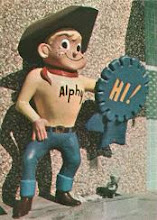
“Not much time for banjo strummin’
For the mills are busy hummin’
Pine tree crops – citrus, cattle –
And chemicals, too,
Cover Dixie like the dew!
Our food business, too, is zoomin’
‘Cause this NEW Southland’s
really boomin’!”
- advertising verse from 1955
Up until the mid-20th century, it would be accurate to say that the industrial production of the Southern states lagged behind other parts of the country. This was the era before the “rust belt” became rusty, and a majority of manufactured goods still came from above the Mason-Dixon Line. Take a look at most any mass produced item from that time, and if it lists a city of origin, it’s likely as not to read “Chicago”, “Rochester, N.Y.”, “Cinti, O. (Cincinnati)” or some other northern or upper Midwest location. Although many companies had established west coast branch factories to save on freight costs, the output of the South remained mostly agricultural in nature, with relatively few exceptions.
Around the mid-1940’s, this began to change rapidly. The lower operating costs of the largely non-union South formed a powerful enticement for companies to expand or relocate there. Civic leaders of towns large and small bent over backwards to offer low tax rates and cheap, plentiful, rail-accessible land on which sprawling single–story manufacturing plants (with acres of parking space) could be built. As a result, many major companies forsook their old, inefficient, multi-story urban factories in cold climes and built gleaming new facilities among the green-meadowed landscapes of places where winter coats wore out far less frequently.
Of course, all of this new development required a workforce, which came from a number of sources. First, many local area workers left the family farm to work in the new factories. Secondly, a large number of northern workers, of both blue and white collar persuasions, relocated to the South, where opportunity beckoned. By the mid-50’s, hundreds of companies had planted their flags there. The textile industry (clothing, carpet, towels, linens, etc.), which already had a significant presence there, moved south in near entirety during those years. Chemicals, aerospace and other forms of high technology would be welcomed into the mix as well. By the mid-50’s, the phrase “New South” had come into widespread use (which continued well into the 1970’s) to describe the new boomland.
Winn-Dixie, an enthusiastic corporate cheerleader for the New South, was eager to capitalize on this growth, continuing to expand aggressively both through acquisition and new store construction through the rest of the 1950’s. In June 1956, the company purchased Ketner-Milner Stores, a 24-unit chain of supermarkets in the Salisbury and Raleigh, North Carolina areas. Ketner-Milner had only been formed the previous year, with the merger of the 10-store Ketner’s Supermarkets and Milner’s Piggly Wiggly.
Interestingly, the Ketner-Milner transaction became the impetus behind what would eventually emerge as a formidable competitor to Winn-Dixie. While Glenn Ketner accepted a vice presidency at Winn-Dixie, his brother Ralph soon resigned, eager to control his own destiny in the food business. In 1957, Ralph Ketner, along with another brother, Brown, and Wilson Smith opened the first Food Town supermarket in Salisbury. Growing slowly at first, Food Town (later renamed Food Lion) would become a dominant player over time.
And Winn-Dixie was expanding in the other direction as well – just after the Ketner-Milner buyout, the company acquired H.G. Hill Stores, a 42-store chain that brought the company into New Orleans, Baton Rouge and other key Louisiana markets, as well as Hattiesburg, Gulfport and Biloxi, Mississippi.
All the while, the company continued to build new stores, averaging some 60 a year by the end of the decade. A 1959 Consumers Research magazine article featured a humorous quote from Winn-Dixie president A.D. Davis on the company’s “scientific” approach to determining ideal new store locations: “We have a radar detector device that picks up diapers on the line in the back yard, and when a great amount of diapers appear on the radar screen as we are driving through a certain area, we know this is the place where we ought to have a store”.
Obviously, whatever they were doing was paying off. In mid-1960, Winn-Dixie had over 500 stores, organized into the following divisions – Montgomery, Alabama – 55 stores, New Orleans – 43 stores, Greenville, S.C. – 110 stores, Raleigh, N.C. – 54 stores and Louisville – 33 stores. Then of course were the Florida divisions: Jacksonville – 83 stores, Miami – 76 stores and Tampa – 60 stores. If the benefits of the “New South” industrial boom may have been felt to a lesser extent in Florida, they were more than offset by the burgeoning tourist economy. In this regard, the best was
yet to come.
In many areas, it must have seemed that new Winn-Dixies (and Kwik Cheks) were popping up all over. Those diapers flapping in the breeze were a sure sign one was on the way.
The photos above, from the
Florida Photographic Collection, show an interesting variety of Winn-Dixie stores from the late 1950’s. The locations are as follows: (1) a brand new Tallahassee store, 1959, (2) Cedar Hills Shopping Center store, Jacksonville, also 1959, (3) Lakewood Shopping Center,
pictured here previously, Jacksonville, 1959 again, (4) a downtown location in Deland, FL, 1956, and lastly, (5) from 1959, a close up of an older Tallahassee location, quaint with its oil-stained curbside parking spaces, “guess your weight” machine and wooden doorframes. The names of two well-known Winn-Dixie brands, Dixie Darling and Astor, are painted on the transom glass. More indicators (as if more are needed) that this scene is from a long-gone era can be found in the price of the Dixie Darling bread – the "...and a half-cent" price, along with the very fact that any price would be
painted on glass. Definitely from a pre-inflationary era.
 If any grocery store could lay claim to the term “landmark”, the one pictured above would certainly qualify. It’s the legendary A&P at the corner of Royal and St. Peter streets in the “Vieux Carré” (known to most of us as the French Quarter) section of New Orleans. Untold numbers of shoppers – locals and tourists alike – have filed past that red marble corner column through the decades.
 One last item - since we’re on the subject of A&P in New Orleans, here’s another area store of more modern design, shown shortly after its opening in another A&P publicity shot, from 1968. Featuring a nice contemporary look, this store was highlighted in the 1970 A&P Study by Progressive Grocer magazine.
  C'est tout!
  C'est tout!