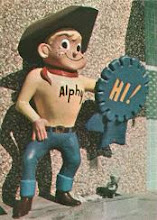
Showing posts with label Alpha Beta. Show all posts

Sunday, September 13, 2015

Fighting Inflation at Alpha Beta


Here’s a wonderful set of photos featuring two stores from one of Southern California’s most fondly remembered supermarket chains – the late, lamented Alpha Beta. The photos were taken in the early 70’s by Werner Weiss, webmaster of the Yesterland website, a superb tribute to the early years of Disneyland. Yesterland, one of the most celebrated and influential nostalgia sites on the web, marked its 20th anniversary online last year. Though Alpha Beta had stores all over SoCal (and several in other regions as well), these were both located in “The O.C.” – Orange County, Alpha Beta’s home turf.

What can you say about the store in the first photo, other than it was a stone cold 1950’s classic? Opened in June, 1958 in the Hillview section of Santa Ana, at 17th Street and Tustin Avenue, this store, with its massive pylon and iconic “Alphy” sign, perfectly exuded the optimism, excitement and humor of the “anything is possible” postwar Southern California. The store didn’t seem much worse for wear sixteen years later, in 1974, when this photo was shot, but you’d have to think it looked more natural with a parking lot full of tailfins.

The rest of the photos are interior shots from the Alpha Beta store in Huntington Beach, at the corner of Brookhurst Street and Hamilton Avenue. I haven’t been able to verify the exact opening year of this store (Alpha Beta’s “No. 126”), but according to Werner, who worked there in college and took these photos in the fall of 1972, it was a new store then. The store sports the “ranch style” roofline that Alpha Beta had favored since the mid-sixties.

What strikes me the most about these photos, even the one of the older store, is how reflective the scenes are of 1972-74 American life, due to the overwhelming presence of one word - “discount” – plastered all over the interior of the store, and in huge letters across the storefront windows.

These were the years when new words and phrases began to creep their way into dinner table conversations across the country: “inflation”, “cost of living” and “Consumer Price Index”, for example, because these things were directly affecting what was on the dinner table. It was an era of rampant, unprecedented inflation, when consumer dollars seemed to shrink by the week. Despite some fairly extreme governmental steps taken to stem the tide (a wage-price freeze, dollar devaluation, etc.), it continued for years.

The scene that evokes this strongest for me personally is in the fifth photo down, the “new ideas” display, with boxes of Tuna Helper, in three glorious flavors, clearly visible on the second shelf. My family ate so much of this stuff (and its sister meal enhancer, Hamburger Helper) in those years that I still feel General Mills should have awarded us a walnut plaque with a golden Betty Crocker spoon mounted to it.

In response to the situation, the major supermarket chains, including such Western-based heavyweights as Safeway, welterweights such as Albertsons, and more regionalized operations like Alpha Beta (then a division of a middleweight, Philly-based Acme Markets) practically fell over themselves trying to attach the word “discount” to their storied names. Certainly this was a national trend, however, with appended names galore - Acme “Super Saver” stores, Food Fair’s accelerated conversion to “Pantry Pride Discount Foods”, and numerous others. Then there was A&P’s disastrous WEO (“Where Economy Originates”) program, but that’s a saga unto itself.

But there had been a precedent for this not that many years before, however. The early 70’s weren’t the first time the major food chains were forced to respond to an economic pinch. There was a dry run of sorts in the fall of 1966, when consumer complaints about supermarket pricing galvanized into a national movement, with boycotts occurring at stores across the country. Numerous press photos exist of bouffanted housewives carrying protest signs, a scene that led some in the press to coin the unfortunate term “girlcott” (Ugh.) to describe the situation.

The 1966 boycotts were short-lived, but in their aftermath, a number of chains experimented with standalone discount formats. Alpha Beta was one of them, with their experimental “Fad” (“food at discount” – nifty, right?) stores. Concerned about price competitiveness but unwilling to risk the Alpha Beta name on a discount venture, the first Fad store, a converted Alpha Beta unit, was opened in Costa Mesa in April 1967.

The location was chosen for its very close proximity to another Alpha Beta store, allowing the company to compare shopping patterns at the two stores and to answer the following questions, as outlined in Esther Cramer’s great book The Alpha Beta Story: “Would the housewife change her shopping habits if operating hours were reduced and games and giveaways were eliminated? Would the volume of sales increase to the necessary level if prices were lowered?” The answers, as it turned out, were “yes”.

As a result, three additional Fad stores were opened that year, followed by yet three more in 1968. Most importantly, it led to a change in pricing policy for the main Alpha Beta stores, which was rolled out in two phases – discounting of all health and beauty items effective in September 1967, and discounting across the entire store effective New Year’s Day 1968. Trading stamps and other promotional gimmicks were dropped, and even the famous tagline on their signs was changed, from “First in Foods” to “Best for Less”. In September 1971, having applied the lessons learned, the Fad name was discontinued and the (by then 11) Fad stores were converted to garden variety Alpha Betas.

So bargain-based grocery shopping turned out to be anything but a fad.

My thanks again to Werner Weiss for letting me know about his wonderful photos, and to the Orange County Archives for making them available. And for those who are curious about what the Fad stores looked like, here’s a typical example from a circa 1967 Alpha Beta Acme Markets promotional photo. 


Friday, October 24, 2008

A Leisurely Day at Alpha Beta, 1966


Here’s a magnificent example of modern day Spanish-style retail architecture – built in 1965! This 1966 photo is shown courtesy of the Orange County Archives, thanks to Chris Jepsen for the tip. This Alpha Beta supermarket opened in March 1965 at the Rossmoor Leisure World Shopping Center in Laguna Hills, coinciding with the opening of the adjacent huge retirement community of the same name. Though the architectural look of this store is heavily employed today, it was exceptional at the time even for Alpha Beta, most of whose new stores had more of a “sixties look” (whatever that means). The store would have easily fit right in with those opened five, ten or more years later. Shopping here would definitely have been my idea of leisure - yours?

Update 10/25/08 - Although gas stations aren't part of the normal fare on this site, I went ahead and added the other Leisure World area photo from the O.C. archives - a Chevron station pic from the same year, 1966, to show how the Spanish-themed architecture carried over through the entire development. This photo has a couple of other interesting aspects - the "mini unisphere" globe in the background which was the logo for Leisure World, and the hand painted "gas war" sign. "Gas wars" were a staple of American life in the years prior to the 1970's energy crisis. Competing stations on opposite corners would cut their price by a penny or two (which was a lot when gas was just 26 cents a gallon!), and the others would scramble to follow suit. Makes me wish the Exxon station down the street would duke it out on my behalf!

Saturday, March 22, 2008

Easter Greetings

A very nice Easter display featuring a cross standing atop a “hill” of Easter lilies (crossing the 'line of separation' between church and supermarket?) in this early 1960’s view from a Southern California Vons location. In-town rival Alpha Beta went the secular route that year, as seen below. These photos are from an early 60’s Progressive Grocer article about “Spring Merchandising Ideas”.
Hope you have a wonderful Easter!

Tuesday, October 2, 2007

Acme's Swingin' Sixties Look


Acme’s stores of the nineteen-sixties could scarcely have looked more different from those of the previous decade. In 1960, a new design was implemented that featured a peaked roof with a full façade of glass. The “Acme” script was discarded in favor of a block-lettered logo at first. After a year or so, a new Acme logo (that to me, at least, still looks modern) with a unique “eye” shape was introduced, completing the image that is still well-remembered today. Also, the design was modified somewhat - the gable portion of the facades was now filled in with opaque panels instead of glass and small sections of stone veneer appeared on the sides. The first photo, featuring the initial “new look”, shows the Newtown Square, PA Acme, a store that was built around 1960, after a 1967 expansion added a side wing. The second photo features the King of Prussia, PA store from 1962, the third the Upper Darby, PA store which opened in August of 1963, and the fourth the Pottstown, PA store (with an Acme-owned Rea and Derick Rexall store barely visible in the distance) which opened in March, 1964.

In 1962, American Stores Company changed its corporate name to Acme Markets, Inc. In retrospect, this move is somewhat surprising in light of the fact that they had just completed the acquisition of a second major banner, and in the next few years would add several other businesses to their corporate family. The name would finally revert back to American Stores in 1974. This “second major banner”, of course, was Southern California’s Alpha Beta Food Markets, which became part of Acme on January 16, 1961, and instantly established Acme on the West Coast with the major presence of a well-respected supermarket brand. Acme would make substantial investments in Alpha Beta’s growth in the coming years, including new and remodeled stores and a massive new distribution and office complex in La Habra, California. Under Acme, Alpha Beta would enter the Bay Area market with its first store in 1967.

The 1960’s also saw Acme’s diversification into the restaurant and pharmacy arenas in both their Eastern and Western regions. The first Alphy’s coffee shops were opened in the SoCal area around 1966 or so. The Alphy’s restaurants (similar in concept to a Denny’s or Sambo’s) were typically located near Alpha Beta store locations in shopping center outparcels. In 1962, the company opened the first four of their Hy-Lo Drug Stores, and would ultimately place a few of these in former Alpha Beta locations. Only a relative handful of Hy-Lo’s were ever opened. In the East, Acme purchased the 47-unit Rea and Derick, a Rexall Drug franchisee, in September 1964. Also, in 1968, Acme obtained franchise rights from Rocky Mount, NC-based Hardee’s Food Systems to operate Hardee’s restaurants in their home Philadelphia region. The Alphy’s and Hy-Lo operations were managed from the Alpha Beta hub in La Habra, while the other businesses, of course, reported to the Philly corporate offices.

Saturday, August 11, 2007

Alpha Beta - Keepin' It Local


One of the great features of Alpha Beta supermarkets from the early 50's through the 70's was the company's practice of showing the town's name on the face of the local stores. If there were multiple Alpha Beta markets in the same town, the name would often reflect the area of town, street or shopping center in which the store was located. It's suprising to me that over the years, no other retail chain (to my knowledge at least) has picked up on this fairly inexpensive way to help strengthen the identity bond with their local communities.
These 1957 photos are from the pre-Acme ownership era, and show the Covina store (opened in 1953) and the newer La Puente store.

Wednesday, August 8, 2007

Alpha Beta - The Early Acme Years


In the early 1960’s, a number of interesting trends took hold in the grocery industry. First, the progression (which began in the 1940’s) towards ever larger footprints for new stores continued at an intensified pace. Most new stores built in the early sixties were at least 15,000 square feet, with many upwards of 20 or even 30,000. Secondly, supermarket chains began to diversify into new businesses – including drugstores, general merchandise discount stores, quick-service restaurants and other ventures not directly related to their original business.

A third major trend that several large supermarket chains participated in was an expansion into far-flung territory through buyouts of other chains. Some examples are the 1964 merger of Boston-based Star Market into Chicago’s Jewel Tea Company and the purchase of the Los Angeles-based Market Basket chain by Kroger the previous year. Both of these acquisitions established their parent companies in new territory, far from home. Both parent companies, in these cases, wisely chose to maintain the original name and identity of the organizations they purchased.

Philadelphia-based American Stores Company, with a history dating back to 1917, was a major player on the East Coast, with 789 Acme Markets located in Pennsylvania, New Jersey, New York, Delaware, Virginia, West Virginia and Washington D.C. by 1961. In January of that year, American (the company would change its name to Acme Markets, Inc. in 1962, and then revert to its original name in the mid-70’s) became a bi-coastal operation with its purchase of La Habra, California based Alpha Beta Food Markets, a 51-store grocery chain with a devoted customer base throughout Southern California. The new subsidiary was renamed Alpha Beta Acme Markets.

At the time Alpha Beta was acquired by American Stores, the company was aggressively expanding (as were most SoCal area chains) through the construction of new stores and major renovation of many existing stores, a policy that would continue under Acme. Many of the “streamline moderne” facades that were standard issue for AB through the forties and fifties were giving way to a new mid-century modern look – mosaic tile and aggregate facings with gold-anodized mesh screens hanging from the front awning. Alpha Beta’s mascot “Alphy” was given a place of honor on huge neon (or backlit, in some cases) signs that towered above the stores.

Pictured here are three stores from the early Alpha Beta Acme years – Harbor Avenue/Costa Mesa, La Mesa (San Diego) from 1964, and La Habra from the following year.