Acme’s stores of the nineteen-sixties could scarcely have looked more different from those of the previous decade. In 1960, a new design was implemented that featured a peaked roof with a full façade of glass. The “Acme” script was discarded in favor of a block-lettered logo at first. After a year or so, a new Acme logo (that to me, at least, still looks modern) with a unique “eye” shape was introduced, completing the image that is still well-remembered today. Also, the design was modified somewhat - the gable portion of the facades was now filled in with opaque panels instead of glass and small sections of stone veneer appeared on the sides. The first photo, featuring the initial “new look”, shows the Newtown Square, PA Acme, a store that was built around 1960, after a 1967 expansion added a side wing. The second photo features the King of Prussia, PA store from 1962, the third the Upper Darby, PA store which opened in August of 1963, and the fourth the Pottstown, PA store (with an Acme-owned Rea and Derick Rexall store barely visible in the distance) which opened in March, 1964.
In 1962, American Stores Company changed its corporate name to Acme Markets, Inc. In retrospect, this move is somewhat surprising in light of the fact that they had just completed the acquisition of a second major banner, and in the next few years would add several other businesses to their corporate family. The name would finally revert back to American Stores in 1974. This “second major banner”, of course, was Southern California’s Alpha Beta Food Markets, which became part of Acme on January 16, 1961, and instantly established Acme on the West Coast with the major presence of a well-respected supermarket brand. Acme would make substantial investments in Alpha Beta’s growth in the coming years, including new and remodeled stores and a massive new distribution and office complex in La Habra, California. Under Acme, Alpha Beta would enter the Bay Area market with its first store in 1967.
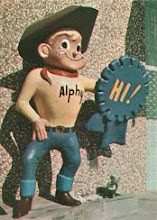
The 1960’s also saw Acme’s diversification into the restaurant and pharmacy arenas in both their Eastern and Western regions. The first Alphy’s coffee shops were opened in the SoCal area around 1966 or so. The Alphy’s restaurants (similar in concept to a Denny’s or Sambo’s) were typically located near Alpha Beta store locations in shopping center outparcels. In 1962, the company opened the first four of their Hy-Lo Drug Stores, and would ultimately place a few of these in former Alpha Beta locations. Only a relative handful of Hy-Lo’s were ever opened. In the East, Acme purchased the 47-unit Rea and Derick, a Rexall Drug franchisee, in September 1964. Also, in 1968, Acme obtained franchise rights from Rocky Mount, NC-based Hardee’s Food Systems to operate Hardee’s restaurants in their home Philadelphia region. The Alphy’s and Hy-Lo operations were managed from the Alpha Beta hub in La Habra, while the other businesses, of course, reported to the Philly corporate offices.