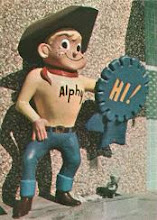
One last Wal-Mart post, that is. In the meantime, the boys here'll get the sign set up. From the looks of their outfits, it must have been a pretty cold day. I don't think I'd mess with 'em.
Saturday, August 2, 2008
A New Wal-Mart On The Way
One last Wal-Mart post, that is. In the meantime, the boys here'll get the sign set up. From the looks of their outfits, it must have been a pretty cold day. I don't think I'd mess with 'em.

Wednesday, July 30, 2008
The Famed Dominick's Arch, 1971
 Welcome to those who have come here by way of Eric Zorn’s Chicago Tribune column today. This website is a tribute to retail chain stores of the past – mainly supermarkets and discount stores, with a few others (department stores, toy stores, etc.) thrown in just for fun. Some chains are gone altogether. For the ones that remain of course, the stores look radically different today.
My name is Dave, and I grew up in the Chicago area during the Ray Rayner/Family Classics/Svengoolie period (which was somewhere between the Mezozoic and Paleozoic eras, I believe). Many of the chains profiled are from the Chicagoland area and can be found at this link. Extended postings on Korvettes, Sears, Turn-Style and the early history of Jewel are here so far, along with a few Dominick’s tidbits. Also Shoppers World , Kmart and Bargain Town, just for good measure. My travels through the years have led me to a general fascination with retail history across the country, and you will find info on chains from many other regions. If your favorite chain isn’t here yet, hopefully it will be soon.
Regarding the photo above - no, the St. Louis Arch has not sold naming rights – this was the original sign from the Dominick’s distribution center in Northlake, Illinois, shown in a 1971 photo. This sign was a landmark for I-290/294 commuters throughout the sixties and seventies. The facility was originally a Kroger distribution center, and when I was very young the Kroger block letter logo (white letters on individual blue square backgrounds) existed where the Dominick’s logo appears in this photo. The sign was replaced with a more conventional version in the early 1980’s.
Thanks so much for stopping in, and please come back!
Sunday, July 27, 2008
The Original Big K


Well, Big K, we hardly knew ye, and now you’re leaving us again. That’s right, the many Kmart stores which for some not well-explained reason took on the “Big K Mart” identity in the mid-90’s are being restored (thankfully) back to just “Kmart”, with a logo closer to their original 1960’s look, albeit with a single color, red. And a familiar sight to many Kroger shoppers is their age-old “Big K” private label brand, probably best recognized in recent decades on their soft drinks, but we’ll talk about that later.
Aside from these, however, was a Mid-South based chain by the name of Big K, which enjoyed a good deal of success as a regional discount store operation in the late 60’s and early 70’s. Big K was a division of Nashville-based Kuhn Brothers Company, Inc., which was founded as a variety store chain in the teens. The information I’ve been able to find about the Kuhn stores, which unfortunately is minimal, indicates that that they were very much cast in the standard Woolworth/Kresge variety store mold. As such they faced similar problems as those firms did in the fifties –footprints too small to accommodate a growing range of popular consumer goods, rising operating costs of counter service as opposed to self service, and most importantly the decline of downtown business districts with the advent of shopping centers with their vast availability of free parking.
In 1962, that historic year for the discount industry, Kuhn’s launched the first of their Big K discount department stores. Kuhn’s employed a strategy similar to Wal-Mart, opening the Big K stores in small-to-medium sized towns within a four-state market area – in their case Alabama, Kentucky, Tennessee and Georgia. Like Wal-Mart, they avoided the larger markets which were likely to be heavily populated with Kmart stores, as Atlanta most certainly was. Kuhn’s-Big K , as the company was renamed, would eventually adjoin the Wal-Mart market area, but there was very little overlap. The Kuhn family and Sam Walton, who were acquaintances, had chosen (for a time at least) to honor an old unwritten code between regional retailers to stay of each others’ territories. Of course another unwritten code, every bit as popular as the first, was to scrap the previous code and build right in your fellow retailer’s backyard. When Wal-Mart opened a store in Jackson, Tennessee, the heart of Big K-land, The Kuhns retaliated by opening stores in West Helena and Blytheville, Arkansas.
By the end of 1973, the company operated 57 Big K’s and 27 Kuhn’s Variety Stores, and had pushed into eastern Arkansas and Missouri, Wal-Mart’s operating area. The Big K stores carried the standard discount store mix of apparel, sporting goods, hardware, toys, etc., and averaged 45,000 square feet. There were three larger stores (65,000-75,000 square feet) ringing the Nashville area, the company’s home turf. In 1977, Kuhn’s-Big K moved into the South Carolina region with its acquisition of Edwards, Inc., a Charleston-based chain of 33 stores in South Carolina.
Soon after the Edwards purchase, the Kuhn’s - Big K operation spun into decline, losing money and experiencing management turmoil. In 1981, Chain Store Age characterized the company as “a broken chain”, citing increasingly intense competition, the strain from the Edwards acquisition and cost overruns on the company’s fancy new Nashville headquarters complex. The magazine was also critical of the Kuhn family’s management approach. Predictions of Big K’s demise were aflight.
Discussions regarding a possible acquisition by Wal-Mart had begun some months before the Chain Store Age article appeared. Wal-Mart, traditionally committed to internal growth, had only one major acquisition under its belt at the time, having purchased the 21-store Mohr Value chain, an Illinois operation, in 1977. When it became evident that Big K would be forced to sell out, the ideal store sizes (directly in line with Wal-Mart’s at the time), respectable customer base, and most of all the chain’s prime locations in new, adjoining territory made the proposition too powerful to resist. Even so, Wal-Mart’s board of directors was split down the middle over the idea. Sam cast the deciding vote in favor of the buyout, and the deal was done. Incidentally, Wal-Mart’s indecision over the buyout paid another dividend – as they hemmed and hawed over the prospect, the value of Big K’s stock continued to fall. The initial purchase price, according to the Wall Street Journal was $17 million in December 1980. By the following June it was $12.9 million, and by the time of the actual buyout in December 1981, it was $7 million - $2 million less than Kuhn’s -Big K had paid for the Edwards chain four years earlier. Sort of gives a new, unwanted meaning to the word “discount”.
The first photo, location unknown, is from 1973. The second and third photos are from the Dickson, Tennessee store and were taken the following year.
Thursday, July 24, 2008
Wal-Mart Expands the "Magic Circle"


If Sam Walton harbored dreams of empire during Wal-Mart’s early years, he did a good job of keeping it to himself. That’s not to say he wasn’t interested in growth – he most certainly was, as is clearly evidenced throughout his autobiography. In Wal-Mart’s first decade and beyond though, the company flew under the radar, expanding slowly within the area that Walton called the “magic circle” – northern Arkansas, southern Missouri, southeastern Kansas and eastern Oklahoma. A typical retailer with a home base in northwest Arkansas could have reasonably been expected to try to plant their flag in Kansas City or St. Louis soon after their first flush of success, but Walton did not and wouldn’t for many years. In 1967, five years after the company’s founding, there were 18 Wal-Marts. By comparison Kmart, another retailer celebrating the five-year mark that year, had 250 stores.
Walton was much more interested in “growing internally”, saturating existing markets to create dominance. New markets were added incrementally, and only in areas that adjoined existing ones, to maximize efficiency. An early sign that this strategy was paying off came in the mid-70’s, as Kmart began to open stores within Wal-Mart’s market area. Until around 1974, Kmart rarely entered cities with a population below 50,000. At that point, they introduced a smaller store format and began to roll it out in various parts of the country. When Kmart entered such Wal-Mart strongholds as Springfield, Missouri and Hot Springs, Arkansas, Wal-Mart creamed them. It was a sign of things to come, on a much larger scale, in the coming decades.
Most importantly, Walton sought to improve the stores. As mentioned in the previous post, he relentlessly pursued competitive intelligence, trying to learn from the good and bad things chains across the country were doing. Conversely, he spent a great deal of time in the Wal-Mart stores, quizzing employees in his friendly but pointed manner, digging deeper if he sensed there was a problem. Walton practiced “management by walking around” long before Tom Peters and Robert Waterman made the phrase famous in the bestselling book “In Search of Excellence”.
At the close of 1970, Wal-Mart had 38 stores and $44 million in sales. Up to this point, a great deal of the financing had come from Sam Walton’s own family, leaving him $2 million in debt by that time. Reluctant to take on the scrutiny and hassles of going public, but weighed down by the heavy debt load and the realization that a stock offering was the only feasible way to keep expanding the company, Walton took the company public in October, 1970. In the space of one day, Sam was out of debt and would never have to personally contribute another dime to Wal-Mart’s expansion. The stock sold out immediately, and of course a major expansion ramp-up was to come. By 1974, Louisiana, Tennessee, Kentucky and Mississippi had received their first Wal-Mart stores.
Then Sam, age 56 at the time, did something that is not well-remembered today and in retrospect seems more than a little surprising. In November 1974, he resigned as Chairman and Chief Executive Officer of Wal-Mart and turned the reins of the company over to a younger man.
The new Wal-Mart chief was 40-year old Ron Mayer, a former Duckwall-ALCO executive who more recently was a Wal-Mart vice president, instrumental in setting up the first version of Wal-Mart’s vaunted computer infrastructure. Walton moved over into a new position, chairman of the executive committee, an oversight position in most companies. He even gave up his office to Mr. Mayer, moving down the hall and out of the way. Had things remained as they were, Sam would have had plenty of time to perfect his tennis game and bird hunting skills, and Wal-Mart would have probably become a decent-size regional player, and probably an eventual acquisition candidate for the likes of Kmart or Target, no offense to Mayer intended.
The vigorous Walton, try as he might, learned quickly that standing on the sidelines was not something he could do. In June 1976, Mayer stepped aside and Walton reassumed leadership of the company. Sam was frank when interviewed about it by the Wall Street Journal –Mayer had left “because I wasn’t able to assume a passive role… I wasn’t about to force myself to stay out” of the company’s decision process. Walton offered Mayer a vice chairmanship, but he declined and chose to leave the company instead. The founder was now back in charge. By the end of 1979, Wal-Mart had 278 stores, over a billion dollars in sales, and operated in 11 states. The magic circle was growing.
The photos above are from 1976, 1978 and 1979 respectively. These pictures remind me of the very first Wal-Mart store I ever laid eyes upon, around 1976, years before I (and much of America) learned of the company’s famous founder. In the early 70’s, my stepfather bought a small farm in rural west Tennessee. It was a rustic place, with a creaky old farmhouse without air conditioning. We’d spend about three weeks there every summer, and many years we would drive down the day after Christmas and spend the rest of our Christmas break there, trying to keep the pipes from freezing. The summers were definitely a shock to the system of this 12-year old Chicagoan, used to spending my vacations lying around the house, watching reruns of Petticoat Junction and Green Acres. Now I was digging postholes and sweating like I never had in my life. (Fresh Air! Bah. Of course now I look back at it as great experience, naturally.) The Wal-Mart location was in Martin, Tennessee, a college town, and was Wal-Mart’s third or fourth store in the state. I clearly remember thinking that it had to be the single store of a family-owned business. Regrettably, we never set foot in the place, and it would be years before I would experience the wonder of Wal-Mart.
Sunday, July 20, 2008
Influencing Wal-Mart


 The one aspect of the Wal-Mart story that I find most fascinating was Sam Walton’s study of the discount store industry, in the years both before and after the launch of his namesake chain. In his autobiography, Walton describes his adventures visiting discount stores all over America. “I ran the country, studying the discounting concept, visiting every store and company headquarters I could find”, he wrote. Starting in the New England area, which was in many ways the birthplace of the concept , Walton worked his way from coast to coast.
 Most often, due to Walton’s humble, disarming approach (“Hi, I’m Sam Walton from Bentonville, Arkansas. We’ve got a few stores out there, and I’d like to visit with Mr. So-and-So” – whoever the head of the company was- “about his business”)and the lack of any perceived competitive threat (which of course was the case at the time), discount chain presidents everywhere were all too happy to escort Sam on a tour, showing off their empires. It was a chance to impress a small-time operator from the sticks.
Walton accurately describes the make-up of the industry at the time as largely composed of “promoter” types – wholesalers or real estate promoters with little interest in the merchandising business who saw an opportunity to strike it rich. “They would take a carbon copy of somebody’s store in Connecticut or Boston, hire some buyers and some supervisors who were supposed to know the business, and start opening up stores. From about 1958 to 1970, it was phenomenally successful”.
The frugal Walton took note of the lifestyles of the discount chiefs, many of whom lived like Roman emperors – private jets, Cadillacs, cadres of servants and so on, living off the "discounting fad" while ignoring the condition of their stores and the quality and attitude of their customer service. Many of them just became lazy, unaware while their businesses slowly deteriorated. By the beginning of the 1990’s, as Walton pointed out referencing a then recent trade magazine article, 76 of the top 100 American discount stores that were in business in 1976 no longer existed. Of course, in the 16 years since Walton’s passing, the remaining count of 24 has been severely pared down as well.
Aside from these “good examples of bad examples”, as Sam might have put it, there were some individuals for whom he developed great respect - John Geisse, who played a key role in the founding of Target and Venture was one, but at the top of Walton’s list were Harry Cunningham, former S.S. Kresge president and father of Kmart, and Sol Price, the founder of Fed-Mart and Price Club.
It’s highly likely that had Kmart not existed, Wal-Mart couldn’t have. Walton, an ardent admirer of the (early, at least) Kmart merchandising style, considered Kmart his “laboratory” and claimed to have visited more Kmart stores than anyone, even while on vacation, as his wife Helen, as quoted in Robert Slater’s The Wal-Mart Triumph attested: “Sam never went by a Kmart that he didn’t stop by and look at it”. In time, Walton gained Cunningham’s respect as well. Long after his 1972 retirement from Kresge, in what certainly ends up sounding like a backhanded slap at his old company, Cunningham was quoted in Sam’s 1992 autobiography – “From the time anybody first noticed Sam, it was obvious he had adopted all of the original Kmart ideas. I always had great admiration for the way he implemented – and later enlarged on – those ideas. Much later on, when I was retired but still a Kmart board member, I tried to advise the company’s management of just what a serious threat I thought he was. But it wasn’t until fairly recently that they took him seriously”.
Sol Price, one of the best known early proponents of the “warehouse store” concept, was a huge influence on Walton in a couple of key areas. Price, still kicking at age 92, founded Fed-Mart in 1954 as a membership warehouse store in San Diego. Eventually, Fed-Mart would grow to a 45-store chain with locations in California, Arizona and Texas. Price sold the chain to a German firm in 1975 and with his son Robert founded The Price Company, another warehouse store operation whose stores went under the name of Price Club, the following year. In 1993, he would merge his company with Costco.
For starters, Sam liked the sound of the name “Fed-Mart”, a fact often cited among the stories about the origin of the Wal-Mart name. To be sure, however, Price’s most notable influence on Walton was in regard to the warehouse store concept itself. In 1983, some months following a dinner with Price and their wives in San Diego, Wal-Mart launched its first Sam’s Wholesale Club in Oklahoma City. Despite this new competitive relationship, the two men maintained a warm personal friendship, as evidenced (and possibly tested) by a story Walton related in his book. Sam, on one of his competitive store visits, browsed the Price Club store on Morena Avenue in San Diego, tape recorder in hand, noting prices and other details about the store. Stopped by a security guard who demanded the tape, Walton obliged, asking to write a note to Robert Price about the tape, which also contained observations from other area stores. A few days later, Walton received the tape in the mail, none of it erased, accompanied by a friendly note from Price. Now, that's a friend!
The photos above are circa 1972.
Subscribe to:
Posts (Atom)