Saturday, August 11, 2007

Alpha Beta - Keepin' It Local


One of the great features of Alpha Beta supermarkets from the early 50's through the 70's was the company's practice of showing the town's name on the face of the local stores. If there were multiple Alpha Beta markets in the same town, the name would often reflect the area of town, street or shopping center in which the store was located. It's suprising to me that over the years, no other retail chain (to my knowledge at least) has picked up on this fairly inexpensive way to help strengthen the identity bond with their local communities.
These 1957 photos are from the pre-Acme ownership era, and show the Covina store (opened in 1953) and the newer La Puente store.

Wednesday, August 8, 2007

Alpha Beta - The Early Acme Years


In the early 1960’s, a number of interesting trends took hold in the grocery industry. First, the progression (which began in the 1940’s) towards ever larger footprints for new stores continued at an intensified pace. Most new stores built in the early sixties were at least 15,000 square feet, with many upwards of 20 or even 30,000. Secondly, supermarket chains began to diversify into new businesses – including drugstores, general merchandise discount stores, quick-service restaurants and other ventures not directly related to their original business.

A third major trend that several large supermarket chains participated in was an expansion into far-flung territory through buyouts of other chains. Some examples are the 1964 merger of Boston-based Star Market into Chicago’s Jewel Tea Company and the purchase of the Los Angeles-based Market Basket chain by Kroger the previous year. Both of these acquisitions established their parent companies in new territory, far from home. Both parent companies, in these cases, wisely chose to maintain the original name and identity of the organizations they purchased.

Philadelphia-based American Stores Company, with a history dating back to 1917, was a major player on the East Coast, with 789 Acme Markets located in Pennsylvania, New Jersey, New York, Delaware, Virginia, West Virginia and Washington D.C. by 1961. In January of that year, American (the company would change its name to Acme Markets, Inc. in 1962, and then revert to its original name in the mid-70’s) became a bi-coastal operation with its purchase of La Habra, California based Alpha Beta Food Markets, a 51-store grocery chain with a devoted customer base throughout Southern California. The new subsidiary was renamed Alpha Beta Acme Markets.

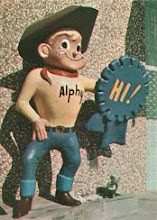
At the time Alpha Beta was acquired by American Stores, the company was aggressively expanding (as were most SoCal area chains) through the construction of new stores and major renovation of many existing stores, a policy that would continue under Acme. Many of the “streamline moderne” facades that were standard issue for AB through the forties and fifties were giving way to a new mid-century modern look – mosaic tile and aggregate facings with gold-anodized mesh screens hanging from the front awning. Alpha Beta’s mascot “Alphy” was given a place of honor on huge neon (or backlit, in some cases) signs that towered above the stores.

Pictured here are three stores from the early Alpha Beta Acme years – Harbor Avenue/Costa Mesa, La Mesa (San Diego) from 1964, and La Habra from the following year.

Sunday, August 5, 2007

A Gala Premiere - Studio City 1963


Here is the Grand Opening ad for the Studio City Market Basket store featured in the previous post. This ad appeared in the Pasadena Star-News on January 16, 1963. One of the interesting aspects of "Grand Opening" ads from these years is that they often featured photos or line drawings of the actual store in question. The line drawing in this case is a fairly accurate representation.

Friday, August 3, 2007

Market Basket Mayhem!!


Highly recommended viewing for fans of old supermarkets is the 1964 Jerry Lewis film “The Disorderly Orderly”. This film features le Jerry in typical fine form, wreaking havoc as he earnestly performs the duties of an entry-level job, this particular one being an orderly in a sanitarium. Our family digs this film, even though my wife is only 1/8th French!

The climactic scene features Jerry and company laying waste to the nearly-new Studio City, California Market Basket store, which was located at 11315 Ventura Boulevard. Not only is it funny, but it offers a rare, up-close look (especially when viewed in slow-motion) at a classic SoCal grocery store in the prime of its life. When you see this you’ll gasp, you’ll marvel, you’ll think “Man, they were running a heck of a promotion on Hi-C that day!”

A little background – the Market Basket chain of Southern California (not to be confused with the unaffiliated Texas and New England chains bearing the same name) was founded with a single store in Pasadena in 1930. By 1963, the year the Studio City store was opened, the company had 56 stores throughout L.A. and the surrounding regions. In October of that year the chain was acquired by Kroger, providing them a beachhead (no pun intended) in the vital Southern California market. Prior to this time, Kroger had no stores west of Kansas.

The Market Baskets’ most distinctive features, to be sure, were the gigantic “basket-weaved” signs that towered above each store. Even in an era when many L.A. thoroughfares boasted great, often outrageous signage, these babies really must have stood out.

A few more notes - the building still exists, although it is no longer a grocery store. Secondly, if you watch the film carefully, you can spot a “Cinnamon Cinder” nightclub near the Market Basket. There were several of these non-alcoholic clubs in the SoCal area in the early 60’s, and many now classic rock and roll acts played there. They were owned by legendary concert promoter and Newlywed Game host Bob Eubanks.

Wednesday, August 1, 2007

Albertsons - At Your Service


Here's a 1966 photo showing an Albertsons store crew - an eager bunch, poised and ready to deliver a superior customer experience. The woman to the far left does appear to be somewhat anxious - perhaps she was new on the job. In the background is an archetypal "marina-style" Albertsons, as referred to in an earlier post.
By this time, Albertsons' market presence had grown to cover nine western states, with over 170 stores at year's end, adding 20-plus new stores a year. Interestingly, company founder and board chairman Joe Albertson continued to maintain his offices in a second-floor loft above the company's first store, which opened in Boise in 1939. By the mid-60's, this first store had been expanded to 25,000 square feet from the original 7,500.